QUESTION IMAGE
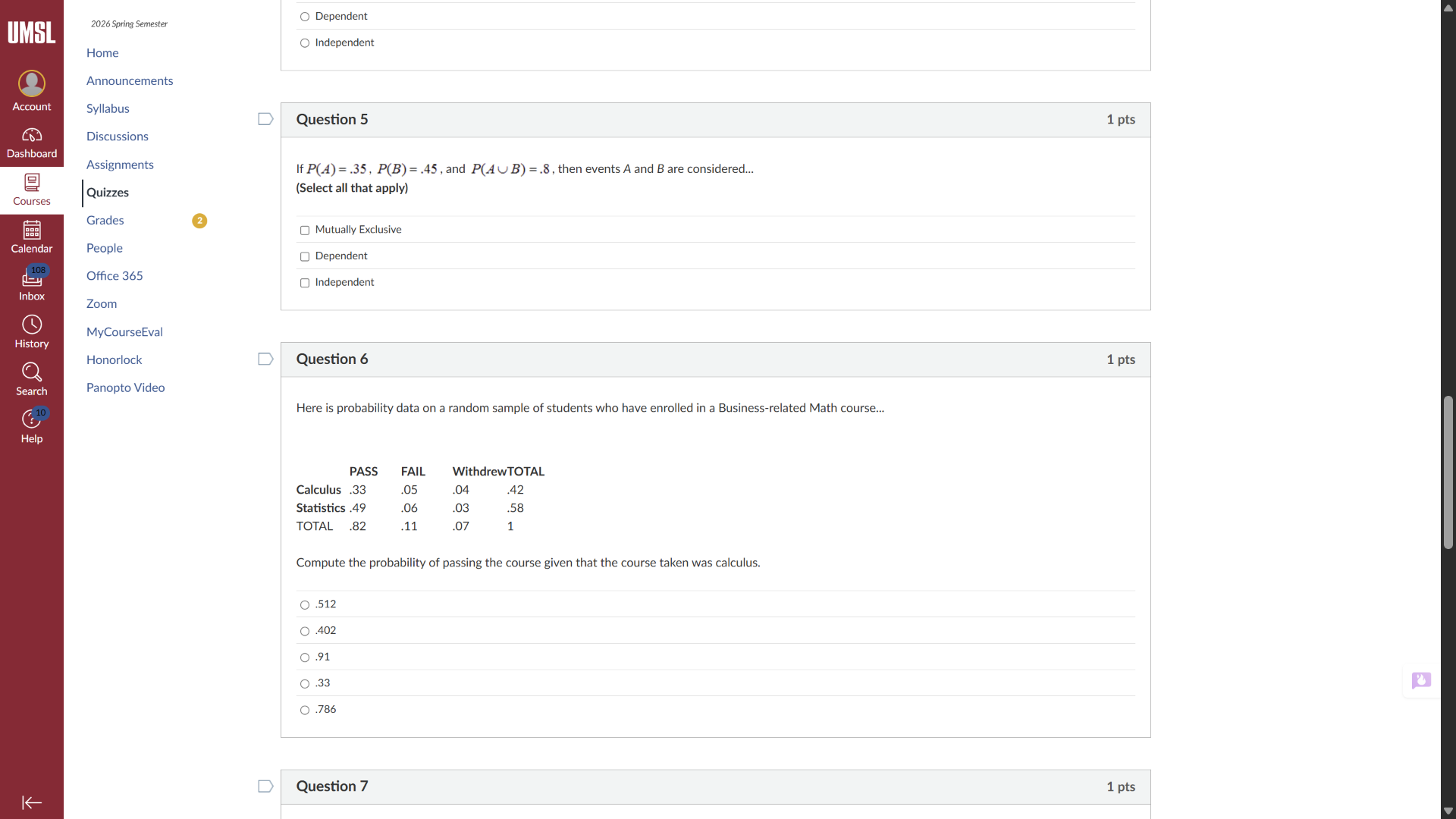
Question
question 5
1 pts
if $p(a)=.35$, $p(b)=.45$, and $p(a\cup b)=.8$, then events a and b are considered...
(select all that apply)
mutually exclusive
dependent
independent
question 6
1 pts
here is probability data on a random sample of students who have enrolled in a business - related math course...
\
compute the probability of passing the course given that the course taken was calculus.
.512
.402
.91
.33
.786
question 7
1 pts
Question 5
Step1: Recall the formula for \( P(A \cup B) \)
The formula for the probability of the union of two events \( A \) and \( B \) is \( P(A \cup B) = P(A) + P(B) - P(A \cap B) \). We can use this to find \( P(A \cap B) \).
Step2: Calculate \( P(A \cap B) \)
Given \( P(A) = 0.35 \), \( P(B) = 0.45 \), and \( P(A \cup B) = 0.8 \). Substitute into the formula:
\[
\]
Step3: Analyze Mutually Exclusive Events
Mutually exclusive events are events that cannot occur at the same time, meaning \( P(A \cap B) = 0 \). Since we found \( P(A \cap B) = 0 \), events \( A \) and \( B \) are mutually exclusive.
Step4: Analyze Dependent/Independent Events
For independent events, \( P(A \cap B) = P(A) \times P(B) \). Let's check: \( P(A) \times P(B) = 0.35 \times 0.45 = 0.1575
eq 0 \), so they are not independent. For dependent events, we just need to check if they are not independent (which they aren't), but the key here is the mutually exclusive part. However, since \( P(A \cap B) = 0 \), the main characteristic here is mutually exclusive. But let's confirm the options:
- Mutually Exclusive: Yes, because \( P(A \cap B) = 0 \).
- Dependent: Let's see, if two events are mutually exclusive and not both zero probability, they are dependent. Since \( P(A) \) and \( P(B) \) are not zero, and they are mutually exclusive (so not independent), they are dependent. Wait, but let's re - check. Wait, the formula for independent events is \( P(A \cap B)=P(A)P(B) \). We have \( P(A \cap B) = 0 \), \( P(A)P(B)=0.35\times0.45 = 0.1575
eq0 \), so they are not independent, hence dependent. And they are mutually exclusive.
Wait, but let's go back. The question says "Select all that apply".
First, mutually exclusive: \( P(A \cap B) = 0 \), so yes.
Dependent: Since they are not independent (as \( P(A \cap B)
eq P(A)P(B) \)), they are dependent.
Independent: No, as shown above.
So the applicable options are Mutually Exclusive and Dependent. Wait, but let's confirm the logic.
Mutually exclusive events: \( A \) and \( B \) can't happen together, so \( P(A \cap B) = 0 \). Correct.
Dependent events: Two events are dependent if \( P(A \cap B)
eq P(A)P(B) \). Here, \( P(A \cap B) = 0 \), \( P(A)P(B)=0.1575 \), so they are dependent. Correct.
Independent: No, as \( P(A \cap B)
eq P(A)P(B) \).
Step1: Recall the Conditional Probability Formula
The formula for conditional probability is \( P(A|B)=\frac{P(A\cap B)}{P(B)} \). In this case, we want to find the probability of passing the course given that the course taken was calculus, i.e., \( P(\text{Pass}|\text{Calculus}) \).
Step2: Identify the Values from the Table
From the table, for Calculus:
- \( P(\text{Pass and Calculus}) = 0.33 \)
- \( P(\text{Calculus}) = 0.42 \)
Step3: Apply the Conditional Probability Formula
\[
P(\text{Pass}|\text{Calculus})=\frac{P(\text{Pass and Calculus})}{P(\text{Calculus})}=\frac{0.33}{0.42}\approx0.786
\]

Snap & solve any problem in the app
Get step-by-step solutions on Sovi AI
Photo-based solutions with guided steps
Explore more problems and detailed explanations
Mutually Exclusive, Dependent