QUESTION IMAGE
Question
question 3
1 pts
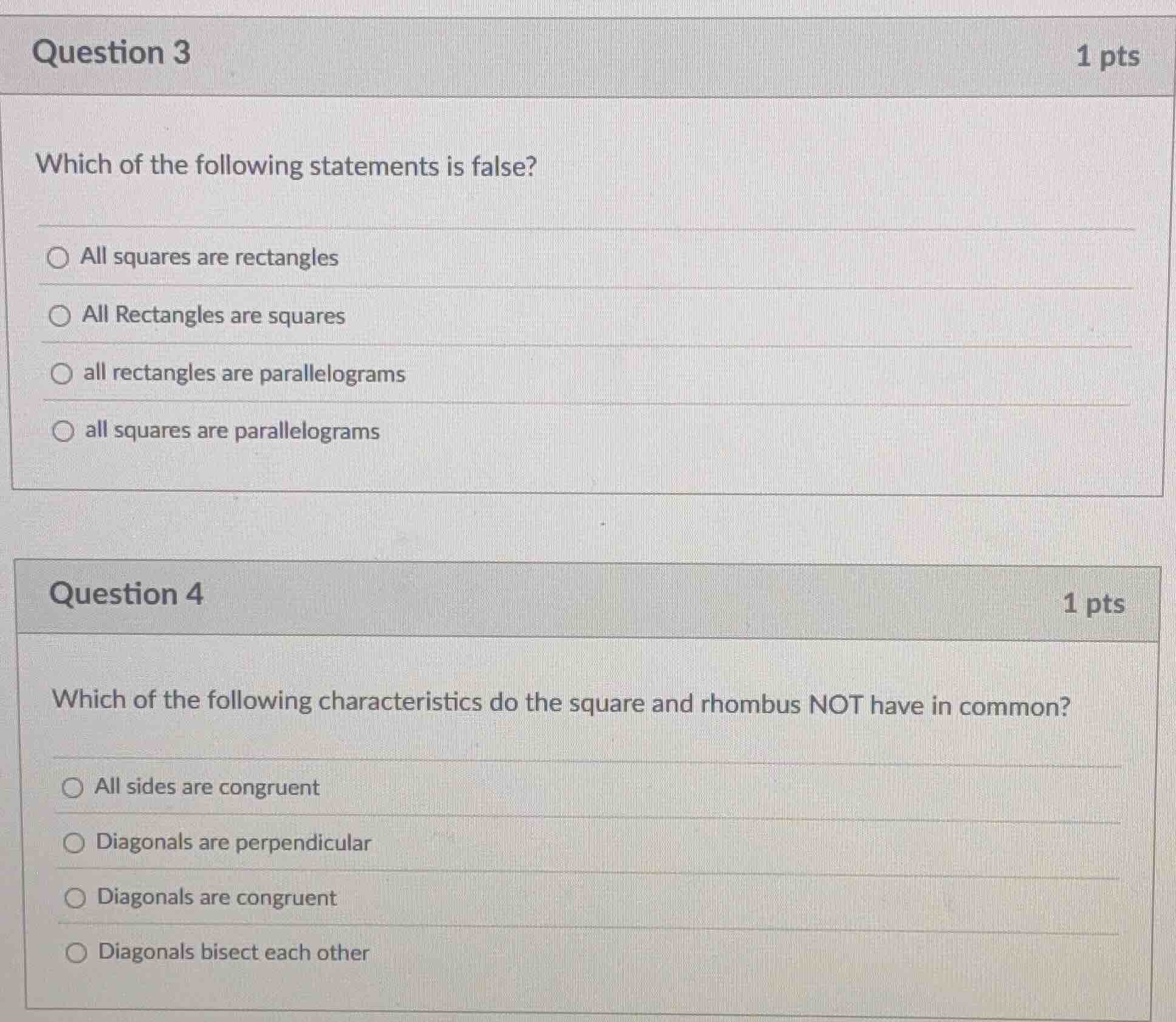
which of the following statements is false?
all squares are rectangles
all rectangles are squares
all rectangles are parallelograms
all squares are parallelograms
question 4
1 pts
which of the following characteristics do the square and rhombus not have in common?
all sides are congruent
diagonals are perpendicular
diagonals are congruent
diagonals bisect each other
Response
Question 3
Brief Explanations
- A square has all angles 90° and opposite sides equal, so it's a rectangle (since a rectangle requires 4 right angles and opposite sides equal). So "All squares are rectangles" is true.
- A rectangle has opposite sides equal and 4 right angles, but a square also requires all sides equal. A rectangle can have length ≠ width (e.g., a 2x4 rectangle isn't a square), so "All Rectangles are squares" is false.
- A rectangle has opposite sides parallel and equal (defining a parallelogram), so "all rectangles are parallelograms" is true.
- A square has opposite sides parallel and equal (defining a parallelogram), so "all squares are parallelograms" is true.
Brief Explanations
- Square: all sides congruent; Rhombus: all sides congruent. So this is a common characteristic.
- Square: diagonals are perpendicular; Rhombus: diagonals are perpendicular. So this is a common characteristic.
- Square: diagonals are congruent (equal in length); Rhombus: diagonals are not necessarily congruent (they bisect each other at right angles but can have different lengths). So this is not a common characteristic.
- Square: diagonals bisect each other; Rhombus: diagonals bisect each other. So this is a common characteristic.

Snap & solve any problem in the app
Get step-by-step solutions on Sovi AI
Photo-based solutions with guided steps
Explore more problems and detailed explanations
B. All Rectangles are squares