QUESTION IMAGE
Question
- question
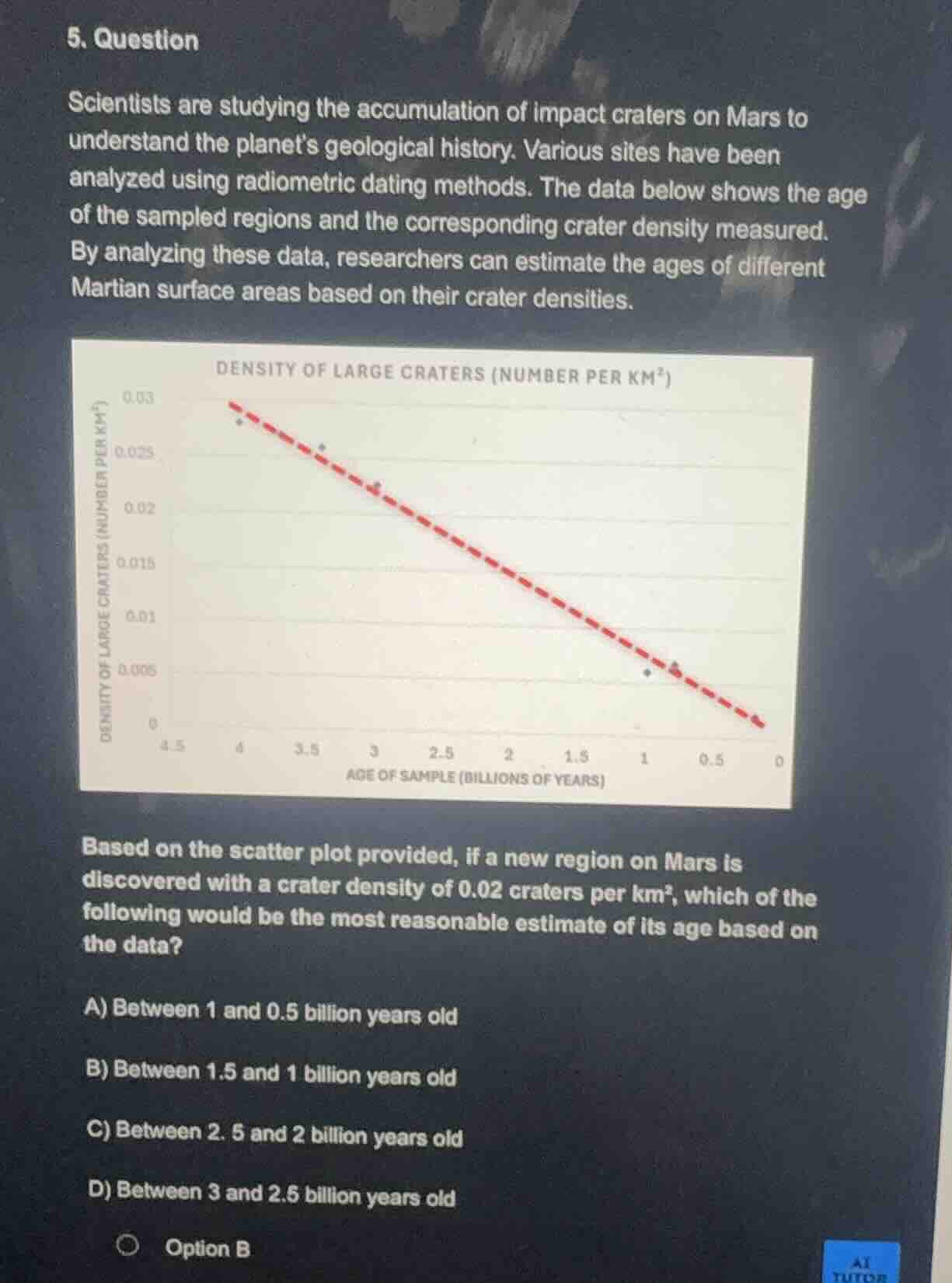
scientists are studying the accumulation of impact craters on mars to understand the planet’s geological history. various sites have been analyzed using radiometric dating methods. the data below shows the age of the sampled regions and the corresponding crater density measured. by analyzing these data, researchers can estimate the ages of different martian surface areas based on their crater densities.
based on the scatter plot provided, if a new region on mars is discovered with a crater density of 0.02 craters per km², which of the following would be the most reasonable estimate of its age based on the data?
a) between 1 and 0.5 billion years old
b) between 1.5 and 1 billion years old
c) between 2.5 and 2 billion years old
d) between 3 and 2.5 billion years old
option b
Step1: Analyze the scatter plot trend
The scatter plot shows a negative linear relationship between crater density (y - axis) and age (x - axis). As crater density decreases, age (in billions of years) also decreases (or as density increases, age increases).
Step2: Locate the crater density value
We are given a crater density of 0.02 craters per \(km^2\). On the y - axis (density of large craters), find the value 0.02.
Step3: Find the corresponding x - value (age)
From the scatter plot, when the density is 0.02, we look at the red dashed line (the trend line) and find the corresponding x - value (age). The x - axis is age in billions of years. Looking at the plot, when density is 0.02, the age should be between 3 and 2.5 billion years old (since as density decreases from 0.025 (at around 3.5 billion) to 0.015 (at around 2.5 billion), 0.02 is in between, and the x - values for density 0.02 fall between 3 and 2.5 billion years).

Snap & solve any problem in the app
Get step-by-step solutions on Sovi AI
Photo-based solutions with guided steps
Explore more problems and detailed explanations
D) Between 3 and 2.5 billion years old