QUESTION IMAGE
Question
question 2 of 2
select the correct answer from each drop - down menu.
complete the sentences to distinguish between a conjecture, a postulate, and a theorem.
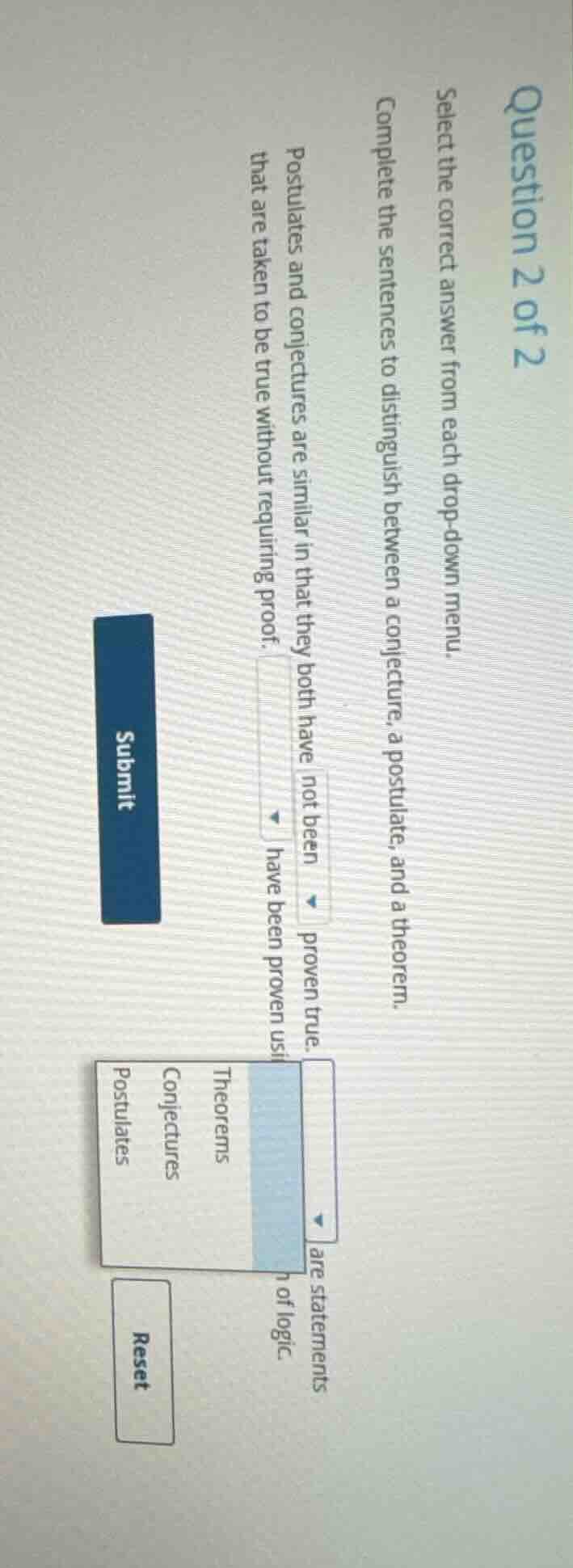
postulates and conjectures are similar in that they both have not been proven true. that are taken to be true without requiring proof.
theorems, conjectures, postulates
have been proven usin
submit
reset
To solve this, we analyze the definitions:
- Conjectures: Statements that are proposed but not been proven (they are hypotheses to be tested).
- Postulates: Statements taken as true without requiring proof (they are assumed for a system).
- Theorems: Statements that have been proven using logic, postulates, or other theorems.
For the first blank (about conjectures and postulates’ proof status):
- Conjectures: “not been” proven (they are unproven hypotheses).
- Postulates: “have been” is incorrect; postulates are taken as true without proof, but the second part of the sentence says “they both have… taken to be true without requiring proof” – wait, re-reading: “Postulates and conjectures are similar in that they both have [blank] proven true.” Wait, no—correction:
Wait, the sentence structure: “Postulates and conjectures are similar in that they both have [blank] proven true.”
- Conjectures: are not been proven (they are unproven).
- Postulates: are taken as true without proof (so also “not been” proven, because postulates are assumed, not proven). Wait, maybe the first drop-down is for “conjectures” and “postulates” vs “theorems”.
Wait, the second part: “[blank] are statements that are taken to be true without requiring proof.” That is Postulates (by definition: postulates are axioms assumed true without proof).
Let’s re-express:
- First drop-down (about conjectures/postulates’ proof):
- Conjectures: “not been” proven (they are unproven).
- Postulates: also “not been” proven (they are assumed, not proven).
- Second drop-down (statement taken as true without proof):
- Postulates (by definition: postulates/axioms are assumed true; theorems are proven; conjectures are unproven hypotheses).
So:
- First blank (for “Postulates and conjectures are similar in that they both have [blank] proven true”): “not been” (because neither conjectures nor postulates are proven—conjectures are unproven, postulates are assumed without proof).
- Second blank (for “[blank] are statements that are taken to be true without requiring proof”): “Postulates”.
- Conjectures are unproven (so “not been” proven).
- Postulates are assumed true without proof (so “Postulates” fit the second sentence).
- Theorems are proven (but they are not the focus here).

Snap & solve any problem in the app
Get step-by-step solutions on Sovi AI
Photo-based solutions with guided steps
Explore more problems and detailed explanations
First blank: not been
Second blank: Postulates
(For the second drop-down, the correct option is "Postulates" as postulates are defined as statements taken to be true without proof.)