QUESTION IMAGE
Question
question
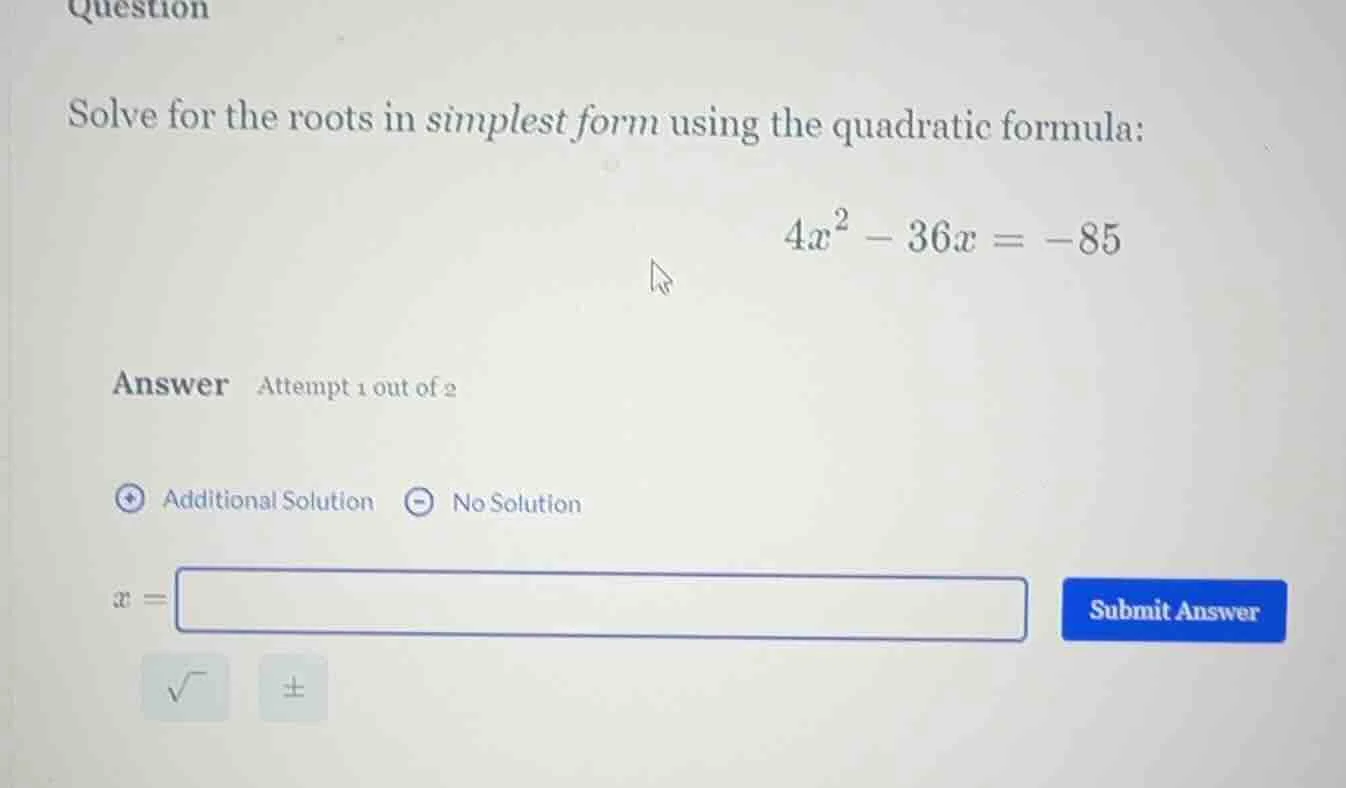
solve for the roots in simplest form using the quadratic formula:
$4x^2 - 36x = -85$
answer attempt 1 out of 2
+ additional solution - no solution
$x = \square$
submit answer
Step1: Rewrite in standard form
First, rewrite the equation \(4x^2 - 36x = -85\) in standard quadratic form \(ax^2 + bx + c = 0\) by adding 85 to both sides:
\(4x^2 - 36x + 85 = 0\)
Here, \(a = 4\), \(b = -36\), and \(c = 85\).
Step2: Apply quadratic formula
The quadratic formula is \(x = \frac{-b \pm \sqrt{b^2 - 4ac}}{2a}\).
First, calculate the discriminant \(D = b^2 - 4ac\):
\(D = (-36)^2 - 4(4)(85)\)
\(D = 1296 - 1360\)
\(D = -64\) Wait, no, wait, let's recalculate: \(4\times4\times85 = 1360\), and \((-36)^2 = 1296\)? Wait, no, 36 squared is 1296? Wait, 30 squared is 900, 6 squared is 36, and 2306=360, so (30+6)^2=900+360+36=1296. Then 1296 - 1360 = -64? Wait, that can't be. Wait, no, I must have made a mistake. Wait, the original equation is \(4x^2 - 36x = -85\), so adding 85: \(4x^2 - 36x + 85 = 0\). Then \(a=4\), \(b=-36\), \(c=85\). Then discriminant \(D = b^2 - 4ac = (-36)^2 - 4485 = 1296 - 1360 = -64\)? Wait, that's negative? But that would mean no real roots, but maybe complex roots. Wait, but the problem says "solve for the roots in simplest form". Wait, maybe I made a mistake in the sign. Wait, let's check again. Wait, 4485: 485=340, 3404=1360. (-36)^2=1296. 1296-1360= -64. So discriminant is -64. Then the square root of -64 is \(8i\) (since \(\sqrt{-64} = \sqrt{64}\times\sqrt{-1} = 8i\)). Then, applying the quadratic formula:
\(x = \frac{-(-36) \pm \sqrt{-64}}{2*4} = \frac{36 \pm 8i}{8}\)
Simplify: divide numerator and denominator by 4: \(\frac{9 \pm 2i}{2}\)
Wait, but maybe I made a mistake in the sign of c. Wait, original equation: \(4x^2 - 36x = -85\), so moving -85 to left: \(4x^2 - 36x + 85 = 0\). So c is 85. So discriminant is \(b^2 - 4ac = (-36)^2 - 4485 = 1296 - 1360 = -64\). So the roots are complex. But maybe the problem expects real roots? Wait, maybe I made a mistake in the equation. Wait, let's check the original equation again: \(4x^2 - 36x = -85\). Let's multiply both sides by 1: no, wait, maybe I messed up the sign of b. Wait, the quadratic formula is \(x = \frac{-b \pm \sqrt{b^2 - 4ac}}{2a}\). So b is -36, so -b is 36. Then denominator is 24=8. So \(x = \frac{36 \pm \sqrt{(-36)^2 - 4485}}{8}\). So \(\sqrt{1296 - 1360} = \sqrt{-64} = 8i\). So \(x = \frac{36 \pm 8i}{8} = \frac{9 \pm 2i}{2}\). So the roots are \(\frac{9 + 2i}{2}\) and \(\frac{9 - 2i}{2}\). But maybe the problem has a typo, or I made a mistake. Wait, let's check the discriminant again. Wait, 4x² -36x +85=0. Let's compute 4ac: 44*85=1360. b²=1296. 1296-1360= -64. Yes. So the roots are complex. But the problem says "solve for the roots in simplest form". So maybe that's the answer.
Wait, but maybe I made a mistake in the equation. Let me check again. The original equation is 4x² -36x = -85. So 4x² -36x +85=0. So a=4, b=-36, c=85. Then quadratic formula: x = [36 ± sqrt(1296 - 1360)] / 8 = [36 ± sqrt(-64)] /8 = [36 ±8i]/8 = 9/2 ± i. So x = 9/2 + i or 9/2 - i. So in simplest form, that's (9 ± 2i)/2? Wait, 36/8 is 9/2, 8i/8 is i. So x = 9/2 ± i. Which is the same as (9 ± 2i)/2? Wait, no, 9/2 is 4.5, and i is 1i. So 9/2 ± i is correct.
But maybe the problem was supposed to have real roots. Did I copy the equation correctly? The user wrote: 4x² -36x = -85. Yes. So maybe that's the case. So the roots are complex.

Snap & solve any problem in the app
Get step-by-step solutions on Sovi AI
Photo-based solutions with guided steps
Explore more problems and detailed explanations
\(x = \frac{9}{2} \pm i\) (or \(x = \frac{9 \pm 2i}{2}\))