QUESTION IMAGE
Question
question
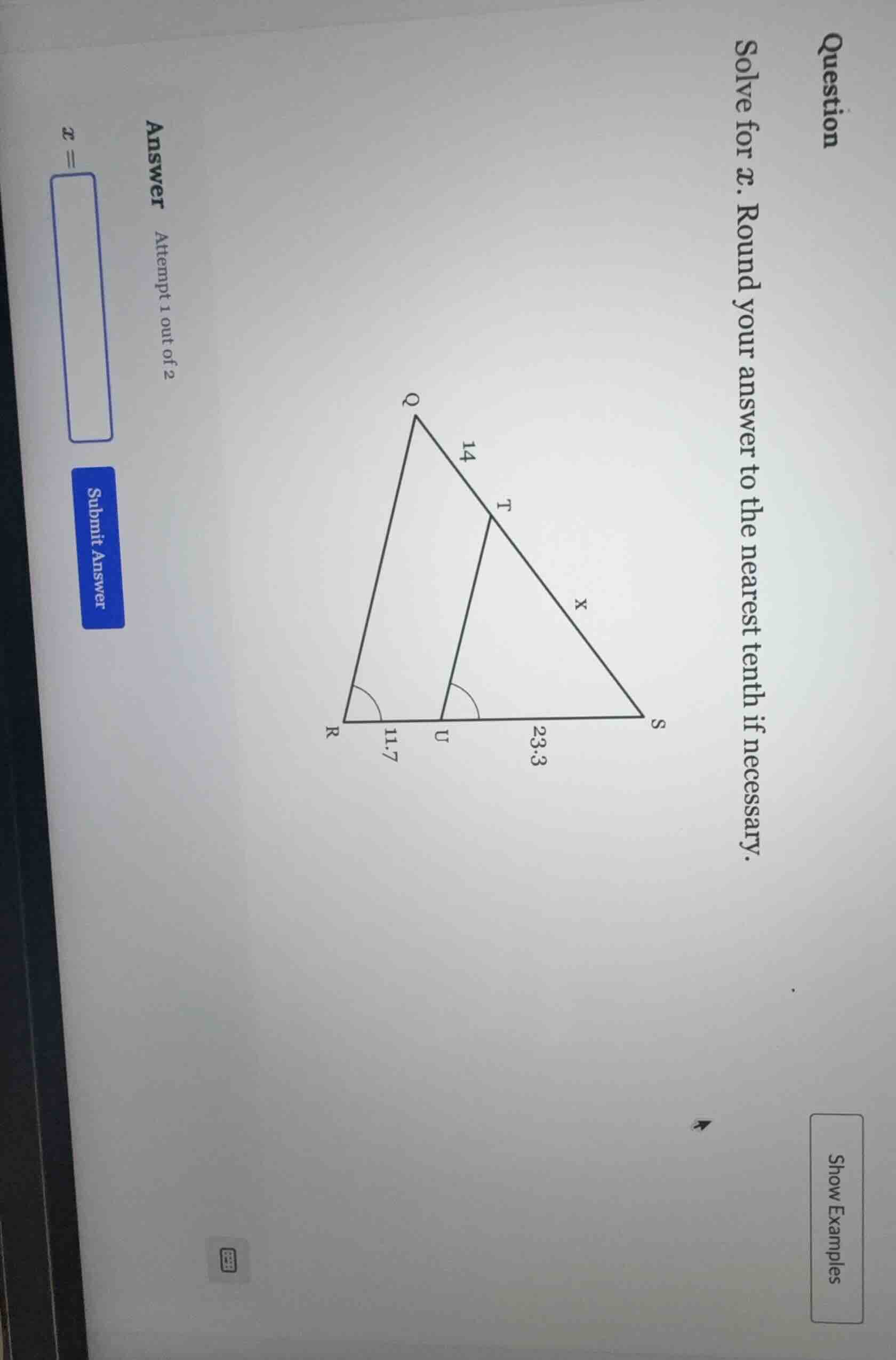
solve for x. round your answer to the nearest tenth if necessary.
answer attempt 1 out of 2
x =
submit answer
show examples
Step1: Identify Similar Triangles
Triangles \( \triangle QRS \) and \( \triangle UTS \) are similar (by AA similarity, as \( \angle R \cong \angle U \) and \( \angle S \) is common). So, the ratios of corresponding sides are equal: \( \frac{QT}{TS} = \frac{RU}{US} \). Wait, actually, correct proportion: \( \frac{QR}{UT} \) no, wait, \( QT = 14 \), \( TS = x \), \( RU = 11.7 \), \( US = 23.3 \), and \( QS = QT + TS = 14 + x \), \( RS = RU + US = 11.7 + 23.3 = 35 \). So by the Basic Proportionality Theorem (Thales' theorem), since \( UT \parallel QR \) (because \( \angle R \cong \angle U \), so \( UT \parallel QR \)), we have \( \frac{QT}{TS} = \frac{RU}{US} \)? Wait, no, Thales' theorem: if a line is drawn parallel to one side of a triangle, intersecting the other two sides, then it divides those sides proportionally. So here, \( UT \parallel QR \), so \( \frac{QT}{TS} = \frac{RU}{US} \)? Wait, \( QT = 14 \), \( TS = x \), \( RU = 11.7 \), \( US = 23.3 \). Wait, no, \( RU \) and \( US \) are segments on \( RS \), and \( QT \) and \( TS \) are segments on \( QS \). So the correct proportion is \( \frac{QT}{QS} = \frac{RU}{RS} \)? No, wait, Thales' theorem: \( \frac{QT}{TS} = \frac{RU}{US} \). Let's check: \( QT = 14 \), \( TS = x \), \( RU = 11.7 \), \( US = 23.3 \). So \( \frac{14}{x} = \frac{11.7}{23.3} \)? Wait, no, that would be if \( UT \parallel QR \), then \( \frac{QT}{TS} = \frac{RU}{US} \). Wait, let's rederive. Since \( \angle R = \angle U \) (given, the angles at \( R \) and \( U \) are equal), and \( \angle S \) is common, so \( \triangle QRS \sim \triangle UTS \) by AA similarity. Therefore, corresponding sides: \( \frac{QS}{TS} = \frac{RS}{US} \). \( QS = 14 + x \), \( TS = x \), \( RS = 11.7 + 23.3 = 35 \), \( US = 23.3 \). So \( \frac{14 + x}{x} = \frac{35}{23.3} \). Wait, no, similar triangles: \( \triangle QRS \sim \triangle UTS \), so \( \frac{QR}{UT} = \frac{RS}{US} = \frac{QS}{TS} \). Wait, maybe better to use \( \frac{QT}{TS} = \frac{RU}{US} \). Wait, \( QT = 14 \), \( TS = x \), \( RU = 11.7 \), \( US = 23.3 \). So \( \frac{14}{x} = \frac{11.7}{23.3} \)? No, that would be inverse. Wait, no, if \( UT \parallel QR \), then \( \frac{QT}{TS} = \frac{RU}{US} \). So \( \frac{14}{x} = \frac{11.7}{23.3} \)? Wait, solving for \( x \): \( x = \frac{14 \times 23.3}{11.7} \). Wait, let's compute that.
Step2: Solve for \( x \)
Using the proportion from similar triangles (AA similarity, \( \triangle QRS \sim \triangle UTS \)): \( \frac{QT}{TS} = \frac{RU}{US} \) (since \( UT \parallel QR \), so the segments are proportional). So \( \frac{14}{x} = \frac{11.7}{23.3} \)? Wait, no, actually, \( \frac{QT}{QS} = \frac{RU}{RS} \)? Wait, \( QS = 14 + x \), \( RS = 11.7 + 23.3 = 35 \). So \( \frac{14}{14 + x} = \frac{11.7}{35} \). Let's solve this. Cross-multiplying: \( 14 \times 35 = 11.7 \times (14 + x) \). \( 490 = 163.8 + 11.7x \). Subtract 163.8: \( 490 - 163.8 = 11.7x \). \( 326.2 = 11.7x \). Then \( x = \frac{326.2}{11.7} \approx 27.9 \). Wait, no, that can't be. Wait, maybe the correct proportion is \( \frac{QT}{TS} = \frac{RU}{US} \), so \( \frac{14}{x} = \frac{11.7}{23.3} \). Then \( x = \frac{14 \times 23.3}{11.7} \). Let's calculate that: \( 14 \times 23.3 = 326.2 \), \( 326.2 \div 11.7 \approx 27.9 \). Wait, but let's check the similar triangles again. The angles at \( R \) and \( U \) are equal, so \( UT \parallel QR \), so by Thales' theorem, \( \frac{QT}{TS} = \frac{RU}{US} \). So \( QT = 14 \), \( TS = x \), \( RU = 11.7 \), \( US = 23.3 \). So \( \frac{14}{x} = \frac{11.7}{23.3} \). Solving for \( x \): \( x =…

Snap & solve any problem in the app
Get step-by-step solutions on Sovi AI
Photo-based solutions with guided steps
Explore more problems and detailed explanations
\( \boxed{27.9} \)