QUESTION IMAGE
Question
question 4 of 5
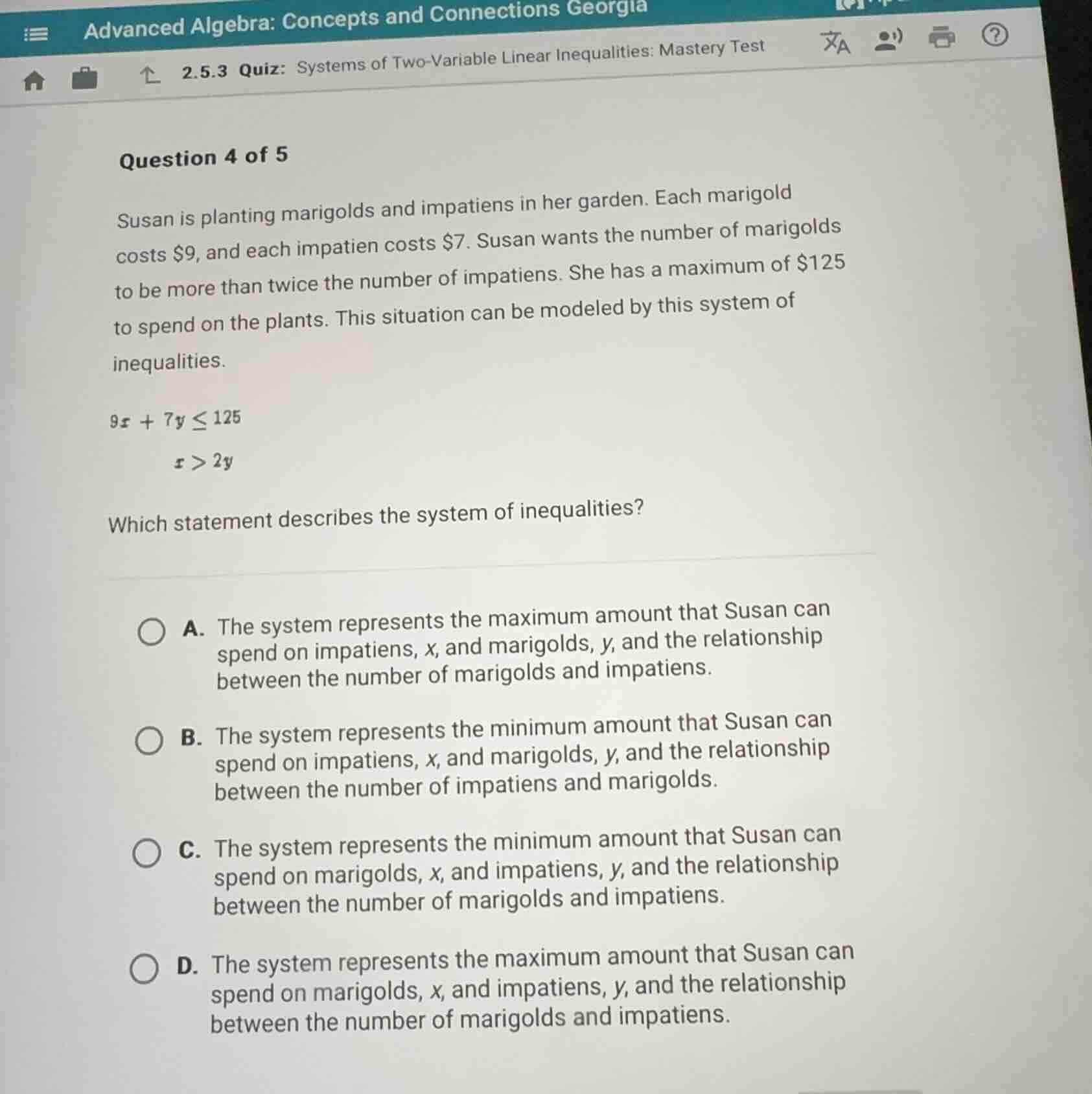
susan is planting marigolds and impatiens in her garden. each marigold
costs $9, and each impatien costs $7. susan wants the number of marigolds
to be more than twice the number of impatiens. she has a maximum of $125
to spend on the plants. this situation can be modeled by this system of
inequalities.
$9x + 7y \leq 125$
$x > 2y$
which statement describes the system of inequalities?
\\(\bigcirc\\) a. the system represents the maximum amount that susan can
spend on impatiens, x, and marigolds, y, and the relationship
between the number of marigolds and impatiens.
\\(\bigcirc\\) b. the system represents the minimum amount that susan can
spend on impatiens, x, and marigolds, y, and the relationship
between the number of impatiens and marigolds.
\\(\bigcirc\\) c. the system represents the minimum amount that susan can
spend on marigolds, x, and impatiens, y, and the relationship
between the number of marigolds and impatiens.
\\(\bigcirc\\) d. the system represents the maximum amount that susan can
spend on marigolds, x, and impatiens, y, and the relationship
between the number of marigolds and impatiens.
- Analyze the cost inequality \(9x + 7y\leq125\): The left - hand side \(9x + 7y\) represents the total cost of \(x\) marigolds (each costing \$9) and LXI3 impatiens (each costing \$7). The inequality \(9x + 7y\leq125\) means that the total cost of the plants is less than or equal to \$125, which is the maximum amount Susan can spend. So this inequality represents a maximum - cost constraint.
- Analyze the quantity inequality \(x > 2y\): Here, \(x\) is the number of marigolds and \(y\) is the number of impatiens. The inequality \(x>2y\) represents the relationship between the number of marigolds and impatiens (the number of marigolds is more than twice the number of impatiens).
- Evaluate the options:
- Option A: It misidentifies \(x\) as the number of impatiens and \(y\) as the number of marigolds. From the problem, \(x\) is the number of marigolds and \(y\) is the number of impatiens. So A is incorrect.
- Option B: The inequality \(9x + 7y\leq125\) is a maximum - cost constraint, not a minimum - cost constraint, and it also misidentifies the variables. So B is incorrect.
- Option C: The inequality \(9x + 7y\leq125\) is a maximum - cost constraint, not a minimum - cost constraint. So C is incorrect.
- Option D: The inequality \(9x + 7y\leq125\) represents the maximum amount Susan can spend on \(x\) marigolds and \(y\) impatiens, and \(x > 2y\) represents the relationship between the number of marigolds (\(x\)) and impatiens (\(y\)). This option correctly describes the system of inequalities.

Snap & solve any problem in the app
Get step-by-step solutions on Sovi AI
Photo-based solutions with guided steps
Explore more problems and detailed explanations
D. The system represents the maximum amount that Susan can spend on marigolds, \(x\), and impatiens, \(y\), and the relationship between the number of marigolds and impatiens.