QUESTION IMAGE
Question
question 4 of 5
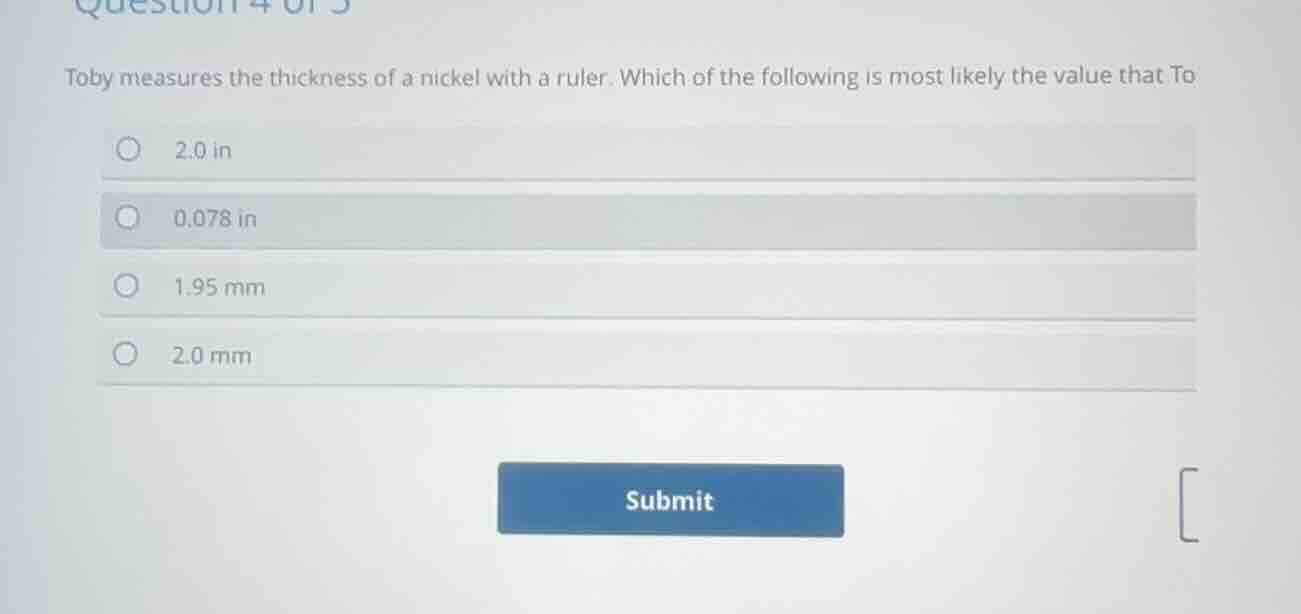
toby measures the thickness of a nickel with a ruler. which of the following is most likely the value that to
2.0 in
0.078 in
1.95 mm
2.0 mm
submit
First, we know the actual thickness of a nickel is about 1.95 mm (or converting to inches, since 1 inch = 25.4 mm, so 1.95 mm = 1.95/25.4 ≈ 0.0768 in, close to 0.078 in). But we need to check the units. A ruler for measuring a nickel's thickness - if using a ruler (likely in inches or mm, but let's recall: a nickel's thickness is about 1.95 mm (or ~0.0768 in). Now, check the options: 2.0 in is too thick, 0.078 in is close to the inch conversion, 1.95 mm and 2.0 mm. Wait, but the question is about measuring with a ruler. A typical ruler (like a standard inch ruler or metric). But the actual thickness of a US nickel is 1.95 mm (or 0.0768 inches). Now, between 0.078 in, 1.95 mm, 2.0 mm. Wait, but let's check the precision. A ruler's precision: if it's a standard inch ruler, the smallest division is 1/16 in (~0.0625 in) or 1/32 in (~0.03125 in). 0.078 in is between 1/16 (0.0625) and 1/12 (~0.0833), so possible. But the metric ruler: 1.95 mm is very precise (to hundredth of mm), but a standard metric ruler has mm and half - mm or 0.5 mm divisions. Wait, no - the actual thickness of a nickel is 1.95 mm (official value). But let's check the options. Wait, the options: 2.0 in is way too big. 0.078 in is ~1.98 mm (since 0.07825.4 = 1.9812 mm), close to 2.0 mm or 1.95 mm. But the most accurate is 1.95 mm? Wait no, wait the question is "most likely the value". Wait, maybe I made a mistake. Wait, the US nickel's thickness is 1.95 mm (or 0.0768 inches). So 0.078 in is very close to the inch conversion, 1.95 mm is the exact metric value. But let's check the options. Wait, the options are: 2.0 in (no), 0.078 in, 1.95 mm, 2.0 mm. Wait, but let's see: if measuring with a ruler, a standard ruler (like a school ruler) - if it's a metric ruler, you can measure 1.95 mm? But a standard metric ruler has mm markings, so 1.95 mm would be hard to measure (since most rulers have mm as the smallest, or 0.5 mm). Wait, no, the actual thickness is 1.95 mm, so 1.95 mm is the correct value. Wait, but 0.078 in is also close. Wait, maybe the question is about the unit. Wait, the problem says "measures the thickness of a nickel with a ruler" - a ruler can be in inches or metric. But the official thickness is 1.95 mm. So between 1.95 mm and 0.078 in. Wait, but 0.078 in is 1.98 mm (0.07825.4 = 1.9812), close to 2.0 mm. Wait, maybe the answer is 1.95 mm? No, wait let's check again. Wait, the options: 1.95 mm is the exact thickness, 2.0 mm is a rounded value, 0.078 in is a rounded inch value. But which is more likely? Wait, maybe the question is from a US context, where rulers can be in inches. But 0.078 in is ~2.0 mm (since 0.07825.4≈1.98 mm). Wait, but the official thickness is 1.95 mm. So 1.95 mm is the correct value. But wait, let's check the options again. Wait, the user's selected option was 0.078 in, but maybe I'm wrong. Wait, no - let's calculate: 1 inch = 25.4 mm. So 0.078 in 25.4 = 1.9812 mm. The actual thickness is 1.95 mm, so 0.078 in is a bit over, but 1.95 mm is exact. But maybe the ruler's precision: if using a metric ruler, can you measure 1.95 mm? A standard metric ruler has mm markings, so you can see 1.95 mm (if the ruler has 0.5 mm or 0.1 mm divisions? No, standard metric rulers for school have mm and half - mm (0.5 mm) divisions, so you can measure to the nearest 0.5 mm? No, some have 0.1 mm, but usually, for a nickel, the thickness is 1.95 mm, which is close to 2.0 mm, but 1.95 mm is the correct value. Wait, but the options: 1.95 mm is an option, 2.0 mm is another. Wait, maybe the question is about the unit - the ruler is used, and if it's a stand…

Snap & solve any problem in the app
Get step-by-step solutions on Sovi AI
Photo-based solutions with guided steps
Explore more problems and detailed explanations
1.95 mm