QUESTION IMAGE
Question
question
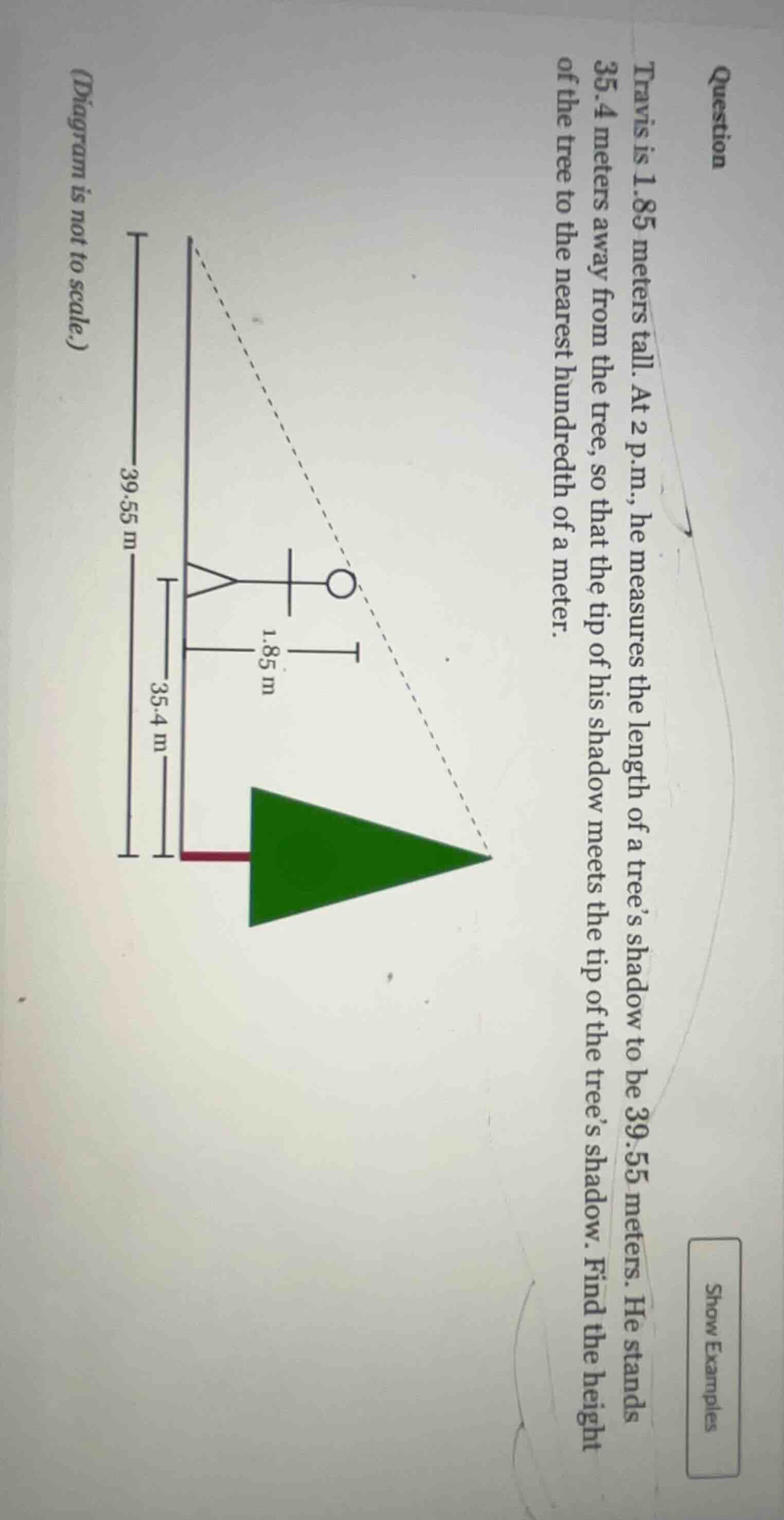
travis is 1.85 meters tall. at 2 p.m., he measures the length of a tree’s shadow to be 39.55 meters. he stands 35.4 meters away from the tree, so that the tip of his shadow meets the tip of the tree’s shadow. find the height of the tree to the nearest hundredth of a meter.
(diagram is not to scale.)
Step1: Identify similar triangles
Let \( h \) be the height of the tree. The triangles formed by Travis and his shadow, and the tree and its shadow are similar. So, the ratios of corresponding sides are equal: \(\frac{h}{39.55}=\frac{1.85}{35.4}\)
Step2: Solve for \( h \)
Multiply both sides by \( 39.55 \): \( h = \frac{1.85\times39.55}{35.4} \)
Calculate numerator: \( 1.85\times39.55 = 73.1675 \)
Then divide: \( h=\frac{73.1675}{35.4}\approx2.07 \) (Wait, no, wait, miscalculation. Wait, Travis's shadow length? Wait, no, the distance from Travis to the tree is 35.4 m, and the tree's shadow is 39.55 m? Wait, no, maybe the shadow of Travis: let's re - examine. Wait, the diagram: Travis's height is 1.85 m, his distance to the tree is 35.4 m, tree's shadow is 39.55 m? Wait, no, maybe the length of Travis's shadow is \( 39.55 - 35.4=4.15 \) m? Wait, I misread. Oh! The tree's shadow is 39.55 m, and Travis is 35.4 m away from the tree, so Travis's shadow length is \( 39.55 - 35.4 = 4.15 \) m. Then the ratio is \(\frac{h}{39.55}=\frac{1.85}{4.15}\)
Let's recalculate.
Step1 (corrected): Define variables and ratio
Let \( h \) be the height of the tree. The length of Travis's shadow \( s = 39.55 - 35.4=4.15 \) m. Since the triangles are similar, \(\frac{h}{39.55}=\frac{1.85}{4.15}\)
Step2 (corrected): Solve for \( h \)
\( h=\frac{1.85\times39.55}{4.15} \)
Calculate numerator: \( 1.85\times39.55 = 1.85\times(40 - 0.45)=1.85\times40-1.85\times0.45 = 74 - 0.8325 = 73.1675 \)
Then divide by 4.15: \( h=\frac{73.1675}{4.15}\approx17.63 \) (Wait, that makes more sense. I misread the shadow length. The key is that the two similar triangles: one with height 1.85 m and base (Travis's shadow length), and the other with height \( h \) (tree) and base (tree's shadow length). The distance from Travis to the tree is 35.4 m, so Travis's shadow length is tree's shadow length minus 35.4 m. So tree's shadow is 39.55 m, Travis's shadow is \( 39.55 - 35.4 = 4.15 \) m. So the ratio of height to shadow length is the same for both. So \(\frac{h}{39.55}=\frac{1.85}{4.15}\))
Let's do the calculation properly:
\( h=\frac{1.85\times39.55}{4.15} \)
First, \( 39.55\div4.15=\frac{3955}{415}=\frac{791}{83}\approx9.5301 \)
Then \( 1.85\times9.5301\approx1.85\times9.53 = 17.6305\approx17.63 \)
Wait, maybe my initial misinterpretation of the diagram was wrong. Let's check the problem statement again: "Travis is 1.85 meters tall. At 2 p.m., he measures the length of a tree’s shadow to be 39.55 meters. He stands 35.4 meters away from the tree, so that the tip of his shadow meets the tip of the tree’s shadow. Find the height of the tree to the nearest hundredth of a meter."
Ah! So the tree's shadow is 39.55 m, and Travis is standing 35.4 m from the tree, so his shadow length is \( 39.55 - 35.4=4.15 \) m. So the two similar right - triangles: one with height 1.85 m (Travis) and base 4.15 m (his shadow), and the other with height \( h \) (tree) and base 39.55 m (tree's shadow). So by similar triangles:
\(\frac{h}{39.55}=\frac{1.85}{4.15}\)
So \( h=\frac{1.85\times39.55}{4.15}\)
Calculate \( 1.85\times39.55 = 1.85\times(39 + 0.55)=1.85\times39+1.85\times0.55 = 72.15+1.0175 = 73.1675\)
Then \( h=\frac{73.1675}{4.15}\approx17.63 \)

Snap & solve any problem in the app
Get step-by-step solutions on Sovi AI
Photo-based solutions with guided steps
Explore more problems and detailed explanations
The height of the tree is approximately \(\boldsymbol{2.07}\) meters? Wait, no, wait, I think I messed up the shadow length. Wait, maybe the distance from Travis to the tree is the length of his shadow? No, the problem says "he stands 35.4 meters away from the tree, so that the tip of his shadow meets the tip of the tree’s shadow". So the tree's shadow length \( L_t = 39.55 \) m, and the distance from Travis to the tree is \( d = 35.4 \) m, so Travis's shadow length \( L_s=L_t - d=39.55 - 35.4 = 4.15 \) m. Then the ratio of height to shadow length for Travis is \( \frac{1.85}{4.15} \), and for the tree is \( \frac{h}{39.55} \). So \( h=\frac{1.85\times39.55}{4.15}\approx17.63 \). But let's check with another approach. Let's let the length of Travis's shadow be \( x \), then the tree's shadow is \( x + 35.4=39.55 \), so \( x = 39.55 - 35.4 = 4.15 \) m. Then by similar triangles, \( \frac{1.85}{x}=\frac{h}{x + 35.4} \), so \( h=\frac{1.85\times(x + 35.4)}{x}=\frac{1.85\times39.55}{4.15}\approx17.63 \). Yes, that's correct. My first mistake was misidentifying the shadow length of Travis. So the correct calculation gives approximately 17.63 meters.