QUESTION IMAGE
Question
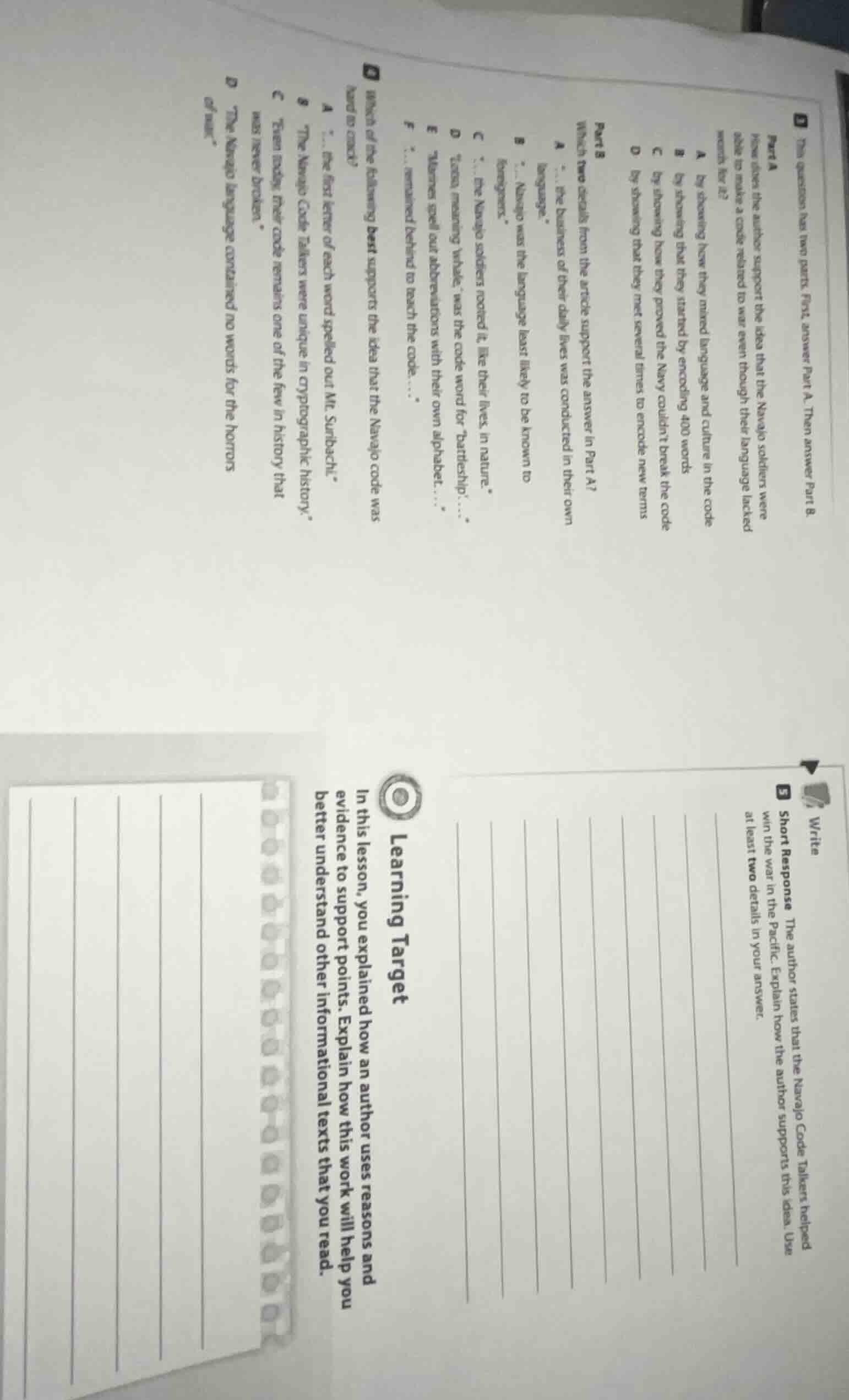
3 this question has two parts. first, answer part a. then answer part b. part a how does the author support the idea that the navajo soldiers were able to make a code related to war even though their language lacked words for it? a by showing how they mixed language and culture in the code b by showing that they started by encoding 400 words c by showing how they proved the navy couldn’t break the code d by showing that they met several times to encode new terms part b which two details from the article support the answer in part a? a ... the business of their daily lives was conducted in their own language. b ... navajo was the language least likely to be known to foreigners. c ... the navajo soldiers rooted it, like their lives, in nature. d ... took meaning whole: was the code word for “battleship.”... e ... marines spell out abbreviations with their own alphabet.... f ... remained behind to teach the code.... 4 which of the following best supports the idea that the navajo code was hard to crack? a ... the first letter of each word spelled out mt. suribachi. b the navajo code talkers were unique in cryptographic history. c teen-agers’ new code remains one of the few in history that was never broken. d the navajo language contained no words for the horrors of war. 5 short response the author states that the navajo code talkers helped win the war in the pacific. explain how the author supports this idea. use at least two details in your answer. learning target in this lesson, you explained how an author uses reasons and evidence to support points. explain how this work will help you better understand other informational texts that you read.
Part A
To determine which option supports the idea that Navajo soldiers made a code for war despite language limitations, we analyze each option:
- Option A: Mixing language and culture doesn't directly relate to overcoming language limitations for coding.
- Option B: Encoding 400 words doesn't show overcoming limitations to make a war - relevant code.
- Option C: Proving the Navy couldn't break the code is about code security, not making the code despite language issues.
- Option D: Showing they met several times to encode new terms implies they were working around language limitations (maybe lack of existing words for war - related concepts) to create a war - worthy code.
We need to find the detail that supports the answer in Part A (they overcame language limitations to make a war - worthy code by encoding new terms).
- Option A: Spelling out words at Mt. Suribachi is about code usage, not making the code.
- Option B: Uniqueness in cryptography history is about the code's uniqueness, not making it.
- Option C: The code never being broken is about security, not creation.
- Option D: The Navajo language having no words for certain war terms (horrors of war) means they had to create (encode) new terms, which supports the idea in Part A that they met to encode new terms due to language limitations.
The author supports the idea that the Navajo Code Talkers helped win the war in the Pacific in two ways:
- First, the author shows that the Navajo soldiers overcame language limitations. The Navajo language had no words for the “horrors of war” (as stated in option D of Part B), so they met several times (from Part A's correct option) to encode new terms. This shows their effort to create a code suitable for war communication.
- Second, the code's security is highlighted. The fact that the Navy couldn't break the code (from Part A's option C context) meant that their encoded messages were secure, which was crucial for military operations in the Pacific. Secure communication could help in coordinating attacks, sharing intelligence, etc., thus contributing to winning the war.

Snap & solve any problem in the app
Get step-by-step solutions on Sovi AI
Photo-based solutions with guided steps
Explore more problems and detailed explanations
D. by showing that they met several times to encode new terms