QUESTION IMAGE
Question
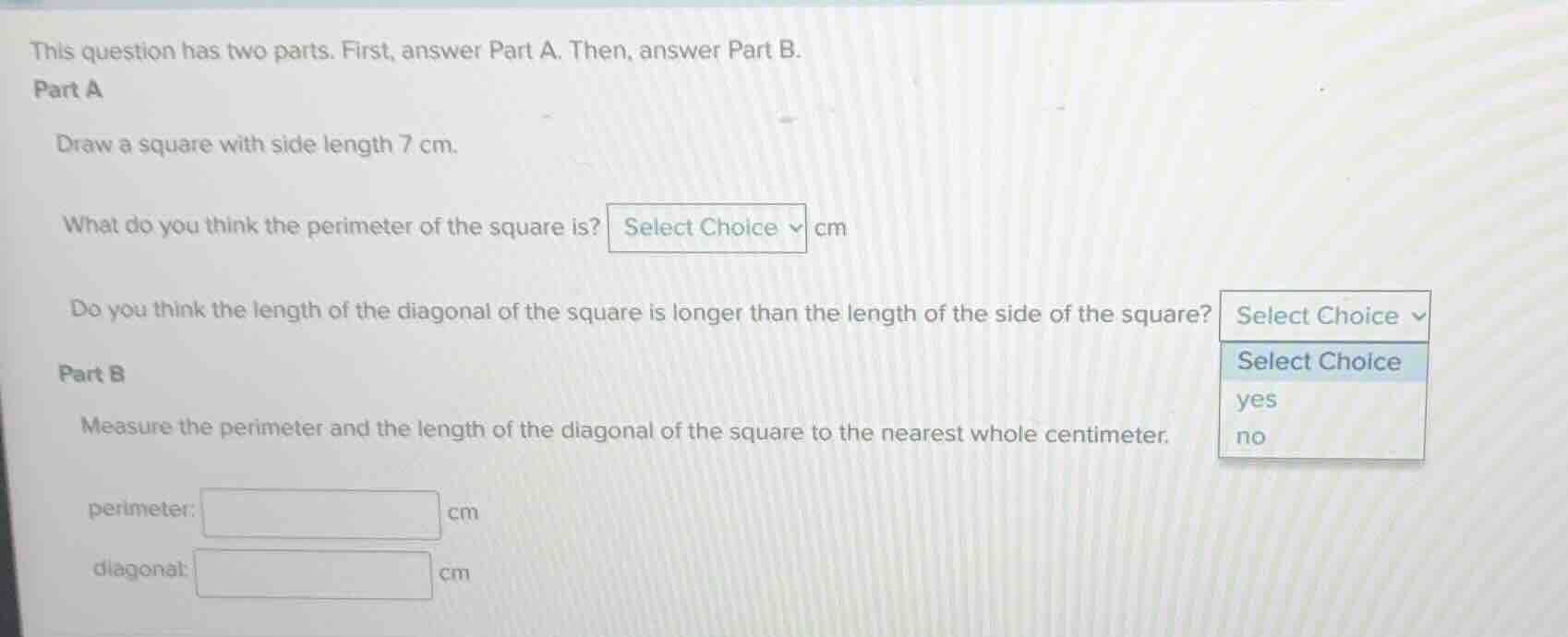
this question has two parts. first, answer part a. then, answer part b.
part a
draw a square with side length 7 cm.
what do you think the perimeter of the square is? select choice cm
do you think the length of the diagonal of the square is longer than the length of the side of the square? select choice
part b
measure the perimeter and the length of the diagonal of the square to the nearest whole centimeter.
perimeter: cm
diagonal: cm
Part A
Perimeter of the Square
Step 1: Recall the formula for the perimeter of a square
The perimeter \( P \) of a square is given by the formula \( P = 4 \times \text{side length} \).
Step 2: Substitute the side length into the formula
The side length of the square is \( 7 \) cm. So, \( P = 4 \times 7 \).
Step 3: Calculate the perimeter
\( 4 \times 7 = 28 \) cm.
Diagonal vs Side Length
In a square, if the side length is \( s \), the length of the diagonal \( d \) can be found using the Pythagorean theorem. For a square, the diagonal forms a right triangle with two sides of the square, so \( d = s\sqrt{2} \). Since \( \sqrt{2} \approx 1.414 \), which is greater than \( 1 \), the diagonal length \( d = 7\sqrt{2} \approx 9.899 \) cm, which is longer than the side length of \( 7 \) cm. So the answer is "yes".
Part B
Perimeter
When we measure the perimeter of the square with side length \( 7 \) cm, using the formula \( P = 4 \times \text{side length} \), we get \( 4\times7 = 28 \) cm. So the perimeter is \( 28 \) cm.
Diagonal
The length of the diagonal of a square with side length \( s \) is given by \( d = s\sqrt{2} \). Substituting \( s = 7 \) cm, we get \( d = 7\sqrt{2} \approx 9.899 \) cm. Rounding to the nearest whole centimeter, we get \( 10 \) cm.
Part A Answers
- Perimeter: \( 28 \) cm
- Diagonal longer than side: yes
Part B Answers
- Perimeter: \( 28 \) cm
- Diagonal: \( 10 \) cm

Snap & solve any problem in the app
Get step-by-step solutions on Sovi AI
Photo-based solutions with guided steps
Explore more problems and detailed explanations
In a square, if the side length is \( s \), the length of the diagonal \( d \) can be found using the Pythagorean theorem. For a square, the diagonal forms a right triangle with two sides of the square, so \( d = s\sqrt{2} \). Since \( \sqrt{2} \approx 1.414 \), which is greater than \( 1 \), the diagonal length \( d = 7\sqrt{2} \approx 9.899 \) cm, which is longer than the side length of \( 7 \) cm. So the answer is "yes".
Part B
Perimeter
When we measure the perimeter of the square with side length \( 7 \) cm, using the formula \( P = 4 \times \text{side length} \), we get \( 4\times7 = 28 \) cm. So the perimeter is \( 28 \) cm.
Diagonal
The length of the diagonal of a square with side length \( s \) is given by \( d = s\sqrt{2} \). Substituting \( s = 7 \) cm, we get \( d = 7\sqrt{2} \approx 9.899 \) cm. Rounding to the nearest whole centimeter, we get \( 10 \) cm.
Part A Answers
- Perimeter: \( 28 \) cm
- Diagonal longer than side: yes
Part B Answers
- Perimeter: \( 28 \) cm
- Diagonal: \( 10 \) cm