QUESTION IMAGE
Question
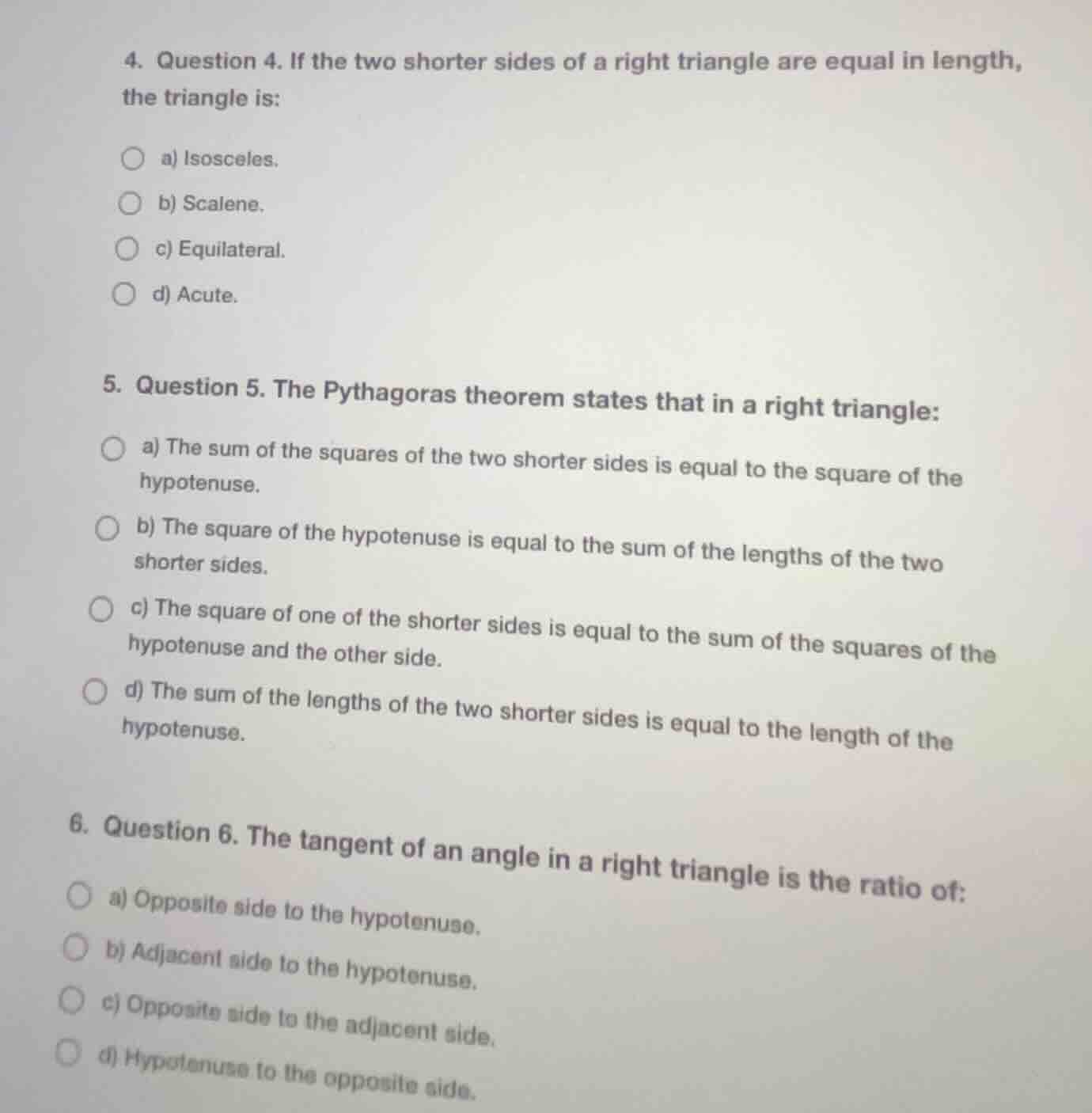
- question 4. if the two shorter sides of a right triangle are equal in length, the triangle is:
a) isosceles.
b) scalene.
c) equilateral.
d) acute.
- question 5. the pythagoras theorem states that in a right triangle:
a) the sum of the squares of the two shorter sides is equal to the square of the hypotenuse.
b) the square of the hypotenuse is equal to the sum of the lengths of the two shorter sides.
c) the square of one of the shorter sides is equal to the sum of the squares of the hypotenuse and the other side.
d) the sum of the lengths of the two shorter sides is equal to the length of the hypotenuse.
- question 6. the tangent of an angle in a right triangle is the ratio of:
a) opposite side to the hypotenuse.
b) adjacent side to the hypotenuse.
c) opposite side to the adjacent side.
d) hypotenuse to the opposite side.
Question 4:
A triangle with two equal sides is defined as isosceles. A right triangle with two equal shorter sides meets this definition. Scalene triangles have no equal sides, equilateral triangles have all sides equal, and acute triangles have all angles less than 90°, which does not match a right triangle.
Question 5:
The Pythagorean theorem is a fundamental geometric rule for right triangles, which specifically states the relationship between the squares of the sides as described in option a. The other options misstate the theorem (using sums of lengths instead of squares, or reversing the relationship).
Question 6:
In right triangle trigonometry, the tangent function for an angle is defined as the ratio of the length of the side opposite the angle to the length of the adjacent side. The other options describe sine (opposite/hypotenuse) or incorrect ratios.

Snap & solve any problem in the app
Get step-by-step solutions on Sovi AI
Photo-based solutions with guided steps
Explore more problems and detailed explanations
- a) Isosceles.
- a) The sum of the squares of the two shorter sides is equal to the square of the hypotenuse.
- c) Opposite side to the adjacent side.