QUESTION IMAGE
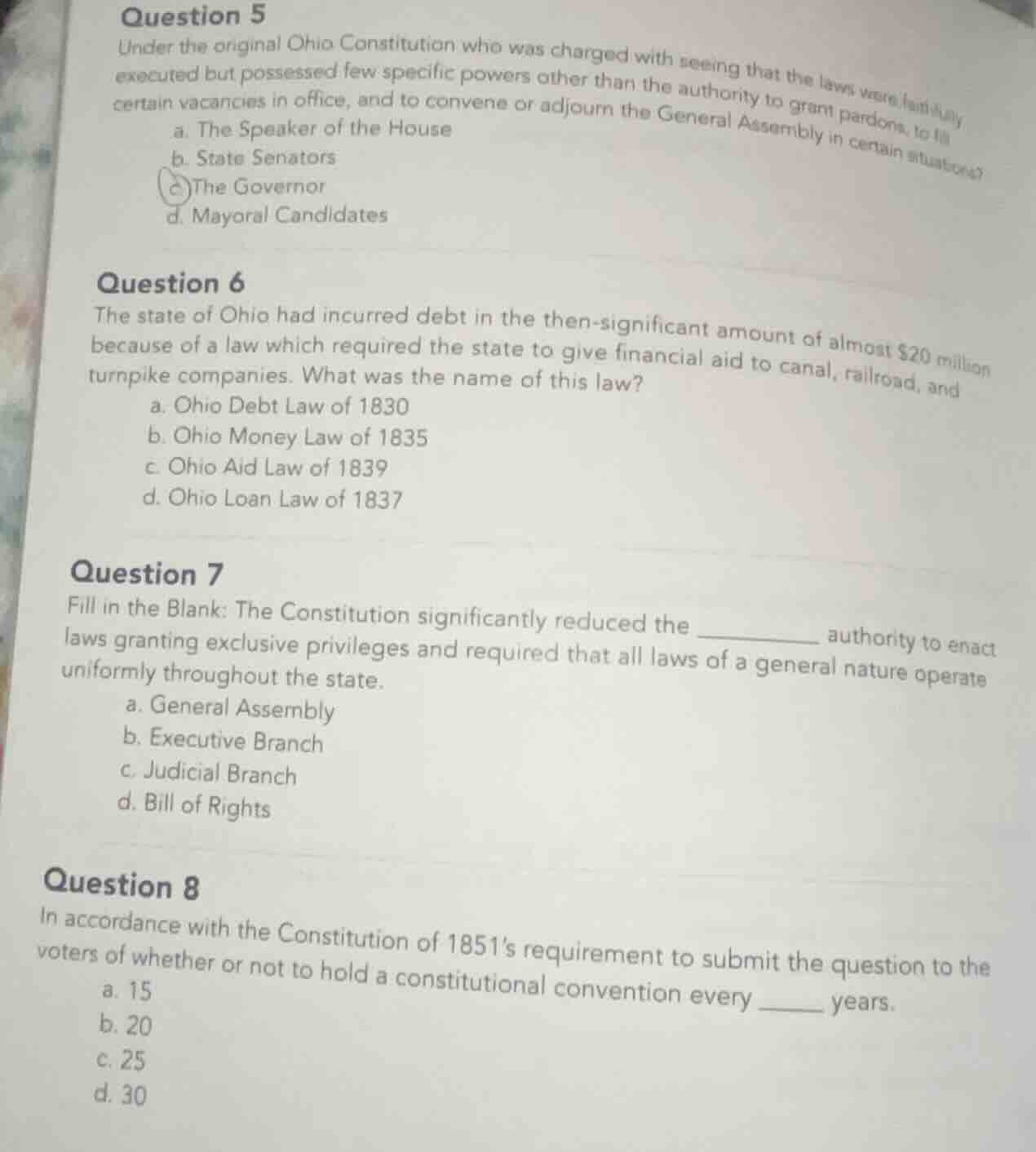
Question
question 5
under the original ohio constitution who was charged with seeing that the laws were faithfully
executed but possessed few specific powers other than the authority to grant pardons, to fill
certain vacancies in office, and to convene or adjourn the general assembly in certain situations?
a. the speaker of the house
b. state senators
c. the governor
d. mayoral candidates
question 6
the state of ohio had incurred debt in the then - significant amount of almost $20 million
because of a law which required the state to give financial aid to canal, railroad, and
turnpike companies. what was the name of this law?
a. ohio debt law of 1830
b. ohio money law of 1835
c. ohio aid law of 1839
d. ohio loan law of 1837
question 7
fill in the blank: the constitution significantly reduced the _______ authority to enact
laws granting exclusive privileges and required that all laws of a general nature operate
uniformly throughout the state.
a. general assembly
b. executive branch
c. judicial branch
d. bill of rights
question 8
in accordance with the constitution of 1851’s requirement to submit the question to the
voters of whether or not to hold a constitutional convention every ______ years.
a. 15
b. 20
c. 25
d. 30
Question 5
Under the original Ohio Constitution, the Governor was responsible for ensuring laws were executed, had pardon power, filled vacancies, and could convene/adjourn the General Assembly in certain cases. The Speaker of the House (legislative), State Senators (legislative), and Mayoral Candidates (local) don't fit this role.
The Ohio Loan Law of 1837 required the state to provide financial aid to canal, railroad, and turnpike companies, leading to a large debt. The other laws (Ohio Debt Law of 1830, Ohio Money Law of 1835, Ohio Aid Law of 1839) don't match this description.
The Constitution reduced the General Assembly's (legislature) authority to enact exclusive - privilege laws and required general laws to be uniform. The Executive Branch (enforces laws), Judicial Branch (interprets laws), and Bill of Rights (rights - related) don't have law - enacting authority in this context.

Snap & solve any problem in the app
Get step-by-step solutions on Sovi AI
Photo-based solutions with guided steps
Explore more problems and detailed explanations
c. The Governor