QUESTION IMAGE
Question
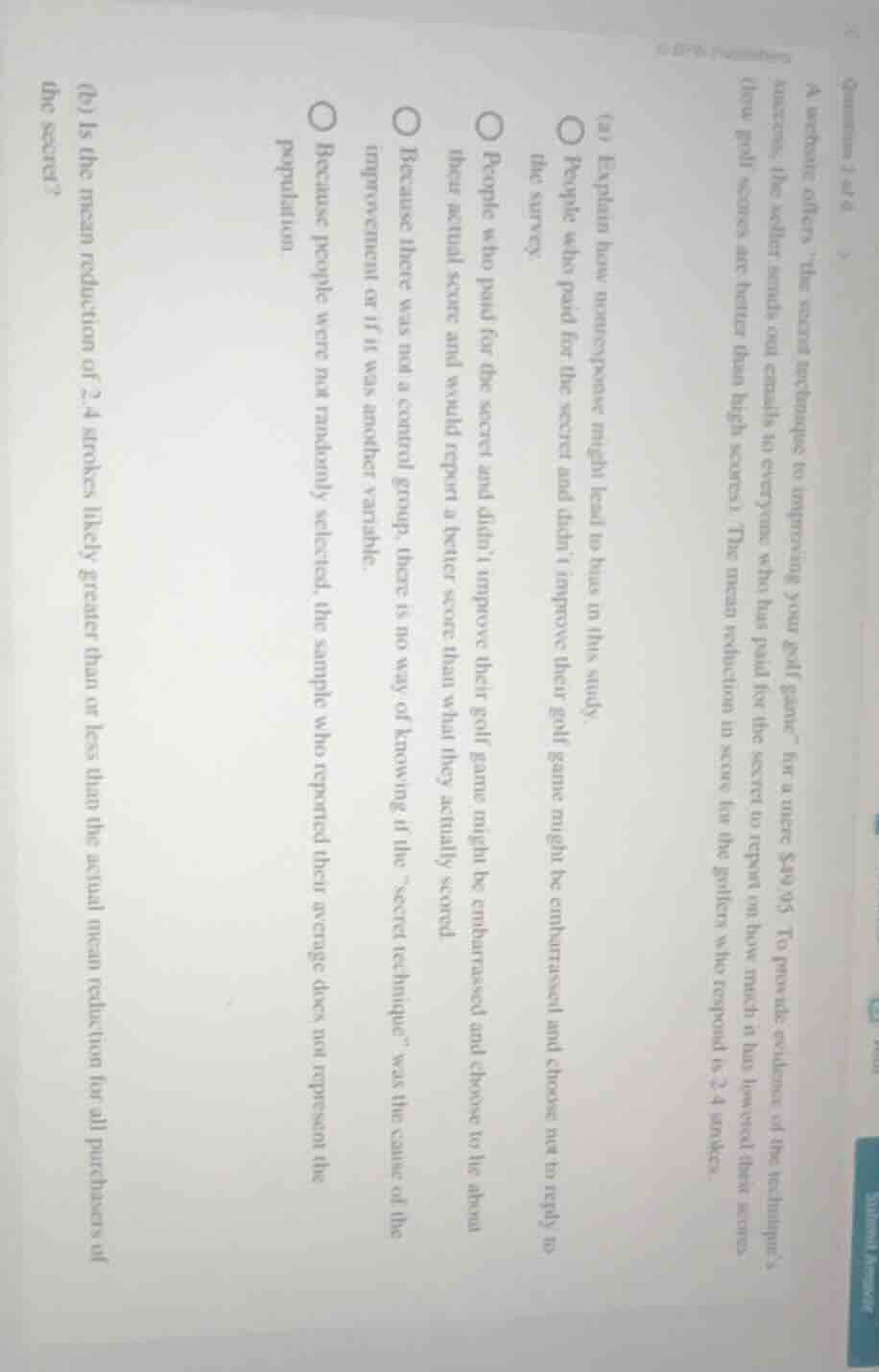
question 3 of 9 a website offers the secret technique to improving your golf game for a mere $49.95. to provide evidence of the technique’s success, the seller sends out emails to everyone who has paid for the secret to report on how much it has lowered their scores (how golf scores are better than high scores). the mean reduction in score for the golfers who responded is 2.4 strokes. (a) explain how nonresponse might lead to bias in this survey. people who paid for the secret and didn’t improve their golf game might be embarrassed and choose not to reply to the survey. people who paid for the secret and didn’t improve their golf game might be embarrassed and choose to lie about their actual score and would report a better score than what they actually scored. because there was not a control group, there is no way of knowing if the secret technique was the cause of the improvement or if it was another variable. because people were not randomly selected, the sample who reported their average does not represent the population. (b) is the mean reduction of 2.4 strokes likely greater than or less than the actual mean reduction for all purchasers of the secret?
Part (a)
To determine which option explains nonresponse bias, we analyze each:
- First option: Talks about non - improvement and not replying, but nonresponse bias is about who responds.
- Second option: People paid for the secret but didn't improve might lie about scores. This is response bias (misreporting), not nonresponse.
- Third option: No control group relates to confounding/experimental design, not nonresponse.
- Fourth option: People not randomly selected relates to sampling frame, not nonresponse. Wait, re - evaluating: Nonresponse bias occurs when those who don't respond differ from responders. The first option: “People who paid for the secret and didn’t improve their golf game might be embarrassed and choose not to reply to the survey.” This means non - responders (those who didn't improve and didn't reply) differ from responders (who might have improved or were not embarrassed), leading to bias. Wait, earlier analysis was wrong. Let's re - check:
Option 1: People who paid, didn't improve, embarrassed, don't reply. So non - responders are those with no improvement (embarrassed), responders are others. So this causes nonresponse bias as the sample (responders) doesn't represent all (including non - responders who didn't improve). Wait, the original options: Let's list them again:
- People who paid for the secret and didn't improve their golf game might be embarrassed and choose not to reply to the survey.
- People who paid for the secret and didn't improve their golf game might be embarrassed and choose to lie about their actual score and would report a better score than what they actually scored. (Response bias - lying)
- Because there was not a control group, there is no way of knowing if the “secret technique” was the cause of the improvement or if it was another variable. (Confounding/experimental design issue)
- Because people were not randomly selected, the sample who reported their average does not represent the population. (Sampling frame/selection bias)
So the correct one for nonresponse bias is the first option: People who paid for the secret and didn't improve their golf game might be embarrassed and choose not to reply to the survey. Because nonresponse bias is when individuals with certain characteristics (here, not improved and embarrassed) don't respond, so the sample (responders) is not representative.
The mean reduction of 2.4 strokes is from a sample of responders (those who replied to the survey). Since people who didn't improve (and maybe others) might not have responded (nonresponse bias as in part (a)), the sample is not representative of all purchasers. Also, there's no control group to rule out other factors (like practice, new equipment) that could cause stroke reduction. So the mean reduction of 2.4 strokes is likely less than the actual mean reduction for all purchasers. Because the non - responders (who may have had no improvement or less improvement) are not included in the sample, the sample mean (2.4) is inflated (since only those who maybe had improvement or were willing to report responded). So the actual mean for all purchasers (including non - responders) would be less than 2.4.

Snap & solve any problem in the app
Get step-by-step solutions on Sovi AI
Photo-based solutions with guided steps
Explore more problems and detailed explanations
The option "People who paid for the secret and didn't improve their golf game might be embarrassed and choose not to reply to the survey." (the first option)