QUESTION IMAGE
Question
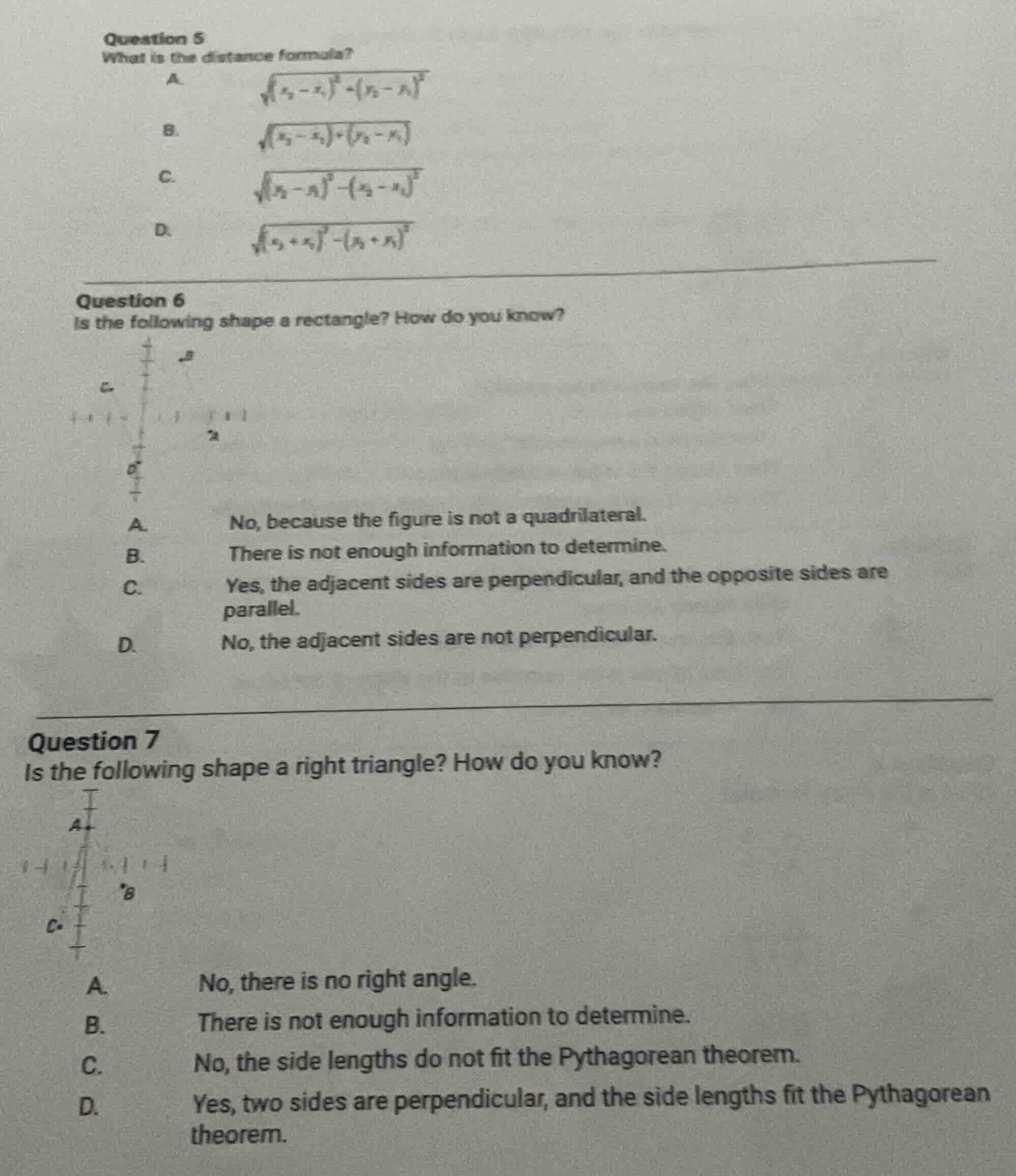
question 5
what is the distance formula?
a. $sqrt{(x_2-x_1)^2+(y_2-y_1)^2}$
b. $sqrt{(x_2-x_1)+(y_2-y_1)}$
c. $sqrt{(y_2-y_1)^2-(x_2-x_1)^2}$
d. $sqrt{(x_2+x_1)^2-(y_2+y_1)^2}$
question 6
is the following shape a rectangle? how do you know?
a. no, because the figure is not a quadrilateral.
b. there is not enough information to determine.
c. yes, the adjacent sides are perpendicular, and the opposite sides are parallel.
d. no, the adjacent sides are not perpendicular.
question 7
is the following shape a right triangle? how do you know?
a. no, there is no right angle.
b. there is not enough information to determine.
c. no, the side lengths do not fit the pythagorean theorem.
d. yes, two sides are perpendicular, and the side lengths fit the pythagorean theorem.
Step1: Identify distance formula
The distance between two points $(x_1,y_1)$ and $(x_2,y_2)$ comes from the Pythagorean theorem, squaring the differences in coordinates, summing them, then taking the square root.
Step2: Analyze Question 6 shape
The shape has 4 vertices (quadrilateral). Check perpendicularity: adjacent sides do not form right angles (slopes don't multiply to -1, or angles are not 90°).
Step3: Analyze Question 7 triangle
Check if sides fit Pythagoras, or if two sides are perpendicular. The triangle has a pair of perpendicular sides, and side lengths satisfy $a^2+b^2=c^2$.

Snap & solve any problem in the app
Get step-by-step solutions on Sovi AI
Photo-based solutions with guided steps
Explore more problems and detailed explanations
Question 5: A. $\sqrt{(x_2 - x_1)^2 + (y_2 - y_1)^2}$
Question 6: D. No, the adjacent sides are not perpendicular.
Question 7: D. Yes, two sides are perpendicular, and the side lengths fit the Pythagorean theorem.