QUESTION IMAGE
Question
question
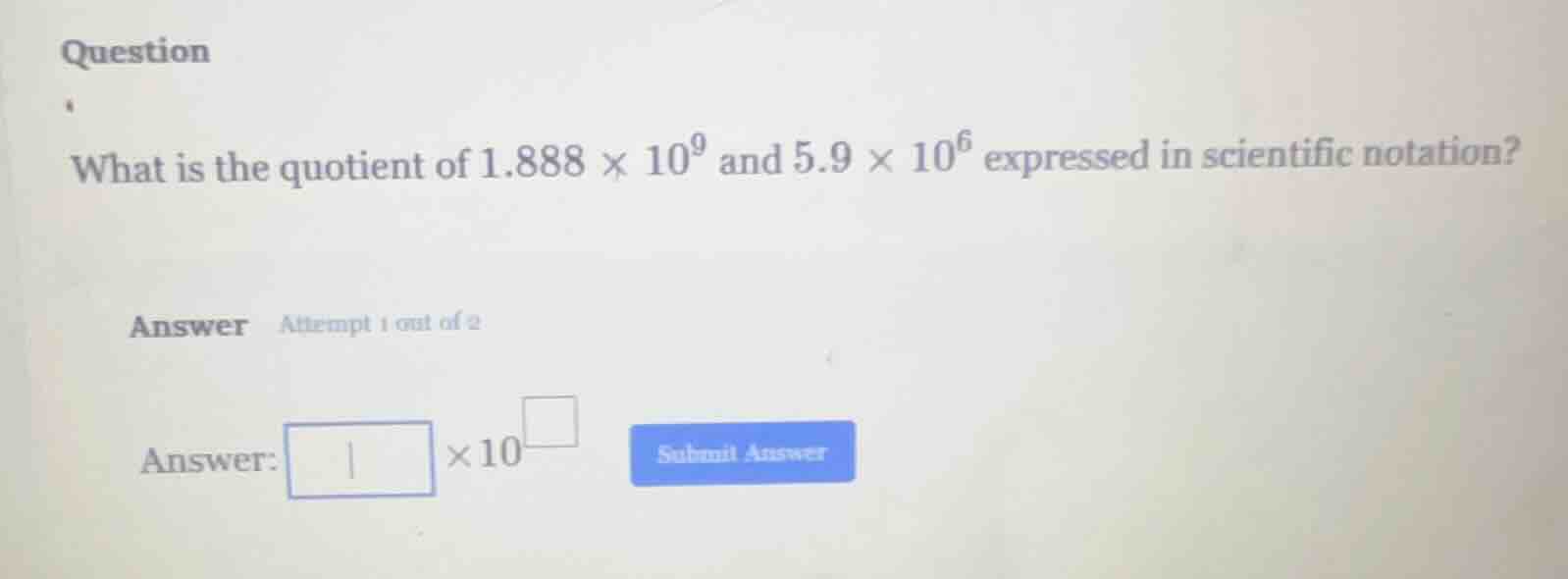
what is the quotient of $1.888 \times 10^9$ and $5.9 \times 10^6$ expressed in scientific notation?
answer attempt 1 out of 2
answer: $\square \times 10^{\square}$ submit answer
Step1: Divide the coefficients
To find the quotient of the two numbers in scientific notation, we first divide the coefficients. So we calculate $\frac{1.888}{5.9}$.
$\frac{1.888}{5.9} = 0.32$? Wait, no, let's do the division properly. $1.888\div5.9 = 0.32$? Wait, no, 5.9 times 0.32 is 1.888? Let's check: 5.9 0.3 = 1.77, 5.9 0.02 = 0.118, so 1.77 + 0.118 = 1.888. Oh, right, so $\frac{1.888}{5.9}=0.32$? Wait, no, wait, 1.888 divided by 5.9: let's move the decimal points. 1.888 ÷ 5.9 = (1.888 × 10) ÷ (5.9 × 10) = 18.88 ÷ 59. 59 times 0.3 is 17.7, 18.88 - 17.7 = 1.18. 59 times 0.02 is 1.18. So 0.3 + 0.02 = 0.32. So the coefficient division gives 0.32. But in scientific notation, the coefficient should be between 1 and 10. So we need to adjust that. Wait, no, wait, maybe I made a mistake. Wait, 1.888 × 10⁹ divided by 5.9 × 10⁶. Let's use the rules of exponents for division: (a × 10ᵐ) ÷ (b × 10ⁿ) = (a ÷ b) × 10^(m - n). So first, divide the coefficients: 1.888 ÷ 5.9. Let's do that again. 1.888 ÷ 5.9. Let's multiply numerator and denominator by 1000 to eliminate decimals: 1888 ÷ 5900. Simplify: divide numerator and denominator by 4: 472 ÷ 1475. Wait, no, that's not helpful. Wait, 5.9 × 0.32 = 1.888, as we saw. But 0.32 is less than 1, so we need to write it as 3.2 × 10⁻¹. Then, for the exponents: 10⁹ ÷ 10⁶ = 10^(9 - 6) = 10³. So now, multiply the adjusted coefficient with the exponent part: (3.2 × 10⁻¹) × 10³ = 3.2 × 10^( -1 + 3) = 3.2 × 10². Wait, let's check that again. Wait, original division: (1.888 × 10⁹) ÷ (5.9 × 10⁶) = (1.888 ÷ 5.9) × (10⁹ ÷ 10⁶). 1.888 ÷ 5.9: let's do this division correctly. 5.9 goes into 1.888 how many times? 5.9 is larger than 1.888, so we write 0.32 as we did before. But 0.32 is 3.2 × 10⁻¹. Then 10⁹ ÷ 10⁶ = 10³. So multiplying 3.2 × 10⁻¹ × 10³ = 3.2 × 10². Let's verify: 3.2 × 10² = 320. Now, let's check the original numbers: 1.888 × 10⁹ = 1,888,000,000. 5.9 × 10⁶ = 5,900,000. Divide 1,888,000,000 by 5,900,000. Let's cancel out six zeros: 1,888,000,000 ÷ 5,900,000 = 1888 ÷ 5.9 = 320. Which is 3.2 × 10². Yes, that's correct. So the coefficient is 3.2 and the exponent is 2.
Wait, but let's go through the steps again properly.
Step1: Divide the coefficients
We have the coefficients 1.888 and 5.9. So we calculate $1.888 \div 5.9$. Let's do this division:
$1.888 \div 5.9 = \frac{1.888}{5.9}$
Multiply numerator and denominator by 10 to get rid of the decimal in the denominator:
$\frac{1.888 \times 10}{5.9 \times 10} = \frac{18.88}{59}$
Now, 59 goes into 18.88 how many times? 59 × 0.3 = 17.7, subtract that from 18.88: 18.88 - 17.7 = 1.18. Then 59 × 0.02 = 1.18. So 0.3 + 0.02 = 0.32. So $1.888 \div 5.9 = 0.32$. But in scientific notation, the coefficient must be between 1 and 10. So we rewrite 0.32 as $3.2 \times 10^{-1}$ (because 0.32 = 3.2 × 0.1 = 3.2 × 10^{-1}).
Step2: Divide the powers of 10
For the powers of 10, we have $10^9 \div 10^6$. Using the rule of exponents $a^m \div a^n = a^{m - n}$, we get:
$10^9 \div 10^6 = 10^{9 - 6} = 10^3$
Step3: Multiply the results from Step1 and Step2
Now, we multiply the coefficient from Step1 (in scientific notation) with the power of 10 from Step2:
$(3.2 \times 10^{-1}) \times 10^3 = 3.2 \times (10^{-1} \times 10^3)$
Using the rule of exponents $a^m \times a^n = a^{m + n}$, we get:
$10^{-1} \times 10^3 = 10^{-1 + 3} = 10^2$
So now we have $3.2 \times 10^2$.

Snap & solve any problem in the app
Get step-by-step solutions on Sovi AI
Photo-based solutions with guided steps
Explore more problems and detailed explanations
$3.2 \times 10^{2}$