QUESTION IMAGE
Question
question 2.
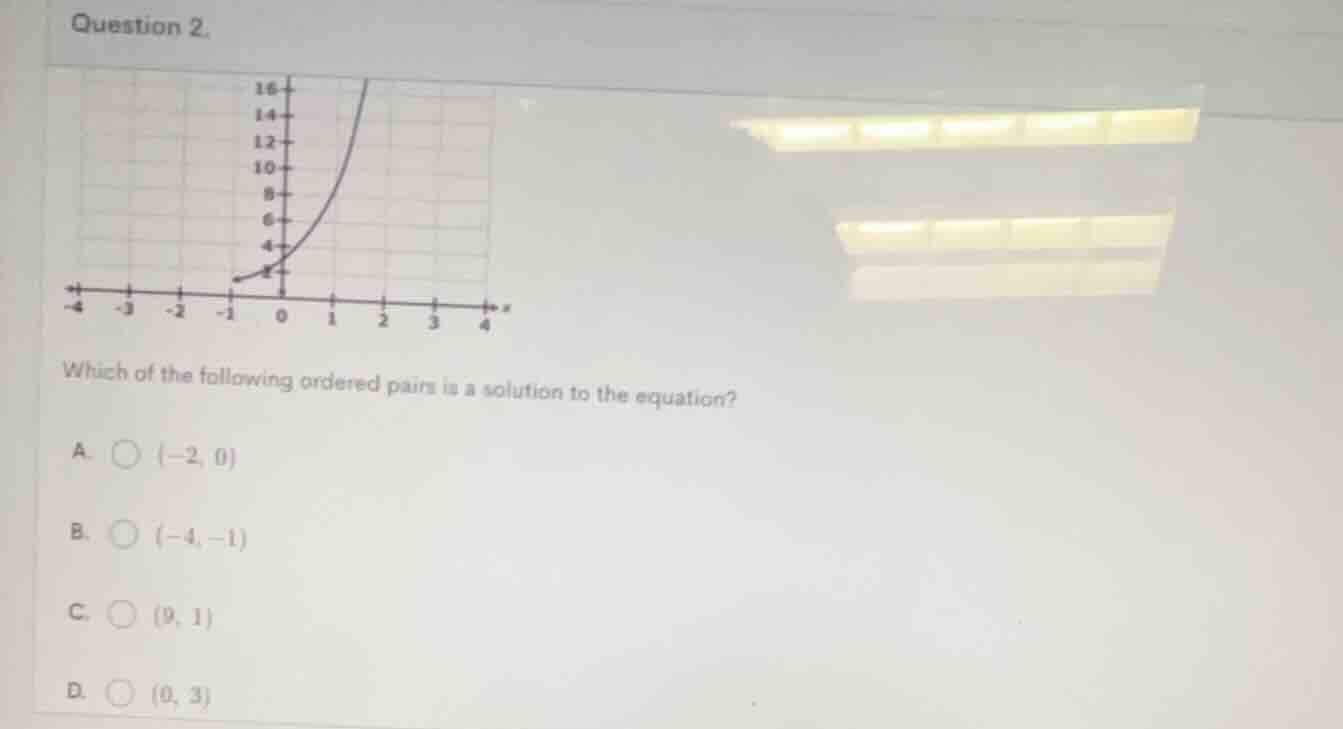
which of the following ordered pairs is a solution to the equation?
a. ((-2, 0))
b. ((-4, -1))
c. ((9, 1))
d. ((0, 3))
Step1: Analyze the graph and ordered pairs
We need to check which ordered pair lies on the given graph (since the graph represents the equation). Let's check each option:
- For option A: \((-2, 0)\). Looking at the graph, when \(x = -2\), the \(y\)-value is not \(0\) (the graph is near \(y = 1\) or so at \(x=-2\)? Wait, actually, let's check the other options too.
- For option B: \((-4, -1)\). The graph's \(x\)-range starts from \(x=-1\) (the curve starts near \(x=-1\)), so \(x=-4\) is far left, and the graph doesn't reach there. Also, \(y\) is positive, so \((-4, -1)\) is not on the graph.
- For option C: \((9, 1)\). The \(x\)-axis goes up to \(4\), and the graph at \(x = 2\) is already at \(16\) (since it's an exponential - like curve). So \(x = 9\) is way beyond, and \(y = 1\) is too low.
- For option D: \((0, 3)\). Looking at the graph, when \(x = 0\), the \(y\)-value is \(3\) (the point on the \(y\)-axis is \((0, 3)\) as per the graph's marking). So \((0, 3)\) is on the graph.
Wait, maybe the equation is an exponential function. Let's assume the equation is \(y = 3\times2^{x}\) (since at \(x = 0\), \(y = 3\), at \(x = 1\), \(y = 6\)? Wait, no, the graph at \(x = 1\) seems to be at \(6\) or \(8\)? Wait, the graph at \(x = 0\) is \(3\) (the point \((0, 3)\) is on the graph). Let's check the ordered pairs:
- For A: \((-2,0)\). Plug \(x=-2\) into \(y = 3\times2^{x}\), \(y=3\times2^{-2}=3\times\frac{1}{4}=\frac{3}{4}
eq0\).
- For B: \((-4, -1)\). \(y = 3\times2^{-4}=3\times\frac{1}{16}=\frac{3}{16}
eq - 1\), and \(x=-4\) is outside the visible graph.
- For C: \((9,1)\). \(y = 3\times2^{9}=3\times512 = 1536
eq1\).
- For D: \((0,3)\). Plug \(x = 0\) into \(y = 3\times2^{x}\), \(y=3\times2^{0}=3\times1 = 3\). So \((0,3)\) satisfies the equation.

Snap & solve any problem in the app
Get step-by-step solutions on Sovi AI
Photo-based solutions with guided steps
Explore more problems and detailed explanations
D. \((0, 3)\)