QUESTION IMAGE
Question
question 3
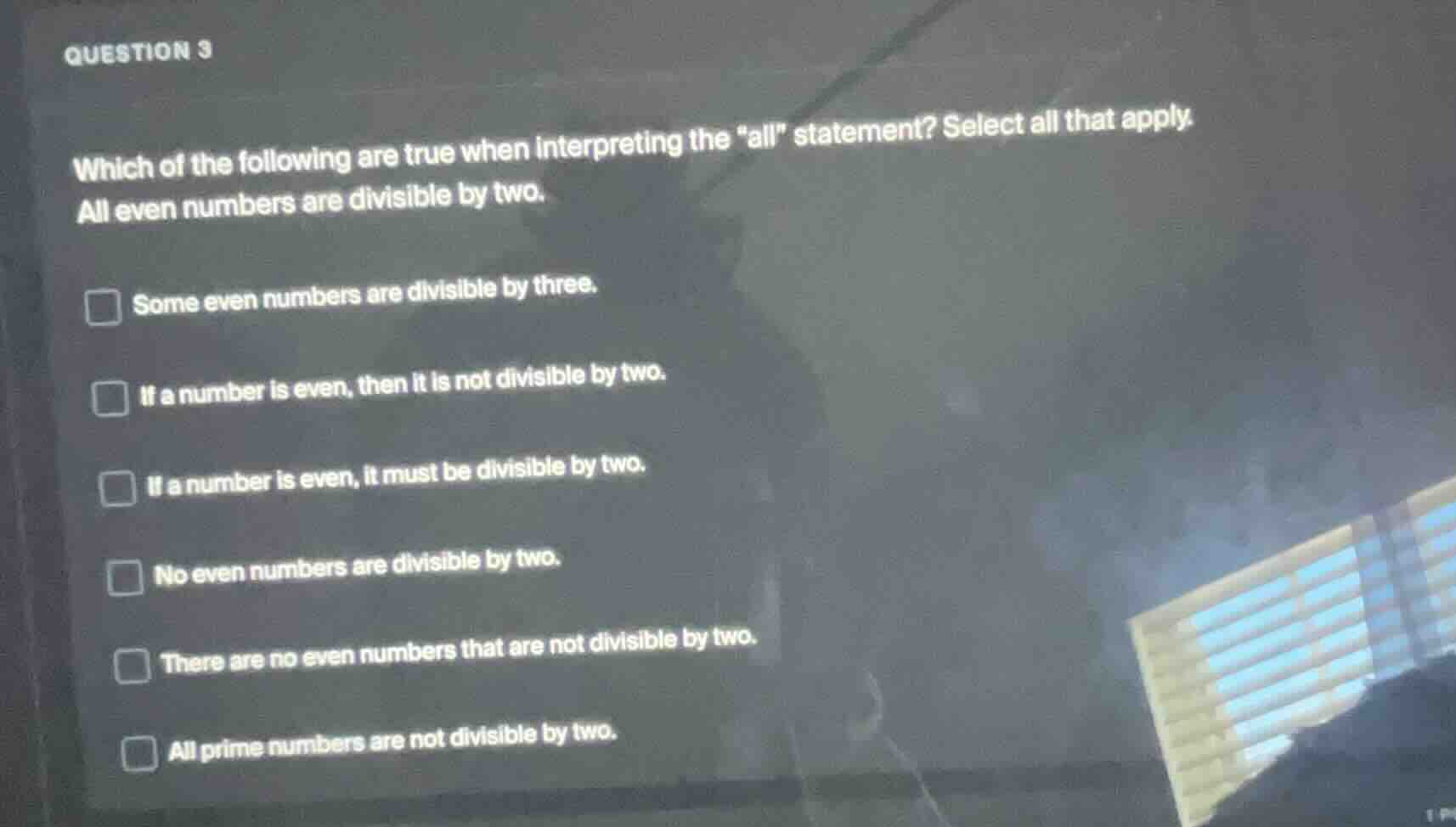
which of the following are true when interpreting the \all\ statement? select all that apply.
all even numbers are divisible by two.
□ some even numbers are divisible by three.
□ if a number is even, then it is not divisible by two.
□ if a number is even, it must be divisible by two.
□ no even numbers are divisible by two.
□ there are no even numbers that are not divisible by two.
□ all prime numbers are not divisible by two.
Brief Explanations
- "Some even numbers are divisible by three": True (e.g., 6, 12 are even and divisible by 3), and this does not contradict the original "all even numbers are divisible by two" statement.
- "If a number is even, then it is not divisible by two": Directly contradicts the original statement, so false.
- "If a number is even, it must be divisible by two": This is a direct restatement of the original "all" statement, so true.
- "No even numbers are divisible by two": Directly contradicts the original statement, so false.
- "There are no even numbers that are not divisible by two": This is logically equivalent to the original statement (all even numbers are divisible by two means there are no exceptions), so true.
- "All prime numbers are not divisible by two": False, because 2 is a prime number that is divisible by two.

Snap & solve any problem in the app
Get step-by-step solutions on Sovi AI
Photo-based solutions with guided steps
Explore more problems and detailed explanations
- Some even numbers are divisible by three.
- If a number is even, it must be divisible by two.
- There are no even numbers that are not divisible by two.