QUESTION IMAGE
Question
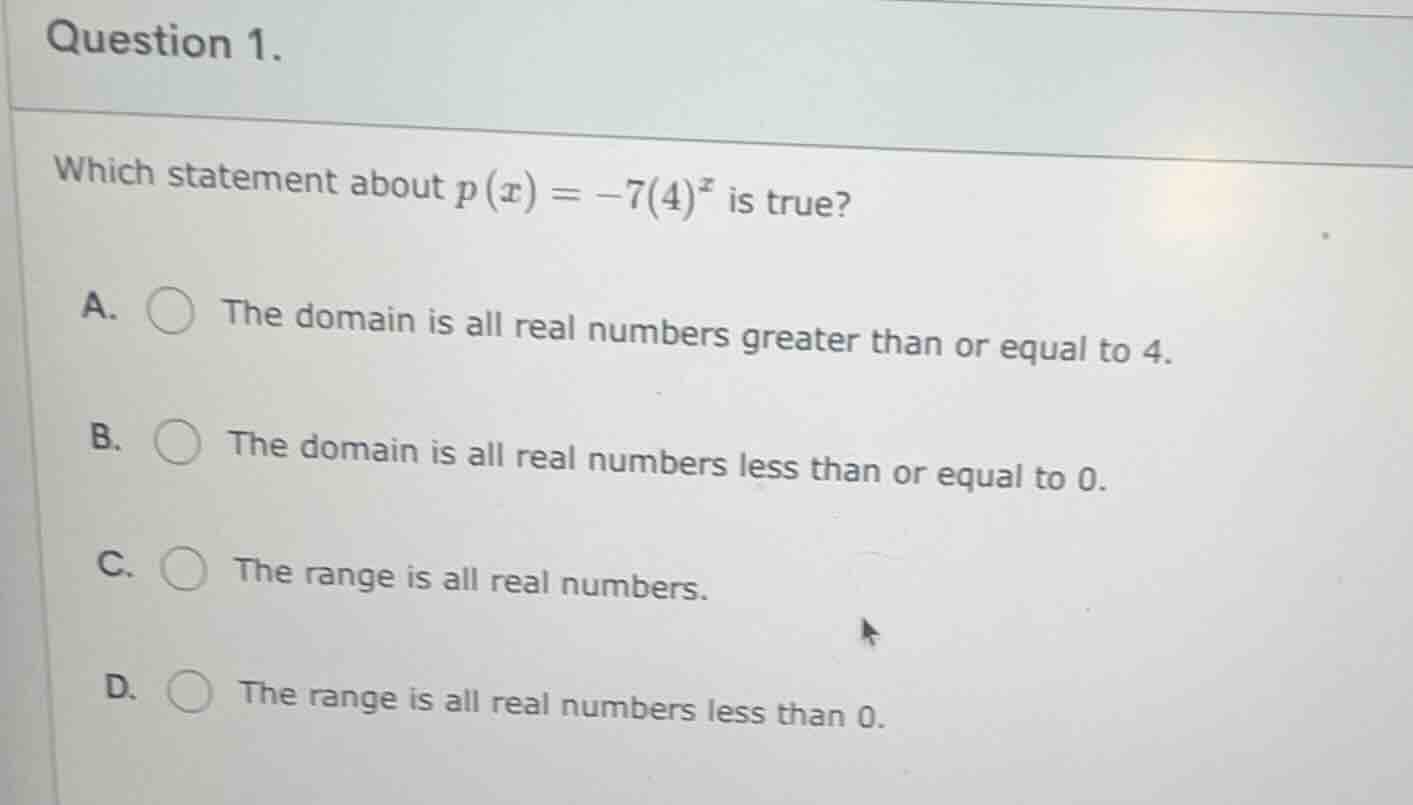
question 1. which statement about $p(x) = -7(4)^x$ is true? a. the domain is all real numbers greater than or equal to 4. b. the domain is all real numbers less than or equal to 0. c. the range is all real numbers. d. the range is all real numbers less than 0.
Step1: Analyze the domain of the exponential function
For the function \( p(x) = -7(4)^{x} \), the base of the exponential function is \( 4 \), and the exponent \( x \) can be any real number. So the domain of an exponential function of the form \( a(b)^{x} \) (where \( b>0, b
eq1 \)) is all real numbers. So options A and B are incorrect because they restrict the domain unnecessarily.
Step2: Analyze the range of the exponential function
First, recall the behavior of \( 4^{x} \). For any real number \( x \), \( 4^{x}>0 \) (since the exponential function with base \( b > 1 \) is always positive for all real \( x \)). Then, multiply by \( - 7 \): when we multiply a positive number by \( -7 \), we get a negative number. So \( -7\times4^{x}<0 \) for all real \( x \). Also, as \( x
ightarrow+\infty \), \( 4^{x}
ightarrow+\infty \), so \( -7\times4^{x}
ightarrow-\infty \); as \( x
ightarrow-\infty \), \( 4^{x}
ightarrow0 \), so \( -7\times4^{x}
ightarrow0 \) (but never actually reaches \( 0 \)). So the range of \( p(x) \) is all real numbers less than \( 0 \). Option C is incorrect because the range is not all real numbers (it doesn't include non - negative numbers), and option D is correct.

Snap & solve any problem in the app
Get step-by-step solutions on Sovi AI
Photo-based solutions with guided steps
Explore more problems and detailed explanations
D. The range is all real numbers less than 0.