QUESTION IMAGE
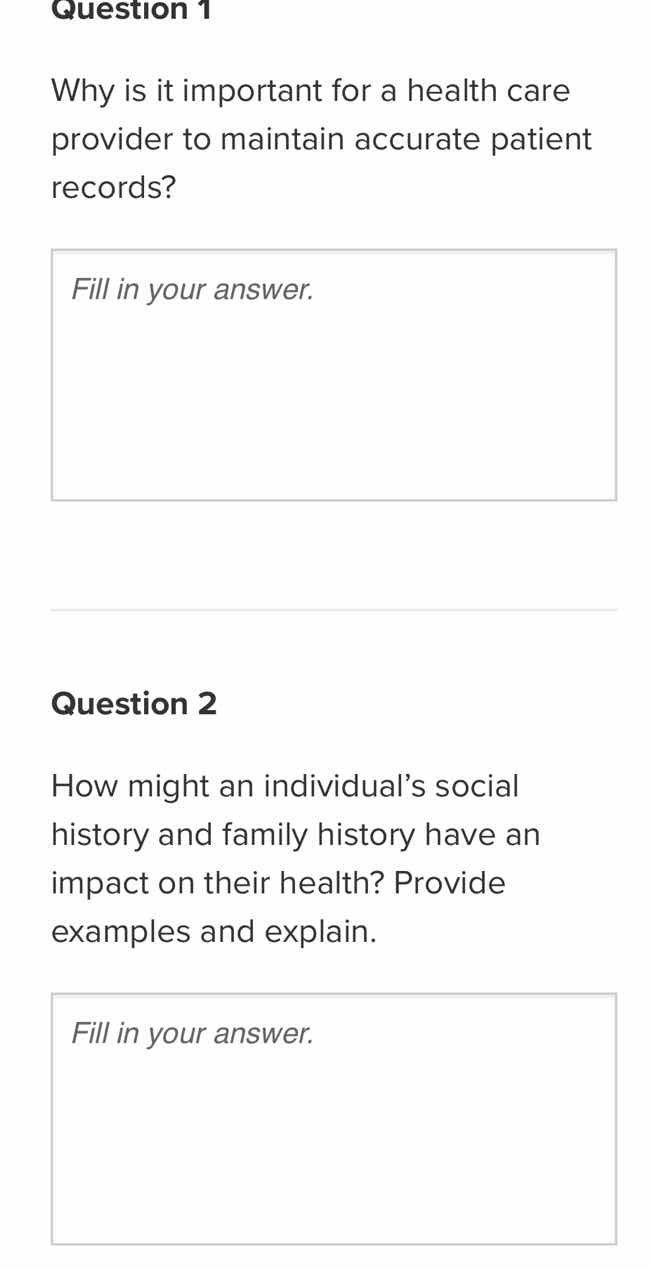
Question
question 1
why is it important for a health care provider to maintain accurate patient records?
fill in your answer.
question 2
how might an individual’s social history and family history have an impact on their health? provide examples and explain.
fill in your answer.
Brief Explanations
For Question 1:
- Clinical Care Accuracy: Ensures providers have complete, up-to-date data to make correct diagnoses and prescribe safe, effective treatments (e.g., avoiding allergic medications noted in records).
- Continuity of Care: Allows seamless transitions between care teams (e.g., a specialist accessing a primary care record to understand a patient's ongoing conditions).
- Legal and Compliance: Serves as a legal document to verify care provided, protect against liability, and meet regulatory requirements.
- Public Health Tracking: Aggregate accurate records help monitor disease trends, identify outbreaks, and inform public health policies.
For Question 2:
- Social History Impact: Social factors shape daily health behaviors and access to care. For example, a person with a low-income social background may lack access to affordable, nutrient-dense food, leading to chronic conditions like type 2 diabetes. A person with a history of high-stress employment (e.g., long-hour shift work) may have elevated risk of hypertension due to consistent stress hormone release.
- Family History Impact: Genetic and shared environmental factors increase disease risk. For example, if a patient has a parent and sibling with breast cancer, their genetic predisposition (e.g., BRCA gene mutation) means they have a significantly higher risk of developing the disease themselves. A family history of cardiovascular disease raises risk due to inherited genetic factors and shared lifestyle habits like a high-fat diet.

Snap & solve any problem in the app
Get step-by-step solutions on Sovi AI
Photo-based solutions with guided steps
Explore more problems and detailed explanations
- Accurate patient records are critical for: ensuring safe, correct clinical decision-making; enabling smooth continuity of care between providers; fulfilling legal, regulatory, and liability requirements; and supporting public health monitoring and policy development.
- - Social history: A low-income individual may face food insecurity, leading to type 2 diabetes; a shift worker with high job stress may develop hypertension from chronic stress hormone exposure.
- Family history: A person with first-degree relatives with BRCA-related breast cancer has a heightened genetic risk of the disease; someone with a family history of heart disease faces elevated risk due to inherited genes and shared unhealthy lifestyle habits.