QUESTION IMAGE
Question
question 2
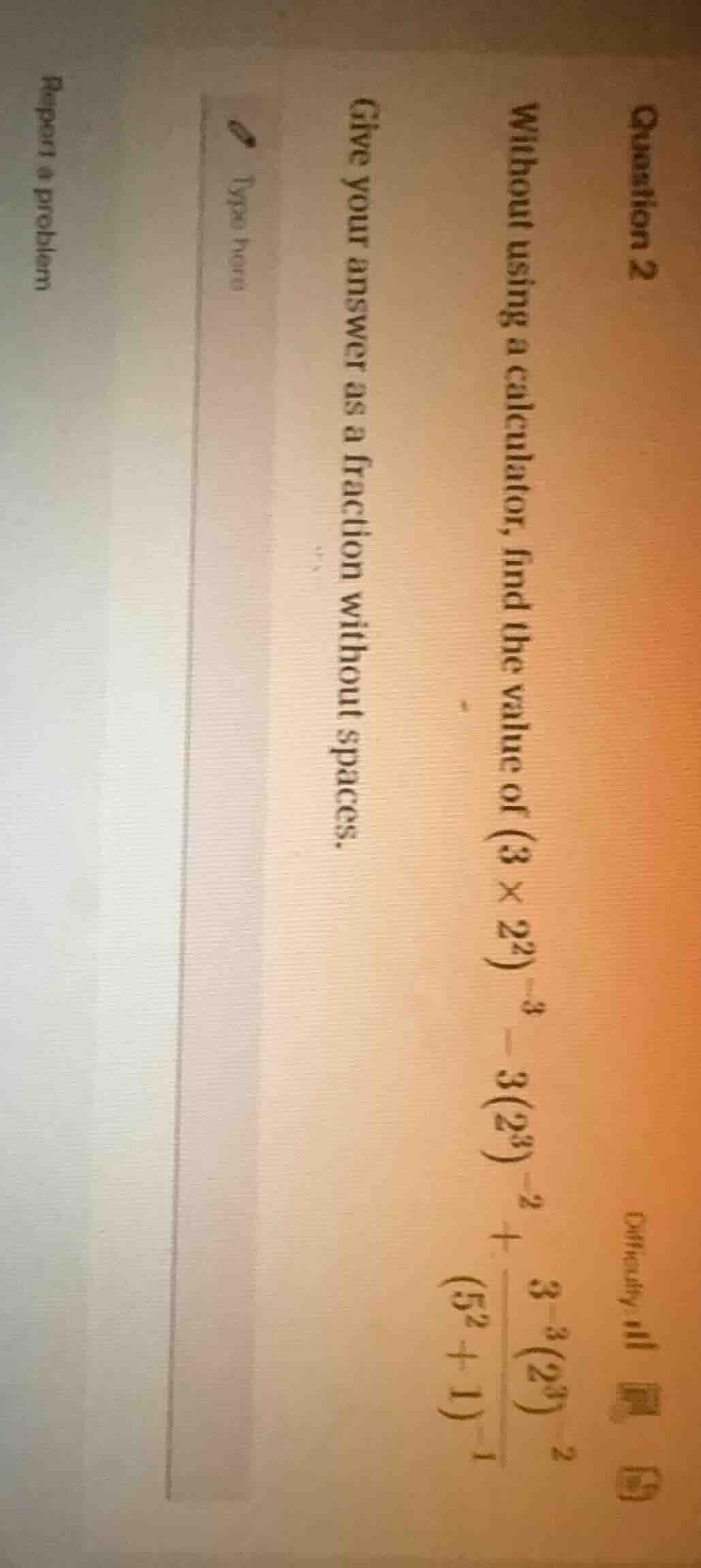
without using a calculator, find the value of ((3 \times 2^2)^{-3} - 3(2^3)^{-2} + \frac{3^{-3}(2^3)^{-2}}{(5^2 + 1)^{-1}}
give your answer as a fraction without spaces.
Step1: Simplify each term using exponent rules
First, recall the exponent rules: \( (ab)^n = a^n b^n \), \( (a^m)^n = a^{mn} \), \( a^{-n} = \frac{1}{a^n} \), and \( (a + b)^{-1}=\frac{1}{a + b} \).
Term 1: \( (3\times2^2)^{-3} \)
First, calculate \( 2^2 = 4 \), then \( 3\times4 = 12 \). So \( (12)^{-3}=\frac{1}{12^3}=\frac{1}{1728} \).
Term 2: \( -3(2^3)^{-2} \)
Calculate \( 2^3 = 8 \), then \( (8)^{-2}=\frac{1}{8^2}=\frac{1}{64} \). Multiply by -3: \( -3\times\frac{1}{64}=-\frac{3}{64} \).
Term 3: \( \frac{3^{-3}(2^3)^{-2}}{(5^2 + 1)^{-1}} \)
First, simplify numerator and denominator separately.
- Numerator: \( 3^{-3}=\frac{1}{3^3}=\frac{1}{27} \), \( (2^3)^{-2}=2^{-6}=\frac{1}{2^6}=\frac{1}{64} \). Multiply them: \( \frac{1}{27}\times\frac{1}{64}=\frac{1}{1728} \).
- Denominator: \( 5^2 + 1 = 25 + 1 = 26 \), so \( (26)^{-1}=\frac{1}{26} \).
Now, divide the numerator by the denominator: \( \frac{\frac{1}{1728}}{\frac{1}{26}}=\frac{1}{1728}\times26=\frac{26}{1728}=\frac{13}{864} \).
Step2: Combine all terms
Now, add the three terms together:
\( \frac{1}{1728}-\frac{3}{64}+\frac{13}{864} \)
First, find a common denominator. The least common multiple of 1728, 64, and 864. Notice that 1728 is a multiple of 64 (1728 ÷ 64 = 27) and 864 (1728 ÷ 864 = 2). So common denominator is 1728.
- \( -\frac{3}{64}=-\frac{3\times27}{64\times27}=-\frac{81}{1728} \)
- \( \frac{13}{864}=\frac{13\times2}{864\times2}=\frac{26}{1728} \)
Now, substitute back:
\( \frac{1}{1728}-\frac{81}{1728}+\frac{26}{1728}=\frac{1 - 81 + 26}{1728}=\frac{-54}{1728} \)
Simplify the fraction: divide numerator and denominator by 18: \( \frac{-54\div18}{1728\div18}=\frac{-3}{96} \), divide by 3 again: \( \frac{-1}{32} \)
Wait, let's check the calculations again for errors.
Wait, let's re - calculate Term 3:
Numerator: \( 3^{-3}(2^3)^{-2}=3^{-3}\times2^{-6}=\frac{1}{3^3}\times\frac{1}{2^6}=\frac{1}{27}\times\frac{1}{64}=\frac{1}{1728} \)
Denominator: \( (5^2 + 1)^{-1}=(25 + 1)^{-1}=26^{-1}=\frac{1}{26} \)
So \( \frac{\frac{1}{1728}}{\frac{1}{26}}=\frac{26}{1728}=\frac{13}{864} \) (correct)
Term 1: \( (3\times2^2)^{-3}=(3\times4)^{-3}=12^{-3}=\frac{1}{12^3}=\frac{1}{1728} \) (correct)
Term 2: \( -3(2^3)^{-2}=-3\times(8)^{-2}=-3\times\frac{1}{64}=-\frac{3}{64} \). Convert to denominator 1728: \( -\frac{3}{64}=-\frac{3\times27}{64\times27}=-\frac{81}{1728} \) (correct)
Now, \( \frac{1}{1728}-\frac{81}{1728}+\frac{13}{864} \)
Convert \( \frac{13}{864} \) to \( \frac{26}{1728} \) (since 864×2 = 1728, 13×2 = 26)
So \( \frac{1-81 + 26}{1728}=\frac{-54}{1728} \)
Simplify \( \frac{-54}{1728} \): divide numerator and denominator by 18: \( \frac{-3}{96} \), divide by 3: \( \frac{-1}{32} \)
Wait, but let's check the original expression again. Maybe I misread the expression. Let's re - examine the original problem:
The expression is \( (3\times2^2)^{-3}-3(2^3)^{-2}+\frac{3^{-3}(2^3)^{-2}}{(5^2 + 1)^{-1}} \)
Wait, in the third term, is it \( (2^3)^{-2} \) or \( (2^2)^{-3} \)? Wait, the original problem: \( \frac{3^{-3}(2^3)^{-2}}{(5^2 + 1)^{-1}} \)
Wait, let's recalculate Term 3:
\( 3^{-3}=\frac{1}{27} \), \( (2^3)^{-2}=2^{-6}=\frac{1}{64} \), so numerator is \( \frac{1}{27}\times\frac{1}{64}=\frac{1}{1728} \)
Denominator: \( (5^2 + 1)^{-1}=\frac{1}{26} \)
So \( \frac{\frac{1}{1728}}{\frac{1}{26}}=\frac{26}{1728}=\frac{13}{864} \)
Term 1: \( (3\times2^2)^{-3}=(12)^{-3}=\frac{1}{1728} \)
Term 2: \( -3\times(2^3)^{-2}=-3\times\frac{1}{64}=-\frac{3}{64} \)
Now, let's convert all terms to 1728 denominator:
\( \frac{1}{1728}-\frac{3\times27}{64\times27}…

Snap & solve any problem in the app
Get step-by-step solutions on Sovi AI
Photo-based solutions with guided steps
Explore more problems and detailed explanations
\(-\frac{1}{32}\)