QUESTION IMAGE
Question
question
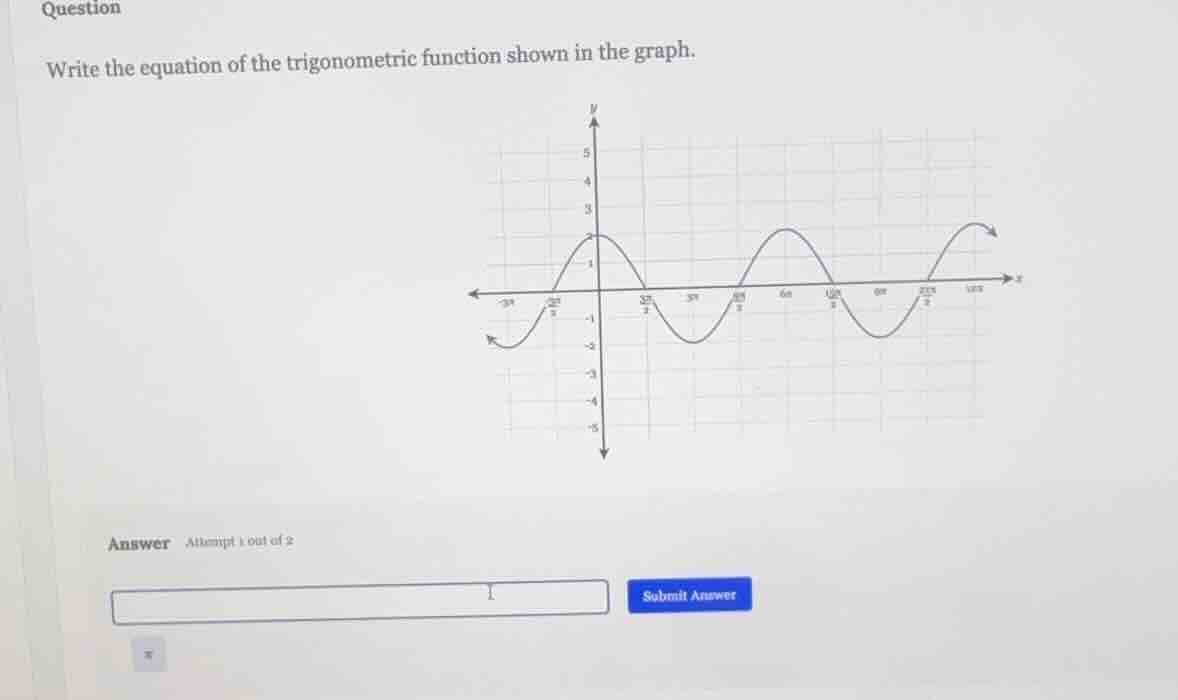
write the equation of the trigonometric function shown in the graph.
answer attempt 1 out of 2
submit answer
Step1: Identify the type of trigonometric function
The graph appears to be a cosine function (starts at a maximum) or a sine function shifted. Let's check the amplitude, period, vertical shift, etc.
Step2: Determine the amplitude (A)
The maximum value is 2 and minimum is -2? Wait, looking at the graph, the peak is at y=2? Wait, no, the grid: from the graph, the maximum y is 2? Wait, no, the y-axis has marks: 5,4,3,2,1,0,-1,-2,-3,-4,-5. Wait, the peak is at y=2? Wait, no, the graph reaches up to y=2? Wait, no, the first peak is at (0, 2)? Wait, no, the grid lines: maybe the amplitude is 2? Wait, no, let's check the period.
Step3: Determine the period (T)
The distance between two consecutive peaks or troughs. Let's see the x-values: from 0 to 2π? Wait, no, looking at the x-axis: the first peak at 0, then next peak at 2π? No, wait the x-axis has marks: -3π, -π/2, 0, π/2, 3π/2, 2π, 5π/2, 3π, 7π/2, 4π, 9π/2, 5π. Wait, the distance between 0 and 2π? No, wait the period: from 0 to 2π, is that the period? Wait, no, the graph repeats every 2π? Wait, no, let's check the distance between two consecutive peaks. The first peak at 0, next peak at 2π? No, wait the x-axis: the first peak at 0, then next peak at 2π? Wait, no, the x-axis marks: 0, 2π? Wait, no, the x-axis has 0, π/2, 3π/2, 2π, 5π/2, 3π, etc. Wait, the distance between 0 and 2π: is that the period? Wait, no, the graph from 0 to 2π: how many cycles? Wait, maybe the period is 2π? Wait, no, let's check the standard cosine function: y = A cos(Bx) + C.
Step4: Determine the vertical shift (C)
The midline (vertical shift) is the average of max and min. If max is 2 and min is -2, then midline is 0. So C=0.
Step5: Determine the amplitude (A)
Amplitude is |max - min| / 2. If max is 2 and min is -2, then amplitude A=2.
Step6: Determine the period and B
The period of a cosine function is T = 2π / |B|. Let's find the period. From the graph, the distance between two consecutive peaks: from 0 to 2π? Wait, no, looking at the x-axis, the first peak at 0, next peak at 2π? Wait, no, the x-axis has 0, then 2π? Wait, no, the x-axis marks: 0, π/2, 3π/2, 2π, 5π/2, 3π, etc. Wait, the distance between 0 and 2π: is that the period? Wait, no, the graph from 0 to 2π: how many cycles? Wait, maybe the period is 2π? Wait, no, let's check the x-axis: the first peak at 0, then next peak at 2π? No, wait the x-axis: the first peak at 0, then next peak at 2π? Wait, no, the x-axis has 0, 2π? Wait, no, the x-axis marks: -3π, -π/2, 0, π/2, 3π/2, 2π, 5π/2, 3π, 7π/2, 4π, 9π/2, 5π. So the distance between 0 and 2π: is that the period? Wait, no, the graph from 0 to 2π: the function goes from (0, 2) down to (π/2, 0), then to (π, -2), then to (3π/2, 0), then to (2π, 2). Wait, that's a period of 2π? Wait, no, that's a period of 2π? Wait, no, the standard cosine function has period 2π, amplitude 1, midline 0. But here, the amplitude is 2? Wait, no, in the graph, the maximum is 2 and minimum is -2, so amplitude A=2. The period is 2π, so B=1 (since T=2π / |B| => 2π = 2π / |B| => |B|=1). The vertical shift C=0 (midline at y=0). So the function is y = 2 cos(x)? Wait, no, wait the first peak is at (0, 2), then next peak at (2π, 2), so period is 2π, amplitude 2, no phase shift, no vertical shift. Wait, but let's check the graph again. Wait, the y-axis: the peak is at y=2? Wait, the grid lines: the y-axis has 2 as a mark? Wait, the graph shows the peak at (0, 2), then goes down to (π/2, 0), then to (π, -2), then to (3π/2, 0), then to (2π, 2). So that's a cosine function with amplitude 2, period 2π, so equation is y…

Snap & solve any problem in the app
Get step-by-step solutions on Sovi AI
Photo-based solutions with guided steps
Explore more problems and detailed explanations
\( y = 2\cos(x) \)