QUESTION IMAGE
Question
question 4
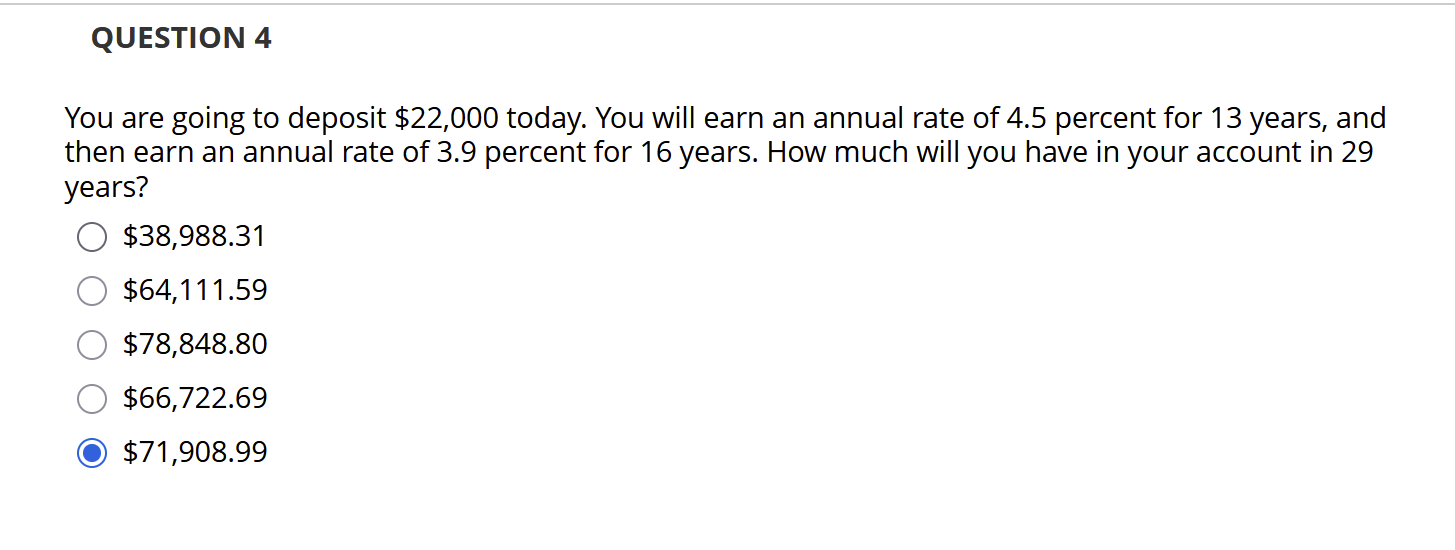
you are going to deposit $22,000 today. you will earn an annual rate of 4.5 percent for 13 years, and then earn an annual rate of 3.9 percent for 16 years. how much will you have in your account in 29 years?
○ $38,988.31
○ $64,111.59
○ $78,848.80
○ $66,722.69
○ $71,908.99
Step1: Calculate the future value after 13 years
The formula for compound interest is $FV = PV(1 + r)^n$, where $PV$ is the present value, $r$ is the annual interest rate, and $n$ is the number of years.
Here, $PV = 22000$, $r_1 = 0.045$, $n_1 = 13$.
So, $FV_1 = 22000(1 + 0.045)^{13}$
Calculate $(1 + 0.045)^{13} \approx 1.045^{13} \approx 1.7722$
Then $FV_1 = 22000\times1.7722 \approx 38988.4$
Step2: Calculate the future value after the next 16 years
Now, the present value for the next period is $FV_1$, $r_2 = 0.039$, $n_2 = 16$.
Using the compound interest formula again: $FV_2 = FV_1(1 + r_2)^{16}$
Substitute $FV_1 \approx 38988.4$, $r_2 = 0.039$, $n_2 = 16$.
First, calculate $(1 + 0.039)^{16} \approx 1.039^{16} \approx 1.844$
Then $FV_2 = 38988.4\times1.844 \approx 71908.99$

Snap & solve any problem in the app
Get step-by-step solutions on Sovi AI
Photo-based solutions with guided steps
Explore more problems and detailed explanations
\$71,908.99