QUESTION IMAGE
Question
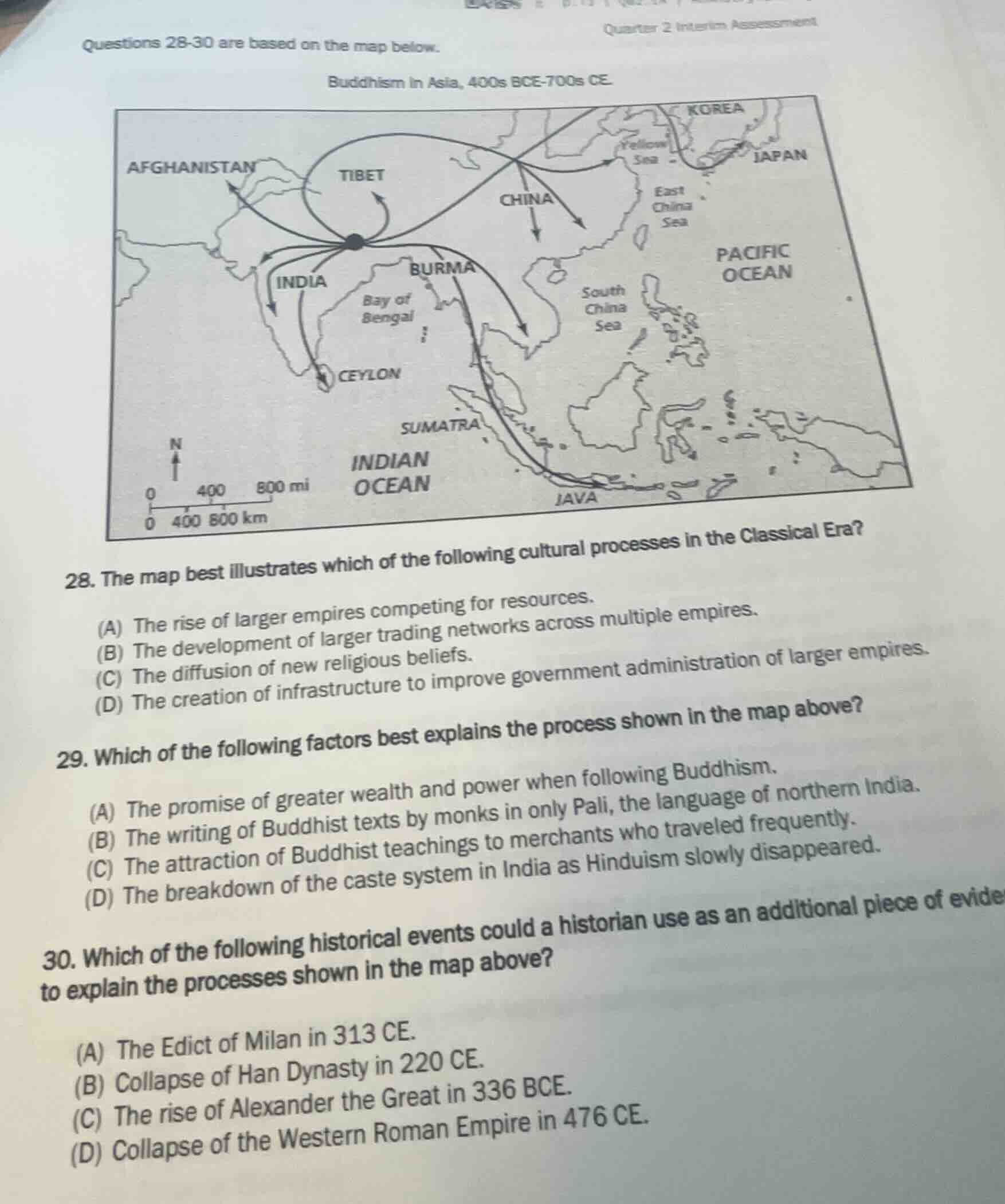
questions 28-30 are based on the map below.
buddhism in asia, 400s bce-700s ce
- the map best illustrates which of the following cultural processes in the classical era?
(a) the rise of larger empires competing for resources.
(b) the development of larger trading networks across multiple empires.
(c) the diffusion of new religious beliefs.
(d) the creation of infrastructure to improve government administration of larger empires.
- which of the following factors best explains the process shown in the map above?
(a) the promise of greater wealth and power when following buddhism.
(b) the writing of buddhist texts by monks in only pali, the language of northern india.
(c) the attraction of buddhist teachings to merchants who traveled frequently.
(d) the breakdown of the caste system in india as hinduism slowly disappeared.
- which of the following historical events could a historian use as an additional piece of evide
to explain the processes shown in the map above?
(a) the edict of milan in 313 ce.
(b) collapse of han dynasty in 220 ce.
(c) the rise of alexander the great in 336 bce.
(d) collapse of the western roman empire in 476 ce.
Question 28
The map is titled "Buddhism in Asia, 400s BCE - 700s CE" and shows the spread of Buddhism from India to other regions like China, Korea, Japan, etc. Option A is about empires competing for resources, which the map doesn't show. Option B is about trading networks, but the map is about religion, not trade. Option D is about infrastructure for government administration, which is not related to the spread of a religion. Option C is about the diffusion (spread) of new religious beliefs, which matches the spread of Buddhism shown in the map.
To explain the spread of Buddhism (the process in the map), we analyze the options. Option A: Buddhism doesn't promise greater wealth and power in that way, so incorrect. Option B: Buddhist texts were not limited to Pali, and this doesn't explain spread. Option C: Merchants traveled frequently and were attracted to Buddhist teachings, which would help spread Buddhism as they moved between regions, this is a valid factor. Option D: The caste system didn't break down in India with Hinduism disappearing (Hinduism continued), so incorrect.
We need an event related to the spread of Buddhism in Asia. Option A: Edict of Milan is about Christianity in Rome, not related. Option B: Collapse of Han Dynasty (220 CE) led to a period of disunity in China, which allowed for the spread of Buddhism as people sought new beliefs, and this is in the time frame of Buddhist spread in Asia. Option C: Rise of Alexander the Great is in the West, not related to Asian Buddhism spread. Option D: Collapse of Western Roman Empire is in the West, not related to Asian Buddhism.

Snap & solve any problem in the app
Get step-by-step solutions on Sovi AI
Photo-based solutions with guided steps
Explore more problems and detailed explanations
C. The diffusion of new religious beliefs.