QUESTION IMAGE
Question
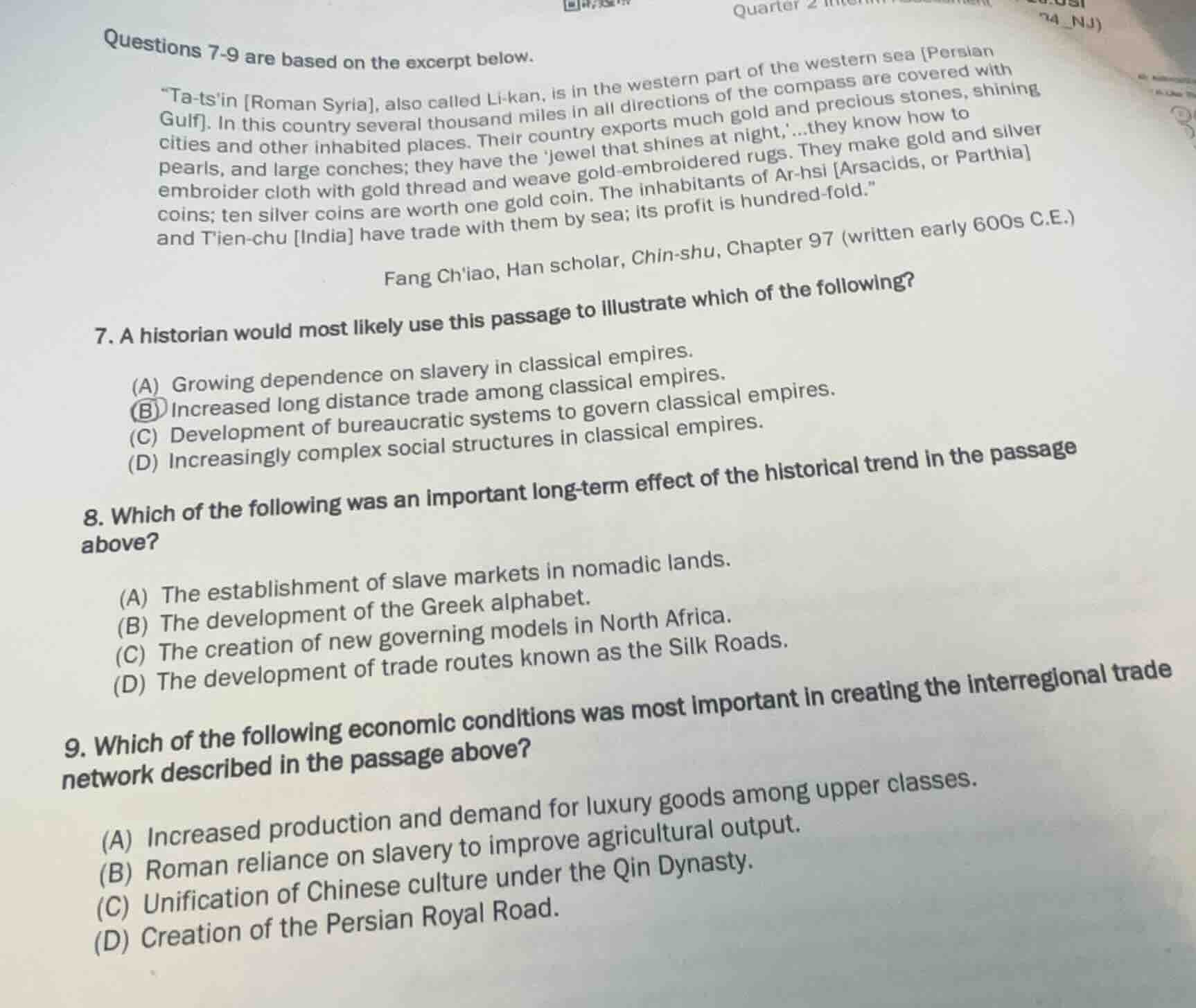
questions 7-9 are based on the excerpt below.
\ta-tsin roman syria, also called li-kan, is in the western part of the western sea persian gulf. in this country several thousand miles in all directions of the compass are covered with cities and other inhabited places. their country exports much gold and precious stones, shining pearls, and large conches; they have the jewel that shines at night,...they know how to embroider cloth with gold thread and weave gold-embroidered rugs. they make gold and silver coins; ten silver coins are worth one gold coin. the inhabitants of ar-hsi arsacids, or parthia and tien-chu india have trade with them by sea; its profit is hundred-fold.\
fang chiao, han scholar, chin-shu, chapter 97 (written early 600s c.e.)
- a historian would most likely use this passage to illustrate which of the following?
(a) growing dependence on slavery in classical empires.
(b) increased long distance trade among classical empires.
(c) development of bureaucratic systems to govern classical empires.
(d) increasingly complex social structures in classical empires.
- which of the following was an important long-term effect of the historical trend in the passage above?
(a) the establishment of slave markets in nomadic lands.
(b) the development of the greek alphabet.
(c) the creation of new governing models in north africa.
(d) the development of trade routes known as the silk roads.
- which of the following economic conditions was most important in creating the interregional trade network described in the passage above?
(a) increased production and demand for luxury goods among upper classes.
(b) roman reliance on slavery to improve agricultural output.
(c) unification of chinese culture under the qin dynasty.
(d) creation of the persian royal road.
Question 7
The passage describes trade between Roman Syria, Parthia, and India. Option A is incorrect as there's no mention of slavery. Option C is wrong as bureaucracy isn't discussed. Option D is incorrect as social structures aren't a focus. Option B matches the trade between classical empires (Roman Syria, Parthia, India) over long distances.
The passage's trend is long - distance trade. Option A is incorrect as slavery isn't in the passage. Option B is wrong as the Greek alphabet isn't related. Option C is incorrect as governing models in North Africa aren't discussed. Option D is correct because the Silk Roads were major interregional trade routes that developed from such long - distance trade.
The passage mentions luxury goods (gold, precious stones, pearls, etc.) being traded. Option A is correct as increased production and demand for luxury goods among upper classes would drive interregional trade. Option B is wrong as slavery for agriculture isn't in the passage. Option C is incorrect as Qin unification of Chinese culture isn't related to this trade. Option D is wrong as the Persian Royal Road is not the focus here.

Snap & solve any problem in the app
Get step-by-step solutions on Sovi AI
Photo-based solutions with guided steps
Explore more problems and detailed explanations
B. Increased long distance trade among classical empires.