QUESTION IMAGE
Question
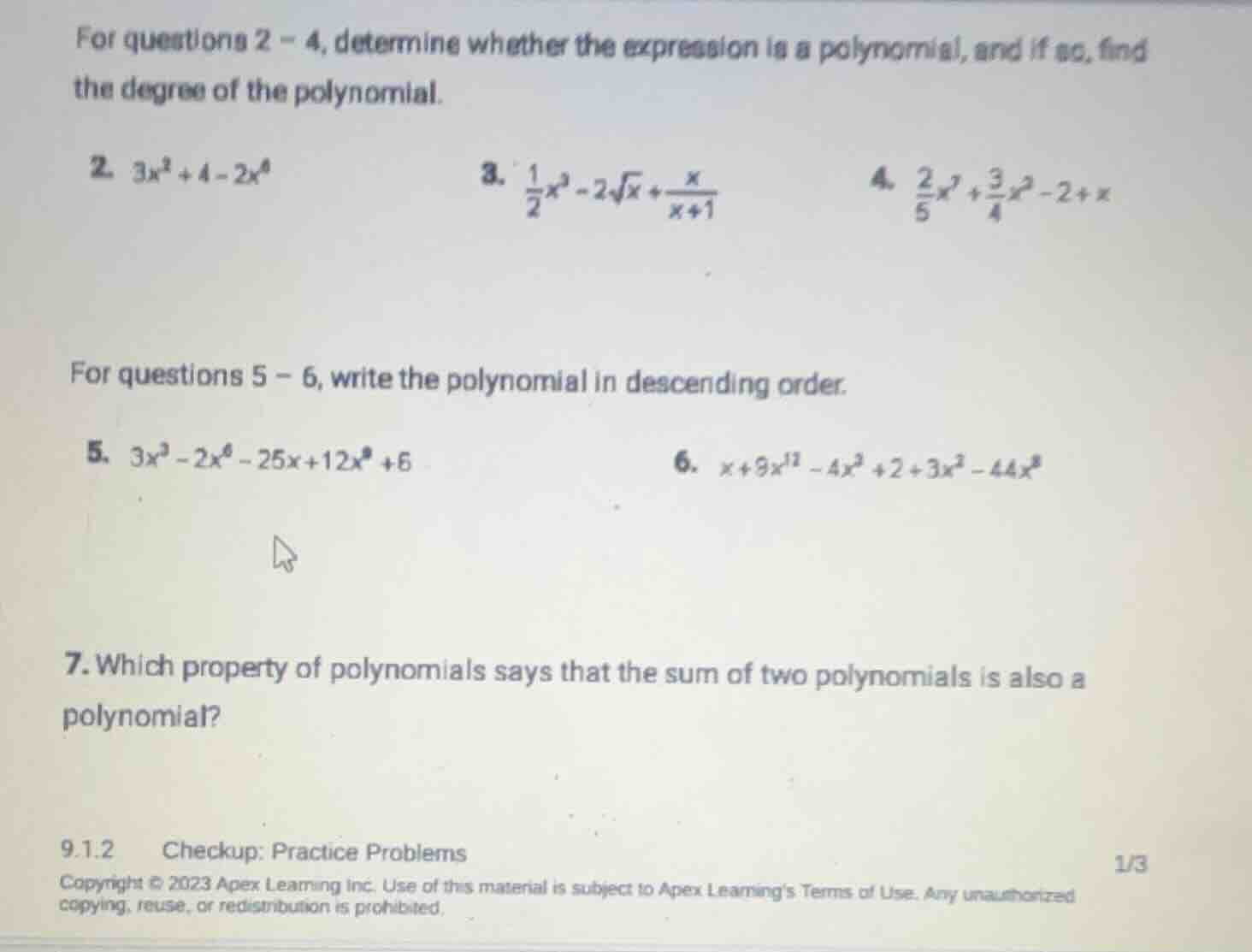
for questions 2 - 4, determine whether the expression is a polynomial, and if so, find the degree of the polynomial.
- $3x^8 + 4 - 2x^4$ 3. $\frac{1}{2}x^3 - 2sqrt{x} + \frac{x}{x + 1}$ 4. $\frac{2}{5}x^7 + \frac{3}{4}x^2 - 2 + x$
for questions 5 - 6, write the polynomial in descending order.
- $3x^3 - 2x^6 - 25x + 12x^9 + 6$ 6. $x + 9x^{12} - 4x^3 + 2 + 3x^2 - 44x^8$
- which property of polynomials says that the sum of two polynomials is also a polynomial?
9.1.2 checkup: practice problems
copyright © 2023 apex learning inc. use of this material is subject to apex learning’s terms of use. any unauthorized copying, reuse, or redistribution is prohibited. 1/3
Question 2
Step1: Recall polynomial definition
A polynomial is an expression of the form \(a_nx^n + a_{n - 1}x^{n - 1}+\dots+a_1x + a_0\), where exponents are non - negative integers and coefficients are real numbers. For \(3x^{8}+4 - 2x^{4}\), rewrite it as \(- 2x^{4}+3x^{8}+4\) (or \(3x^{8}-2x^{4}+4\)). The exponents of \(x\) are \(8\), \(4\), and \(0\) (for the constant term \(4\)), all non - negative integers, and coefficients are real numbers. So it is a polynomial.
Step2: Find the degree
The degree of a polynomial is the highest power of \(x\) in the polynomial. In \(3x^{8}-2x^{4}+4\), the highest power of \(x\) is \(8\).
Step1: Analyze each term
- For the term \(\frac{1}{2}x^{3}\), it is a valid term of a polynomial (exponent \(3\) is a non - negative integer).
- For the term \(-2\sqrt{x}=-2x^{\frac{1}{2}}\), the exponent \(\frac{1}{2}\) is not a non - negative integer.
- For the term \(\frac{x}{x + 1}\), it is a rational function (a quotient of two polynomials), not a polynomial term.
Since there are terms that do not satisfy the polynomial definition, the expression is not a polynomial.
Step1: Recall polynomial definition
A polynomial is an expression of the form \(a_nx^n + a_{n - 1}x^{n - 1}+\dots+a_1x + a_0\), where exponents are non - negative integers and coefficients are real numbers. For \(\frac{2}{5}x^{7}+\frac{3}{4}x^{2}-2 + x\), rewrite it as \(\frac{2}{5}x^{7}+\frac{3}{4}x^{2}+x - 2\). The exponents of \(x\) are \(7\), \(2\), \(1\), and \(0\) (for the constant term \(-2\)), all non - negative integers, and coefficients are real numbers. So it is a polynomial.
Step2: Find the degree
The degree of a polynomial is the highest power of \(x\) in the polynomial. In \(\frac{2}{5}x^{7}+\frac{3}{4}x^{2}+x - 2\), the highest power of \(x\) is \(7\).

Snap & solve any problem in the app
Get step-by-step solutions on Sovi AI
Photo-based solutions with guided steps
Explore more problems and detailed explanations
It is a polynomial, and its degree is \(8\).