QUESTION IMAGE
Question
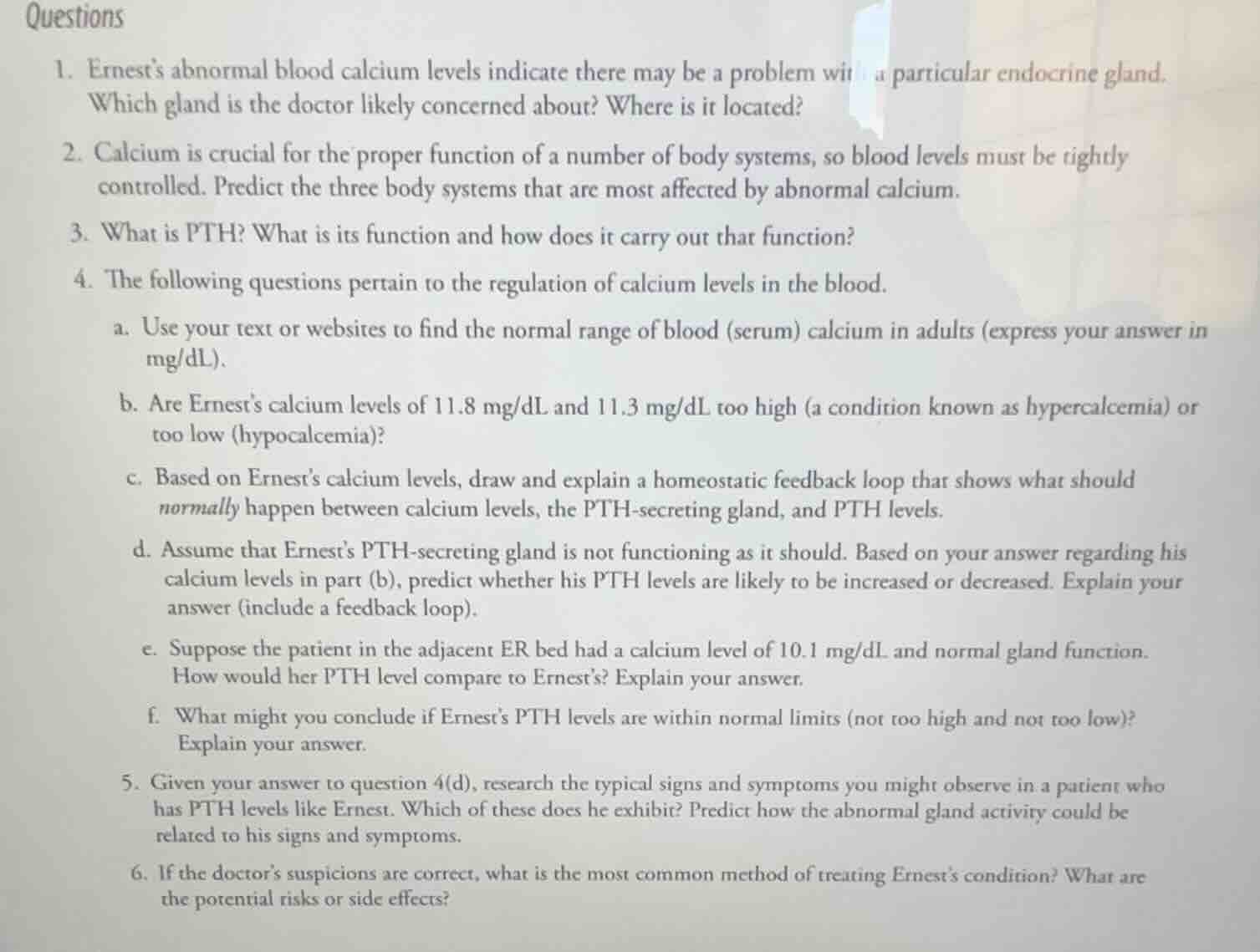
questions
- ernests abnormal blood calcium levels indicate there may be a problem with a particular endocrine gland. which gland is the doctor likely concerned about? where is it located?
- calcium is crucial for the proper function of a number of body systems, so blood levels must be tightly controlled. predict the three body systems that are most affected by abnormal calcium.
- what is pth? what is its function and how does it carry out that function?
- the following questions pertain to the regulation of calcium levels in the blood.
a. use your text or websites to find the normal range of blood (serum) calcium in adults (express your answer in mg/dl).
b. are ernests calcium levels of 11.8 mg/dl and 11.3 mg/dl too high (a condition known as hypercalcemia) or too low (hypocalcemia)?
c. based on ernests calcium levels, draw and explain a homeostatic feedback loop that shows what should normally happen between calcium levels, the pth-secreting gland, and pth levels.
d. assume that ernests pth-secreting gland is not functioning as it should. based on your answer regarding his calcium levels in part (b), predict whether his pth levels are likely to be increased or decreased. explain your answer (include a feedback loop).
e. suppose the patient in the adjacent er bed had a calcium level of 10.1 mg/dl and normal gland function. how would her pth level compare to ernests? explain your answer.
f. what might you conclude if ernests pth levels are within normal limits (not too high and not too low)? explain your answer.
- given your answer to question 4(d), research the typical signs and symptoms you might observe in a patient who has pth levels like ernest. which of these does he exhibit? predict how the abnormal gland activity could be related to his signs and symptoms.
- if the doctors suspicions are correct, what is the most common method of treating ernests condition? what are the potential risks or side effects?
- The parathyroid glands regulate blood calcium, located on the thyroid.
- Nervous, muscular, and skeletal systems rely on calcium.
- PTH (Parathyroid Hormone) raises blood calcium via bone, kidney, intestine actions.
- a. Normal adult serum calcium is a standard clinical range.
b. Compare Ernest's levels to the normal range to classify.
c. A negative feedback loop links calcium, parathyroids, and PTH.
d. Hypercalcemia with faulty parathyroids implies low PTH.
e. Normal calcium means normal PTH, higher than Ernest's low levels.
f. Normal PTH with hypercalcemia points to non-parathyroid causes.
- Low PTH (hypoparathyroidism) causes specific neuromuscular symptoms.
- Parathyroid dysfunction treatment depends on the underlying issue, with associated risks.

Snap & solve any problem in the app
Get step-by-step solutions on Sovi AI
Photo-based solutions with guided steps
Explore more problems and detailed explanations
- The doctor is likely concerned about the parathyroid glands. These four small glands are located on the posterior (back) surface of the thyroid gland in the neck.
- The three most affected body systems are:
- Nervous system: Calcium is critical for nerve impulse transmission.
- Muscular system: Calcium is required for muscle contraction (including cardiac muscle).
- Skeletal system: Calcium is the primary mineral component of bone, and bone acts as a calcium storage reservoir.
- PTH stands for Parathyroid Hormone, a hormone secreted by the parathyroid glands.
- Function: It increases blood calcium levels to maintain homeostasis.
- Mechanism:
- Stimulates osteoclasts in bone to break down bone tissue, releasing calcium into the bloodstream.
- Increases reabsorption of calcium from the filtrate in the kidneys, reducing calcium loss in urine.
- Activates vitamin D in the kidneys, which in turn increases intestinal absorption of calcium from food.
- a. The normal range of adult serum calcium is 8.5–10.5 mg/dL (total calcium).
b. Ernest's calcium levels (11.8 mg/dL and 11.3 mg/dL) are too high, meaning he has hypercalcemia.
c. Homeostatic Feedback Loop (Normal Hypercalcemia Response):
- Stimulus: Blood calcium levels rise above the normal range.
- Receptor: Parathyroid glands detect elevated calcium.
- Control Center: Parathyroid glands reduce secretion of PTH.
- Effector:
- Bone: Osteoclast activity decreases, less calcium released.
- Kidneys: Calcium reabsorption decreases, more calcium excreted; vitamin D activation decreases.
- Intestines: Calcium absorption decreases.
- Response: Blood calcium levels drop back to the normal range.
- Negative feedback: The reduced calcium level signals the parathyroid glands to increase PTH secretion if needed.
d. Ernest has hypercalcemia, and if his PTH-secreting gland is malfunctioning, his PTH levels are likely decreased.
- Explanation: Normally, high calcium levels inhibit PTH secretion. If the gland is functioning improperly, it is over-responding to the high calcium (or has lost its ability to secrete PTH), leading to low PTH levels. The feedback loop would show high calcium → parathyroid glands → decreased PTH → increased calcium excretion/decreased release → calcium levels fall (but in Ernest's case, the system is not correcting the hypercalcemia, possibly due to non-parathyroid causes or glandular failure to respond appropriately).
e. The patient with a calcium level of 10.1 mg/dL (normal range) and normal gland function will have normal PTH levels. This is higher than Ernest's predicted low PTH levels, as her calcium level is within the normal range, so her parathyroid glands are secreting PTH at a normal rate to maintain homeostasis.
f. If Ernest's PTH levels are normal despite his hypercalcemia, this suggests the hypercalcemia is not caused by overactive parathyroid glands (primary hyperparathyroidism). Instead, it is likely due to a non-parathyroid cause, such as excessive vitamin D intake, certain cancers (which can secrete a PTH-like hormone), kidney disease, or prolonged immobilization.
- If Ernest has decreased PTH levels (hypoparathyroidism), typical signs and symptoms include:
- Neuromuscular irritability: Tingling or numbness in the fingers, toes, or around the mouth (paresthesias), muscle cramps, spasms (tetany), seizures.
- Cardiovascular issues: Abnormal heart rhythms (arrhythmias), low blood pressure.
- Skin, hair, and nail changes: Dry, coarse skin; brittle nails; hair loss.
- Cognitive symptoms: Fatigue, anxiety, depression, memory problems.
- The abnormal gland activity (low PTH) leads to low calcium levels (in primary hypoparathyroidism), which increases neuromuscular excitability, causing the tingling, cramps, and spasms. The low calcium also affects cardiac and neurological function.
- The most common treatment depends on the underlying cause of the parathyroid dysfunction:
- If the issue is hypoparathyroidism (low PTH): Treatment involves calcium supplements and vitamin D (calcitriol) to maintain normal blood calcium levels.
- Risks/Side effects: Hypercalcemia (if supplements are overused), kidney stones, constipation, nausea, vomiting.
- If the issue is hyperparathyroidism (high PTH, which would contradict the earlier prediction but is a common parathyroid problem): The most common treatment is surgical removal of the overactive parathyroid gland(s) (parathyroidectomy).
- Risks/Side effects: Damage to the recurrent laryngeal nerve (hoarseness), hypoparathyroidism (if too much parathyroid tissue is removed), bleeding, infection.