QUESTION IMAGE
Question
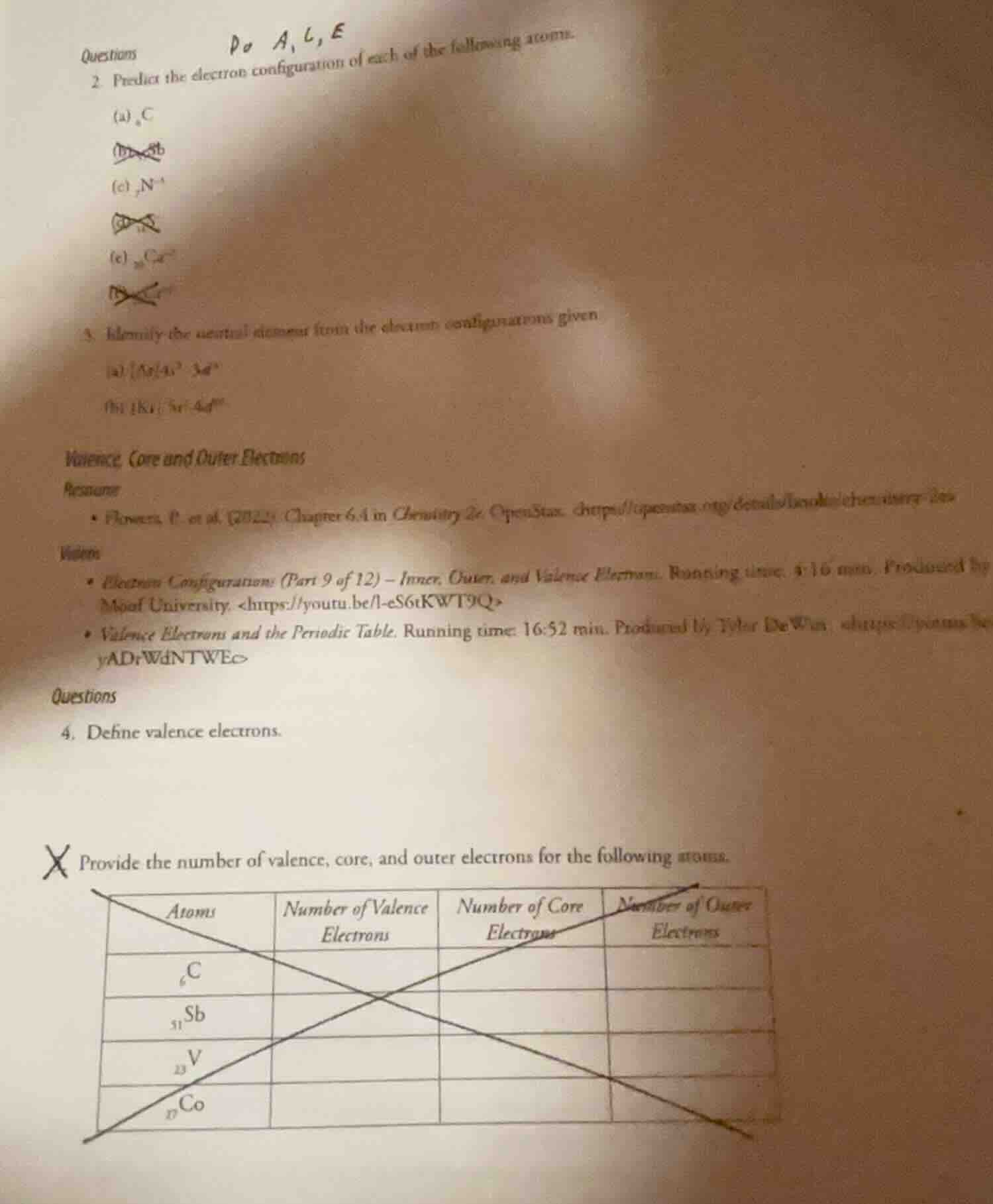
questions do a, c, e 2. predict the electron configuration of each of the following atoms. (a) _6c (b)
(c) _7n^+ (d)
(e) _20ca^2+
- identify the neutral element from the electron configurations given (a) ne4s^2 3d^8 (b) kr5s^2 4d^10
valence, core and outer electrons
resource • flowers, p. et al. (2022). chapter 6.1 in chemistry 2e. openstax. <https://openstax.org/details/books/chemistry-2e>
video • electron configuration: (part 9 of 12) – inner, outer, and valence electrons. running time: 4:16 min. produced by moof university. <https://youtu.be/l-es6tkwt9q> • valence electrons and the periodic table. running time: 16:52 min. produced by tyler dewitt. <https://youtu.be/yadrwdntwec>
questions 4. define valence electrons.
x provide the number of valence, core, and outer electrons for the following atoms.
| atoms | number of valence electrons | number of core electrons | number of outer electrons | --- | --- | --- | --- | _6c | _51sb | _23v | _27co |
Question 2(a): Predict electron configuration of \( _6\text{C} \)
Step 1: Determine atomic number
Carbon has atomic number 6, so 6 electrons.
Step 2: Apply Aufbau principle
Fill orbitals: \( 1s^2 \) (2 e⁻), \( 2s^2 \) (next 2 e⁻), remaining 2 e⁻ in \( 2p \): \( 2p^2 \).
Step 1: Find electrons in \( \text{N}^{3+} \)
Nitrogen (Z=7) loses 3 e⁻, so 7 - 3 = 4 e⁻.
Step 2: Fill orbitals
\( 1s^2 \) (2 e⁻), \( 2s^2 \) (remaining 2 e⁻).
Step 1: Electrons in \( \text{Ca}^{2+} \)
Calcium (Z=20) loses 2 e⁻, so 20 - 2 = 18 e⁻.
Step 2: Noble gas configuration
18 e⁻ match argon (Ar): \( [\text{Ar}] \) or \( 1s^2 2s^2 2p^6 3s^2 3p^6 \).

Snap & solve any problem in the app
Get step-by-step solutions on Sovi AI
Photo-based solutions with guided steps
Explore more problems and detailed explanations
\( 1s^2 2s^2 2p^2 \)