QUESTION IMAGE
Question
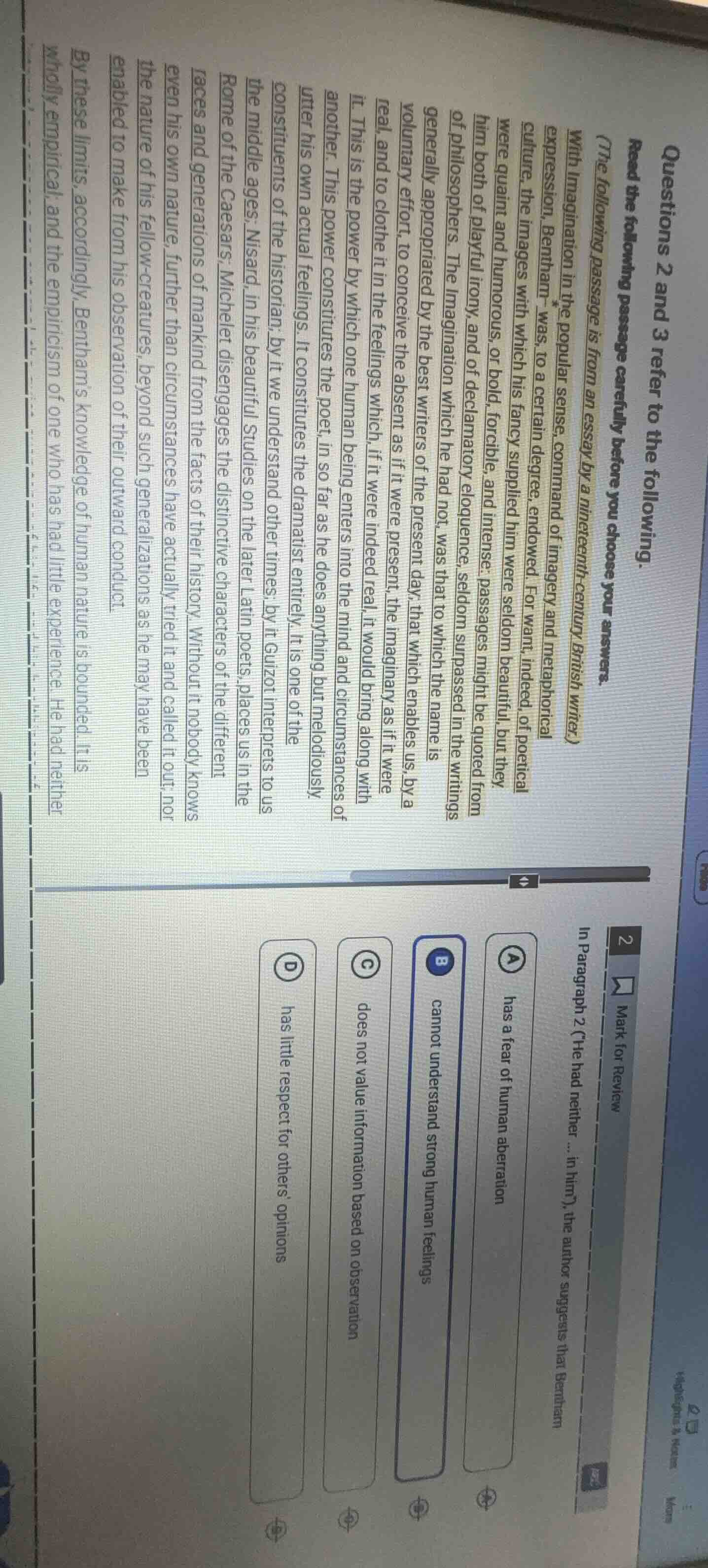
questions 2 and 3 refer to the following.read the following passage carefully before you choose your answers.(the following passage is from an essay by a nineteenth-century british writer.)with imagination in the popular sense, command of imagery and metaphorical expression, bentham* was, to a certain degree, endowed. for want, indeed, of poetical culture, the images with which his fancy supplied him were seldom beautiful, but they were quaint and humorous, or bold, forcible, and intense: passages might be quoted from him both of playful irony, and of declamatory eloquence, seldom surpassed in the writings of philosophers. the imagination which he had not, was that to which the name is generally appropriated by the best writers of the present day; that which enables us, by a voluntary effort, to conceive the absent as if it were present, the imaginary as if it were real, and to clothe it in the feelings which, if it were indeed real, it would bring along with it. this is the power by which one human being enters into the mind and circumstances of another. this power constitutes the poet, in so far as he does anything but melodiously utter his own actual feelings. it constitutes the dramatist entirely. it is one of the constituents of the historian; by it we understand other times; by it guizot interprets to us the middle ages; nisard, in his beautiful studies on the later latin poets, places us in the rome of the caesars; michelet disengages the distinctive characters of the different races and generations of mankind from the facts of their history. without it nobody knows even his own nature, further than circumstances have actually tried it and called it out; nor the nature of his fellow-creatures, beyond such generalizations as he may have been enabled to make from his observation of their outward conduct.by these limits, accordingly, benthams knowledge of human nature is bounded. it is wholly empirical; and the empiricism of one who has had little experience. he had neither2mark for reviewin paragraph 2 (\he had neither ... in him\), the author suggests that benthama has a fear of human aberrationb cannot understand strong human feelingsc does not value information based on observationd has little respect for others opinions
The passage states Bentham lacked experience of human nature beyond outward conduct, and could not grasp the imaginative, empathetic understanding of others' inner feelings (the power that defines poets and dramatists). This aligns with the idea he cannot understand strong human feelings. Other options are unsupported: there is no mention of fear of aberration, rejection of observational information, or lack of respect for others' opinions.

Snap & solve any problem in the app
Get step-by-step solutions on Sovi AI
Photo-based solutions with guided steps
Explore more problems and detailed explanations
B. cannot understand strong human feelings