QUESTION IMAGE
Question
questions
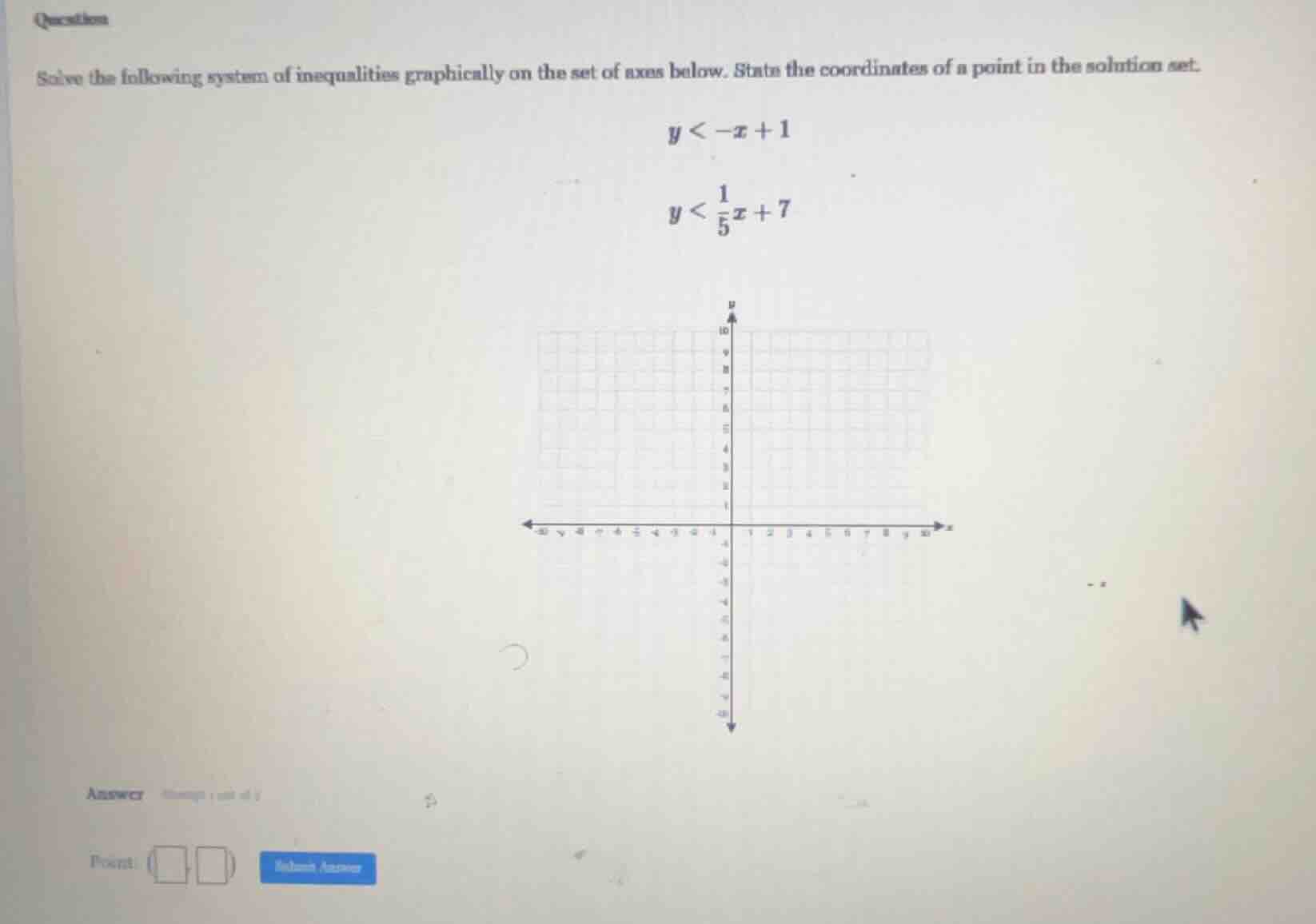
solve the following system of inequalities graphically on the set of axes below. state the coordinates of a point in the solution set.
\\( y < -x + 1 \\)
\\( y < \frac{1}{5}x + 7 \\)
answer
point ( , )
Step 1: Analyze the first inequality \( y < -x + 1 \)
The boundary line for \( y = -x + 1 \) has a slope of \(-1\) and a y - intercept of \(1\). Since the inequality is \( y < -x + 1 \), we draw a dashed line (because the inequality is strict, \(y\) is not equal to \(-x + 1\)) and shade the region below the line.
Step 2: Analyze the second inequality \( y < \frac{1}{5}x + 7 \)
The boundary line for \( y=\frac{1}{5}x + 7\) has a slope of \(\frac{1}{5}\) and a y - intercept of \(7\). Since the inequality is \(y < \frac{1}{5}x+7\), we draw a dashed line and shade the region below the line.
Step 3: Find the intersection region
The solution set of the system of inequalities is the region that is shaded for both inequalities. To find a point in the solution set, we can choose a point that satisfies both inequalities. Let's test the point \((0,0)\):
For the first inequality: \(0 < - 0+1\), which simplifies to \(0 < 1\), this is true.
For the second inequality: \(0<\frac{1}{5}(0)+7\), which simplifies to \(0 < 7\), this is also true.

Snap & solve any problem in the app
Get step-by-step solutions on Sovi AI
Photo-based solutions with guided steps
Explore more problems and detailed explanations
The point \((0,0)\) is in the solution set. (Other valid points could also be chosen, for example, \((- 5,0)\) : For \(y < -x + 1\), \(0 < -(-5)+1=6\) (true); for \(y < \frac{1}{5}x + 7\), \(0<\frac{1}{5}(-5)+7=- 1 + 7 = 6\) (true))