QUESTION IMAGE
Question
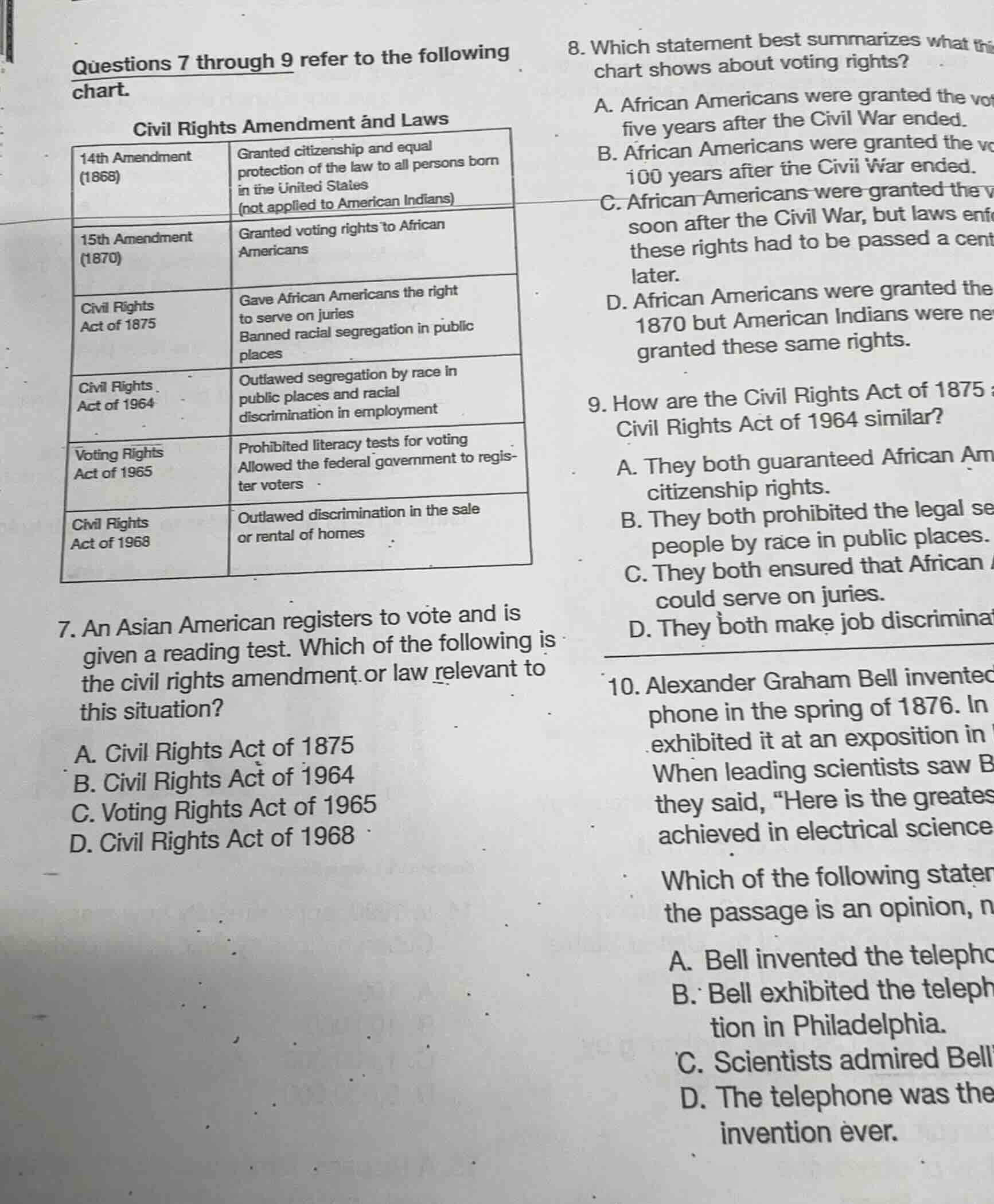
questions 7 through 9 refer to the following chart.
civil rights amendment and laws
14th amendment (1868): granted citizenship and equal protection of the law to all persons born in the united states (not applied to american indians)
15th amendment (1870): granted voting rights to african americans
civil rights act of 1875: gave african americans the right to serve on juries; banned racial segregation in public places
civil rights act of 1964: outlawed segregation by race in public places and racial discrimination in employment
voting rights act of 1965: prohibited literacy tests for voting; allowed the federal government to register voters
civil rights act of 1968: outlawed discrimination in the sale or rental of homes
- an asian american registers to vote and is given a reading test. which of the following is the civil rights amendment or law relevant to this situation?
a. civil rights act of 1875
b. civil rights act of 1964
c. voting rights act of 1965
d. civil rights act of 1968
- which statement best summarizes what the chart shows about voting rights?
a. african americans were granted the vote five years after the civil war ended.
b. african americans were granted the vote 100 years after the civil war ended.
c. african americans were granted the vote soon after the civil war, but laws enforcing these rights had to be passed a century later.
d. african americans were granted the vote 1870 but american indians were never granted these same rights.
- how are the civil rights act of 1875 and civil rights act of 1964 similar?
a. they both guaranteed african american citizenship rights.
b. they both prohibited the legal segregation of people by race in public places.
c. they both ensured that african americans could serve on juries.
d. they both make job discrimination illegal
- alexander graham bell invented the telephone in the spring of 1876. he exhibited it at an exposition in when leading scientists saw bell they said, \here is the greatest achievement in electrical science
which of the following statements from the passage is an opinion, not a fact?
a. bell invented the telephone
b. bell exhibited the telephone in philadelphia.
c. scientists admired bell
d. the telephone was the greatest invention ever.
For Question 7:
The scenario involves a reading (literacy) test during voter registration. The Voting Rights Act of 1965 specifically prohibited literacy tests for voting and allowed federal voter registration oversight, so this is the relevant law.
For Question 8:
The 15th Amendment (1870, soon after the 1865 end of the Civil War) granted African Americans voting rights, but enforcement barriers required the Voting Rights Act of 1965 (a century later) to protect these rights. Option C matches this summary.
For Question 9:
The Civil Rights Act of 1875 banned racial segregation in public places, and the Civil Rights Act of 1964 outlawed racial segregation in public places (plus employment discrimination). Their shared focus on public place segregation makes option B correct.
For Question 10:
Factual statements are verifiable; opinions are subjective claims. Options A, B, and C are verifiable facts, while D ("the telephone was the greatest invention ever") is a subjective opinion.

Snap & solve any problem in the app
Get step-by-step solutions on Sovi AI
Photo-based solutions with guided steps
Explore more problems and detailed explanations
- C. Voting Rights Act of 1965
- C. African Americans were granted the vote soon after the Civil War, but laws enforcing these rights had to be passed a century later.
- B. They both prohibited the legal separation of people by race in public places.
- D. The telephone was the greatest invention ever.