QUESTION IMAGE
Question
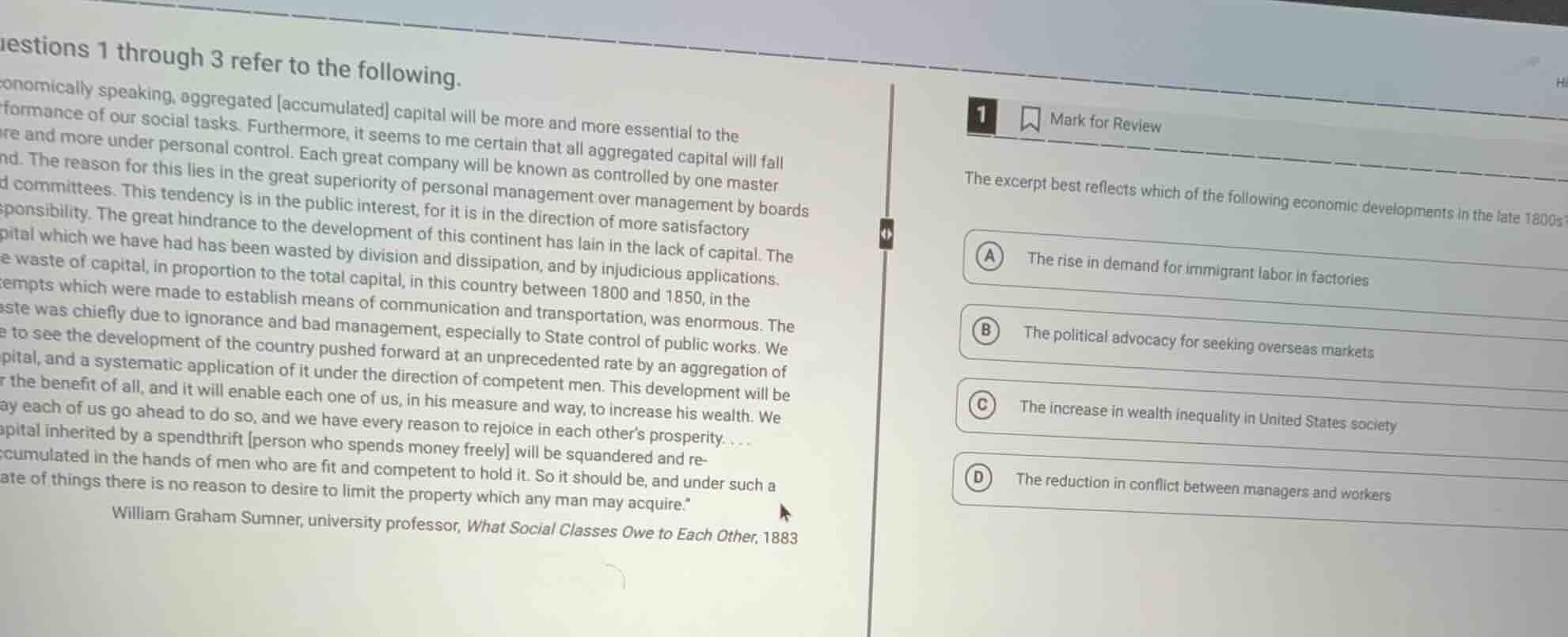
questions 1 through 3 refer to the following.
economically speaking, aggregated accumulated capital will be more and more essential to the
performance of our social tasks. furthermore, it seems to me certain that all aggregated capital
will be more and more under personal control. each great company will be known as controlled by one master
brain. the reason for this lies in the great superiority of personal management over management by boards
and committees. this tendency is in the public interest, for it is in the direction of more satisfactory
responsibility. the great hindrance to the development of this continent has lain in the lack of capital. the
capital which we have had has been wasted by division and dissipation, and by injudicious applications.
the waste of capital, in proportion to the total capital, in this country between 1800 and 1850, in the
attempts which were made to establish means of communication and transportation, was enormous. the
waste was chiefly due to ignorance and bad management, especially to state control of public works. we
desire to see the development of the country pushed forward at an unprecedented rate by an aggregation of
capital, and a systematic application of it under the direction of competent men. this development will be
for the benefit of all, and it will enable each one of us, in his measure and way, to increase his wealth. we
may each of us go ahead to do so, and we have every reason to rejoice in each other’s prosperity. . . .
capital inherited by a spendthrift person who spends money freely will be squandered and re-
accumulated in the hands of men who are fit and competent to hold it. so it should be, and under such a
state of things there is no reason to desire to limit the property which any man may acquire.”
william graham sumner, university professor, what social classes owe to each other, 1883
1 mark for review
the excerpt best reflects which of the following economic developments in the late 1800s?
a the rise in demand for immigrant labor in factories
b the political advocacy for seeking overseas markets
c the increase in wealth inequality in united states society
d the reduction in conflict between managers and workers
The excerpt discusses aggregated capital being controlled by individuals (masters) rather than boards, and the idea that competent men managing capital benefits development, with no limit on property acquisition. In the late 1800s, industrialization led to the rise of big business and wealthy industrialists, increasing wealth inequality. Option A is about immigrant labor, not related to capital control. Option B is about overseas markets, not mentioned. Option D is about manager - worker conflict, not discussed. So the excerpt reflects the increase in wealth inequality.

Snap & solve any problem in the app
Get step-by-step solutions on Sovi AI
Photo-based solutions with guided steps
Explore more problems and detailed explanations
C. The increase in wealth inequality in United States society