QUESTION IMAGE
Question
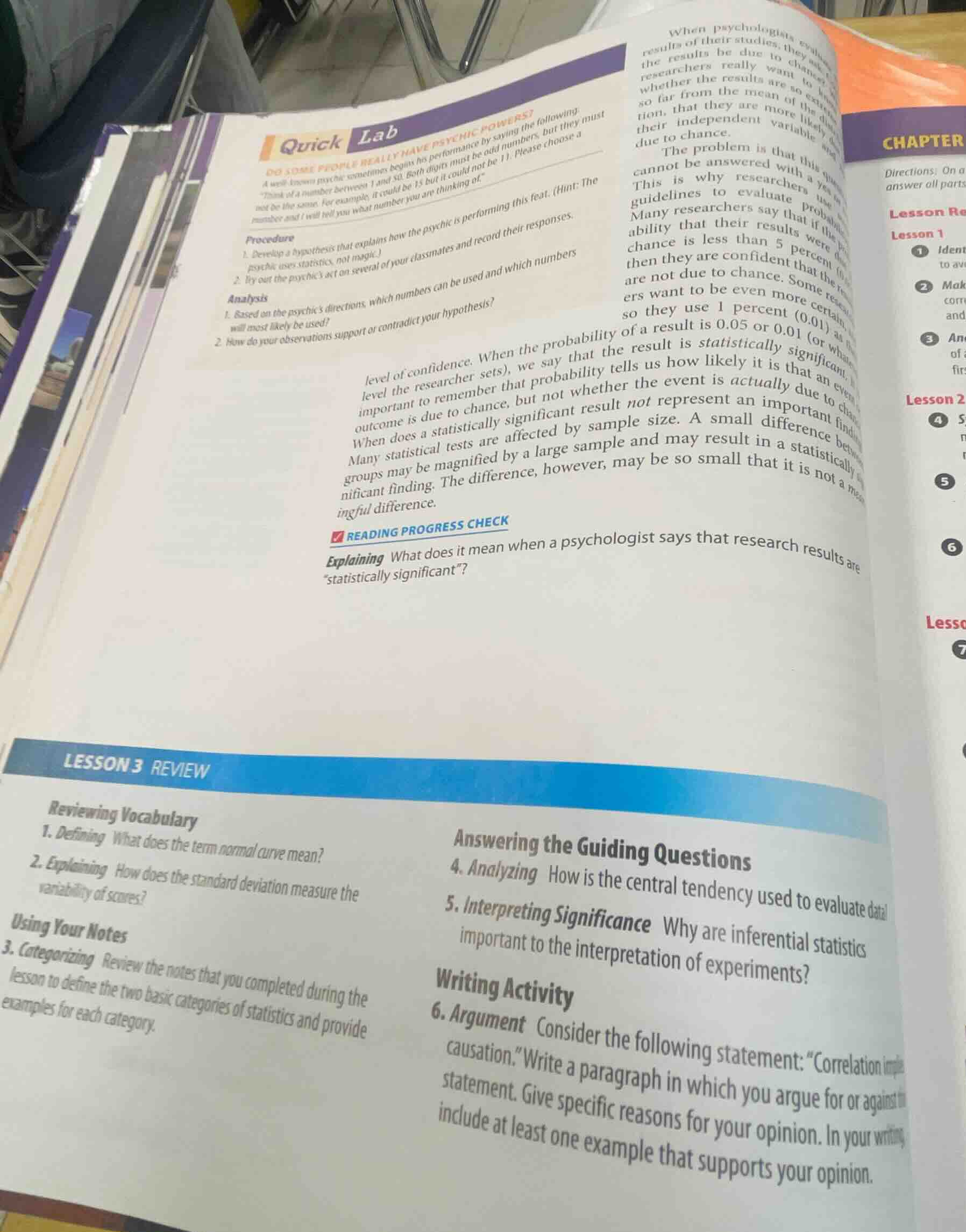
quick lab do some people really have psychic powers? a well - known psychic sometimes begins his performance by saying the following: “think of a number between 1 and 50. both digits must be odd numbers, but they must not be the same. for example, it could be 15, but it could not be 11. please choose a number and i will tell you what number you are thinking of.” procedure 1. develop a hypothesis that explains how the psychic is performing this feat. (hint: the psychic uses statistics, not magic.) 2. try out the psychic’s act on several of your classmates and record their responses. analysis 1. based on the psychic’s directions, which numbers can be used and which numbers will most likely be used? 2. how do your observations support or contradict your hypothesis? when psychologists evaluate the results of their studies, they want the results be due to chance? or do the researchers really want to know whether the results are so far from the mean of the distribution, that they are more likely due to their independent variable and not due to chance. the problem is that this question cannot be answered with a yes or no. this is why researchers use guidelines to evaluate probability. many researchers say that if the probability that their results were due to chance is less than 5 percent (0.05) or 0.01 (or whatever level the researcher sets), we say that the result is statistically significant. it is important to remember that probability tells us how likely it is that an event outcome is due to chance, but not whether the event is actually due to chance. when does a statistically significant result not represent an important finding? many statistical tests are affected by sample size. a small difference between groups may be magnified by a large sample and may result in a statistically significant finding. the difference, however, may be so small that it is not a meaningful difference. reading progress check explaining what does it mean when a psychologist says that research results are “statistically significant”? lesson 3 review reviewing vocabulary 1. defining what does the term normal curve mean? 2. explaining how does the standard deviation measure the variability of scores? using your notes 3. categorizing review the notes that you completed during the lesson to define the two basic categories of statistics and provide examples for each category. answering the guiding questions 4. analyzing how is the central tendency used to evaluate data? 5. interpreting significance why are inferential statistics important to the interpretation of experiments? writing activity 6. argument consider the following statement: “correlation implies causation.” write a paragraph in which you argue for or against this statement. give specific reasons for your opinion. in your writing, include at least one example that supports your opinion.
Reading Progress Check
When a psychologist states results are "statistically significant," it means the probability that the observed results occurred purely by chance is below a pre-determined threshold (commonly 5% or 0.05, sometimes 1% or 0.01). This gives researchers confidence that the results are likely due to the independent variable or tested factor, not random chance. It does not inherently mean the result is practically meaningful, only that it is unlikely to be a random fluke.
Lesson 3 Review
- Normal curve: A symmetrical, bell-shaped graphical representation of a distribution where most data points cluster around the mean, and frequencies taper off evenly on both sides of the mean. It follows a specific mathematical pattern where the mean, median, and mode are equal.
- Standard deviation and variability: Standard deviation measures the average distance of each data point from the mean of the dataset. A larger standard deviation indicates greater spread (higher variability) of scores, while a smaller one means scores are clustered closely around the mean.
- Two basic categories of statistics:
- Descriptive statistics: Summarize or describe the main features of a dataset. Examples include calculating the mean (average) of test scores, creating a frequency table of survey responses, or finding the standard deviation of a group's heights.
- Inferential statistics: Use sample data to make predictions, generalizations, or inferences about a larger population. Examples include conducting a t-test to see if there is a significant difference in test scores between two classes, or using a regression analysis to predict future sales based on past data.
- Central tendency for data evaluation: Central tendency (mean, median, mode) provides a single representative value that summarizes the center of a dataset. It helps researchers quickly understand the typical or average response/measurement in their data, serving as a baseline to compare subgroups, track changes over time, or identify outliers.
- Importance of inferential statistics: Inferential statistics allow researchers to move beyond describing their sample data to draw conclusions about the broader population the sample represents. This is critical for experiments, as it helps determine if observed effects (e.g., a treatment's impact) are generalizable, not just limited to the specific group studied.
- Argument on "Correlation implies causation":
Correlation does not imply causation. Correlation only shows that two variables have a relationship where they change together, but this does not prove that one variable directly causes the other. For example, a correlation might be found between ice cream sales and drowning deaths: as ice cream sales rise, drowning deaths also increase. However, ice cream sales do not cause drowning. Both variables are actually influenced by a third factor: warm summer weather, which leads to more people buying ice cream and more people swimming (and thus more drowning incidents). Assuming causation from correlation can lead to false conclusions, as there may be confounding variables, reverse causation, or the relationship may be coincidental.

Snap & solve any problem in the app
Get step-by-step solutions on Sovi AI
Photo-based solutions with guided steps
Explore more problems and detailed explanations
Reading Progress Check
When a psychologist says research results are "statistically significant," it means the probability that the results occurred by chance is below a pre-set threshold (typically 0.05 or 0.01), giving confidence the results stem from the tested factor, not randomness.
Lesson 3 Review
- A symmetrical, bell-shaped distribution where data clusters around the mean, with mean, median, and mode equal.
- It measures average distance of scores from the mean; higher values mean more spread.
- - Descriptive statistics: Summarize dataset features (e.g., calculating test score means).
- Inferential statistics: Generalize sample findings to a population (e.g., t-tests for group differences).
- It provides a representative central value to summarize and compare dataset trends.
- They let researchers generalize sample findings to a larger population, validating experimental effects beyond the studied group.
- Correlation does not imply causation. Correlation only shows linked variable change, not direct cause. Example: Ice cream sales and drowning deaths correlate, but warm weather (a third variable) causes both, not one causing the other. Assuming causation risks false conclusions from confounding factors or coincidence.