QUESTION IMAGE
Question
quiz 7-2: parallelograms, rectangles, rhombi & squares
- which quadrilaterals always have opposite angles that are congruent?
parallelograms
rectangles
rhombi
squares
- which quadrilaterals always have diagonals that bisect opposite angles?
parallelograms
rectangles
rhombi
squares
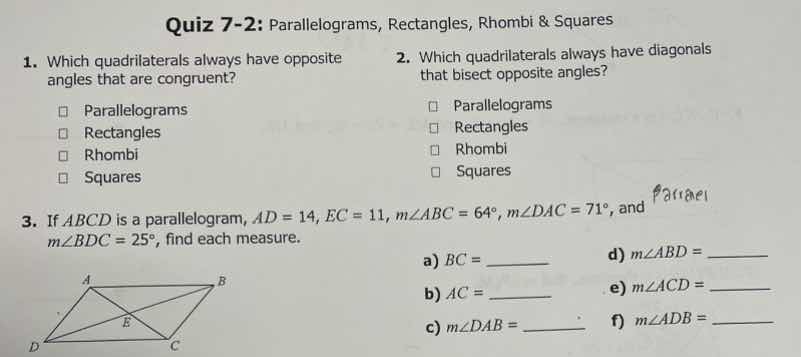
- if (abcd) is a parallelogram, (ad = 14), (ec = 11), (mangle abc = 64^circ), (mangle dac = 71^circ), and (mangle bdc = 25^circ), find each measure.
a) (bc = _____)
d) (mangle abd = _____)
b) (ac = _____)
e) (mangle acd = _____)
c) (mangle dab = _____)
f) (mangle adb = _____)
(image of parallelogram (abcd) with diagonals intersecting at (e))
Question 1
Opposite angles are congruent in all parallelograms, and rectangles, rhombi, squares are all types of parallelograms, so they share this property.
Diagonals that bisect opposite angles is a property unique to rhombi and squares (since squares are a special type of rhombus). Parallelograms and rectangles do not have this property.
Step1: Find BC (opposite sides of parallelogram are equal)
In parallelogram $ABCD$, $AD = BC$. Given $AD=14$, so $BC=14$.
Step2: Find AC (diagonals bisect each other)
Diagonals bisect each other, so $AC = 2\times EC$. Given $EC=11$, so $AC=2\times11=22$.
Step3: Find $m\angle DAB$ (consecutive angles are supplementary)
Consecutive angles in parallelogram are supplementary: $m\angle DAB + m\angle ABC = 180^\circ$. Given $m\angle ABC=64^\circ$, so $m\angle DAB=180^\circ-64^\circ=116^\circ$.
Step4: Find $m\angle ABD$ (alternate interior angles)
$AB\parallel DC$, so $\angle ABD = \angle BDC$. Given $m\angle BDC=25^\circ$, so $m\angle ABD=25^\circ$.
Step5: Find $m\angle ACD$ (alternate interior angles)
$AB\parallel DC$, so $\angle ACD = \angle BAC$. First find $\angle BAC = m\angle DAB - m\angle DAC = 116^\circ-71^\circ=45^\circ$, so $m\angle ACD=45^\circ$.
Step6: Find $m\angle ADB$ (triangle angle sum)
In $\triangle ADB$, $m\angle ADB + m\angle DAB + m\angle ABD=180^\circ$. Substitute values: $m\angle ADB=180^\circ-116^\circ-25^\circ=39^\circ$.

Snap & solve any problem in the app
Get step-by-step solutions on Sovi AI
Photo-based solutions with guided steps
Explore more problems and detailed explanations
- Parallelograms
- Rectangles
- Rhombi
- Squares
---