QUESTION IMAGE
Question
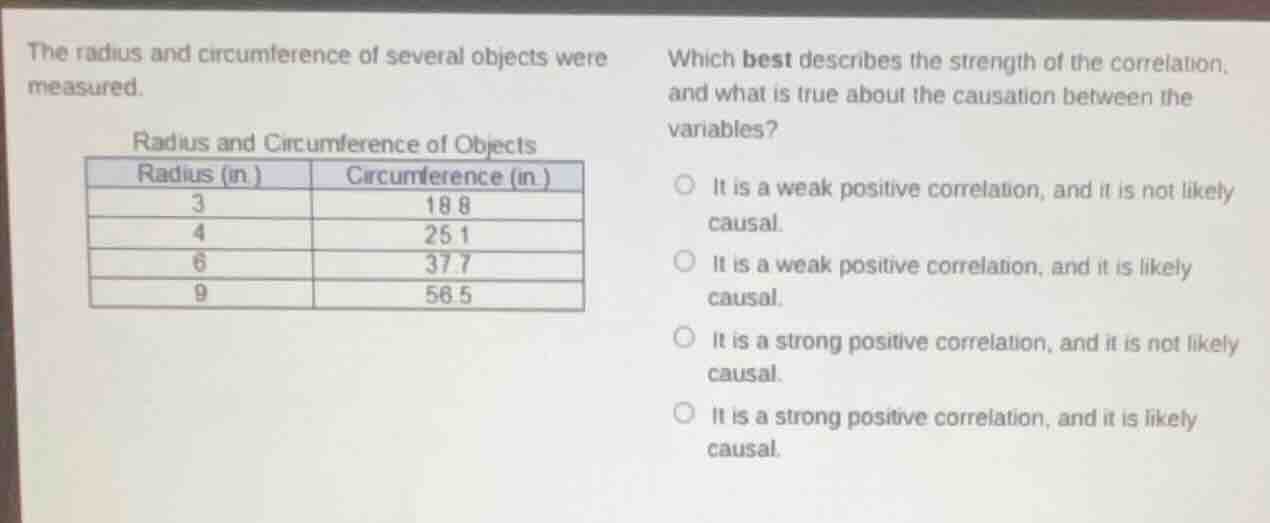
the radius and circumference of several objects were measured.
radius and circumference of objects
| radius (in) | circumference (in) |
|---|---|
| 4 | 25.1 |
| 6 | 37.7 |
| 9 | 56.5 |
which best describes the strength of the correlation, and what is true about the causation between the variables?
- it is a weak positive correlation, and it is not likely causal.
- it is a weak positive correlation, and it is likely causal.
- it is a strong positive correlation, and it is not likely causal.
- it is a strong positive correlation, and it is likely causal.
Step1: Analyze correlation trend
As radius increases, circumference increases. Calculate the ratio of circumference to radius for each pair:
$\frac{18.8}{3} \approx 6.27$, $\frac{25.1}{4} \approx 6.28$, $\frac{37.7}{6} \approx 6.28$, $\frac{56.5}{9} \approx 6.28$
These values are very close to $2\pi \approx 6.28$, showing an almost perfect linear relationship.
Step2: Evaluate causation
Circumference $C = 2\pi r$ by definition, so a larger radius directly causes a larger circumference.

Snap & solve any problem in the app
Get step-by-step solutions on Sovi AI
Photo-based solutions with guided steps
Explore more problems and detailed explanations
It is a strong positive correlation, and it is likely causal.