QUESTION IMAGE
Question
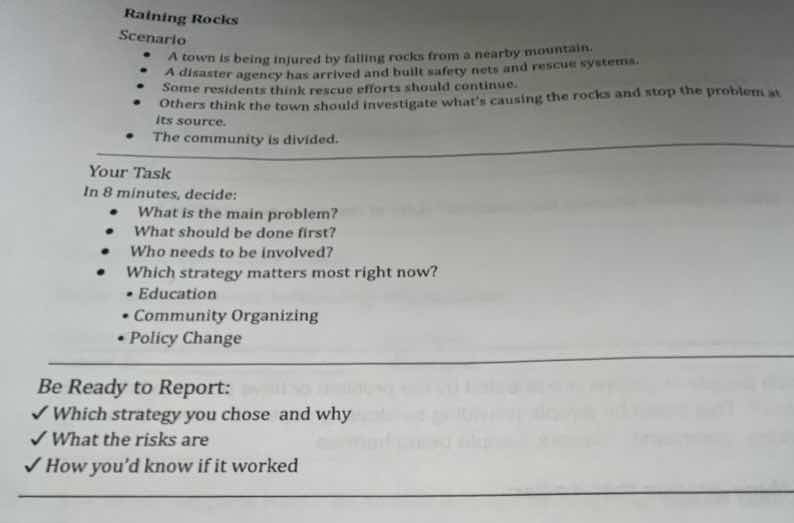
raining rocksscenario• a town is being injured by falling rocks from a nearby mountain.• a disaster agency has arrived and built safety nets and rescue systems.• some residents think rescue efforts should continue.• others think the town should investigate whats causing the rocks and stop the problem atits source.• the community is divided.your taskin 8 minutes, decide:• what is the main problem?• what should be done first?• who needs to be involved?• which strategy matters most right now?• education• community organizing• policy changebe ready to report:✓ which strategy you chose and why✓ what the risks are✓ how youd know if it worked
- Main Problem: The town faces immediate danger from falling rocks, paired with a divided community on how to address the crisis (immediate rescue vs. root-cause investigation).
- First Action: Prioritize ongoing rescue efforts to protect injured and at-risk residents, as this addresses the immediate threat to human life.
- Stakeholders to Involve: Disaster agency personnel, town residents, geologists/rockfall experts, local government officials, and community leaders.
- Top Strategy: Community Organizing is the most critical right now. It will bridge the divide between residents with conflicting priorities, align the community around both short-term safety and long-term solutions, and ensure coordinated action with the disaster agency.
- Risks of This Strategy: Delays in reaching consensus, continued tension between resident groups, or miscommunication that slows both rescue and root-cause work.
- Success Metric: A unified community agreement on a combined plan (ongoing rescue + parallel root-cause investigation) within 24 hours, plus reduced resident conflict and smooth coordination between all involved parties.

Snap & solve any problem in the app
Get step-by-step solutions on Sovi AI
Photo-based solutions with guided steps
Explore more problems and detailed explanations
- Main Problem: Immediate rockfall danger + divided community on crisis response.
- First Action: Continue rescue efforts for safety.
- Stakeholders to Involve: Disaster agency, residents, geologists, local officials, community leaders.
- Top Strategy: Community Organizing
- Why: Unites divided residents to coordinate short-term rescue and long-term root-cause work.
- Risks: Consensus delays, ongoing resident tension, miscommunication slowing action.
- Success Measure: Unified community plan in 24 hours, reduced conflict, coordinated stakeholder action.