QUESTION IMAGE
Question
- x =
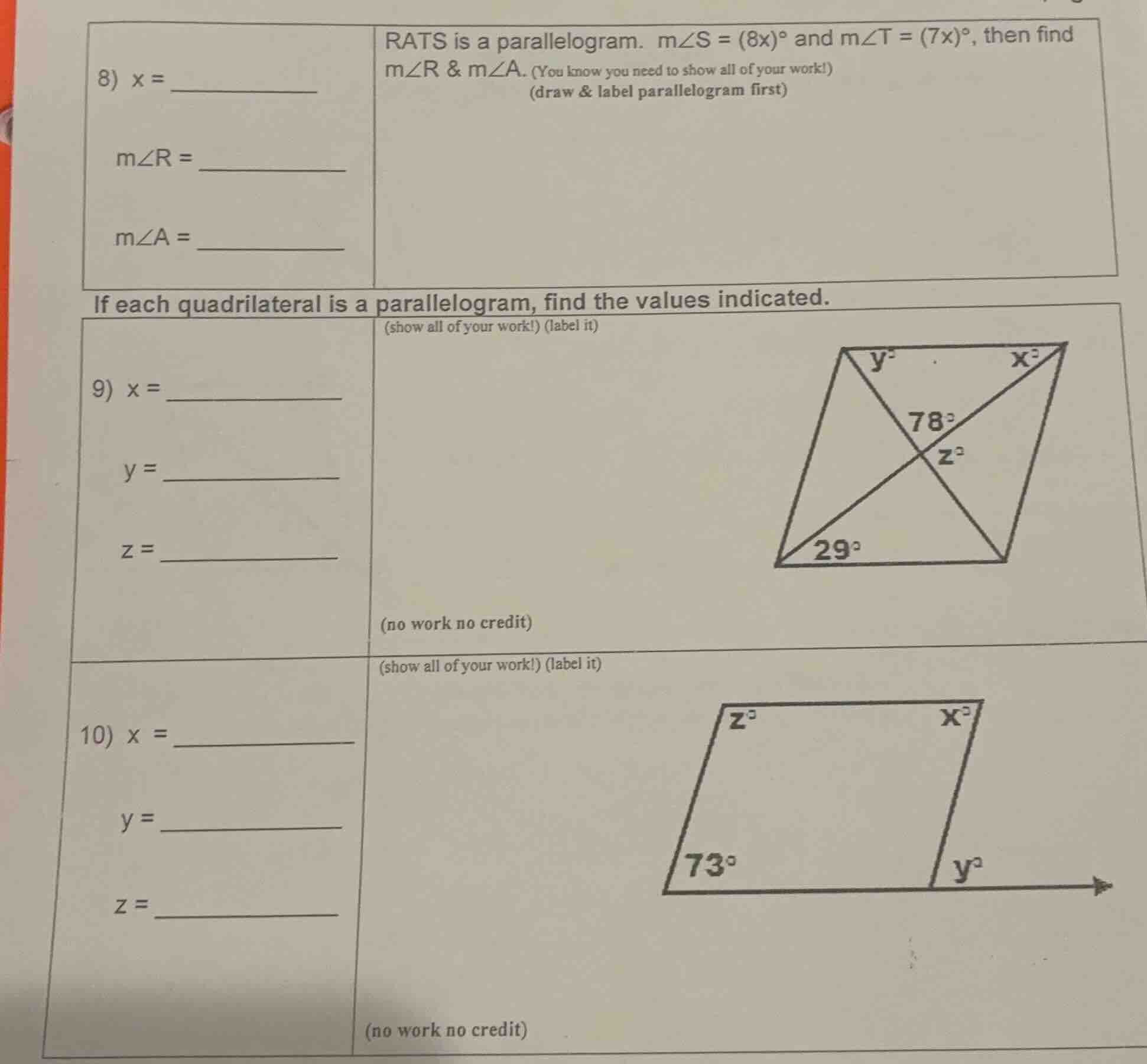
rats is a parallelogram. ( mangle s = (8x)^circ ) and ( mangle t = (7x)^circ ), then find ( mangle r ) & ( mangle a ). (you know you need to show all of your work!)
(draw & label parallelogram first)
( mangle r = )
( mangle a = )
if each quadrilateral is a parallelogram, find the values indicated.
- x =
(show all of your work!) (label it)
( y = )
( z = )
(no work no credit)
- ( x = )
( y = )
( z = )
(show all of your work!) (label it)
(no work no credit)
Problem 8
Step1: Recall parallelogram angle properties
In a parallelogram, consecutive angles are supplementary (sum to \(180^\circ\)). In parallelogram RATS, \(\angle S\) and \(\angle T\) are consecutive angles, so \(m\angle S + m\angle T = 180^\circ\).
Given \(m\angle S=(8x)^\circ\) and \(m\angle T=(7x)^\circ\), we set up the equation:
\(8x + 7x = 180\)
Step2: Solve for \(x\)
Combine like terms: \(15x = 180\)
Divide both sides by 15: \(x=\frac{180}{15}=12\)
Step3: Find \(m\angle R\)
In a parallelogram, opposite angles are equal. \(\angle R\) is opposite to \(\angle S\), so \(m\angle R = m\angle S\).
Substitute \(x = 12\) into \(m\angle S\): \(m\angle S=8\times12 = 96^\circ\), so \(m\angle R = 96^\circ\)
Step4: Find \(m\angle A\)
\(\angle A\) is opposite to \(\angle T\), so \(m\angle A = m\angle T\).
Substitute \(x = 12\) into \(m\angle T\): \(m\angle T=7\times12 = 84^\circ\), so \(m\angle A = 84^\circ\)
Step1: Recall parallelogram diagonal properties
In a parallelogram, the diagonals bisect each other, but also, alternate interior angles are equal, and vertical angles are equal. Also, in a triangle, the sum of angles is \(180^\circ\).
First, vertical angles: the angle opposite \(78^\circ\) is \(z\), so \(z = 180 - 78=102^\circ\)? Wait, no, vertical angles are equal? Wait, no, the angle with \(78^\circ\) and \(z\) are adjacent and form a linear pair? Wait, no, in the parallelogram, the diagonals intersect, so vertical angles are equal. Wait, the triangle with \(78^\circ\), \(29^\circ\), and \(y\): Wait, in a parallelogram, opposite sides are parallel, so alternate interior angles are equal. Let's look at the triangle: one angle is \(29^\circ\), another is \(78^\circ\), so the third angle \(y\) in that triangle: sum of angles in a triangle is \(180^\circ\), so \(y + 29+78 = 180\)? Wait, no, maybe \(x = 29^\circ\) (alternate interior angles, since opposite sides are parallel, the diagonal is a transversal, so \(x = 29^\circ\)). Then, in the triangle with \(78^\circ\), \(x = 29^\circ\), so \(y=180 - 78 - 29=73^\circ\)? Wait, no, vertical angles: \(z\) is vertical to the angle adjacent to \(78^\circ\), so \(z = 180 - 78 = 102^\circ\)? Wait, let's correct:
In a parallelogram, opposite sides are parallel. So the diagonal divides the parallelogram into two congruent triangles. Also, alternate interior angles: the angle marked \(29^\circ\) and \(x\) are alternate interior angles, so \(x = 29^\circ\).
Then, in the triangle with angles \(78^\circ\), \(x = 29^\circ\), and \(y\), the sum of angles in a triangle is \(180^\circ\), so \(y+78 + 29=180\)? Wait, no, the angle at the intersection: the angle \(z\) and \(78^\circ\) are supplementary (linear pair), so \(z = 180 - 78 = 102^\circ\).
Wait, let's re - analyze:
- Alternate interior angles: Since \(AB\parallel CD\) (assuming the parallelogram is \(ABCD\) with diagonals intersecting), and diagonal \(AC\) is a transversal, the angle with measure \(29^\circ\) and \(x\) are alternate interior angles, so \(x = 29^\circ\).
- In the triangle with angles \(78^\circ\), \(x = 29^\circ\), and \(y\), we know that the sum of angles in a triangle is \(180^\circ\). So \(y=180-(78 + 29)=180 - 107 = 73^\circ\)? Wait, no, maybe the triangle has angles \(78^\circ\), \(y\), and \(x\), and another angle? Wait, no, the vertical angle to \(78^\circ\) is not, but the angle \(z\) and \(78^\circ\) are linear pair, so \(z = 180 - 78=102^\circ\).
Wait, let's start over:
- In a parallelogram, opposite sides are parallel. So if we have a parallelogram \(ABCD\) with diagonals \(AC\) and \(BD\) intersecting at a point. Then \(AB\parallel CD\), so \(\angle BAC=\angle DCA\) (alternate interior angles). So \(x = 29^\circ\) (since one angle is \(29^\circ\) and \(x\) is alternate interior angle).
- The angle \(z\) and the angle of \(78^\circ\) are supplementary (they form a linear pair), so \(z=180 - 78 = 102^\circ\).
- In triangle formed by \(78^\circ\), \(x = 29^\circ\), and \(y\), sum of angles in a triangle is \(180^\circ\), so \(y=180-(78 + 29)=73^\circ\).
Step1: Find \(x\)
By alternate interior angles (opposite sides of parallelogram are parallel, diagonal is transversal), \(x = 29^\circ\)
Step2: Find \(y\)
In the triangle, sum of angles is \(180^\circ\). Angles are \(78^\circ\), \(x = 29^\circ\), and \(y\). So \(y=180-(78 + 29)=73^\circ\)
Step3: Find \(z\)
\(z\) and \(78^\circ\) are supplementary (linear pair), so \(z = 180 - 78=102^\circ\)
Step1: Recall parallelogram angle properties
In a parallelogram, opposite angles are equal, and consecutive angles are supplementary. Also, a parallelogram has opposite sides parallel, so corresponding angles (or alternate interior angles) and same - side interior angles are supplementary.
Given one angle is \(73^\circ\), let's assume the parallelogram is \(ABCD\) with \(\angle A = 73^\circ\). Then:
- Opposite angles: \(x=\angle A = 73^\circ\) (opposite angles in parallelogram are equal).
- Consecutive angles: \(z\) is consecutive to \(73^\circ\), so \(z = 180 - 73=107^\circ\) (consecutive angles in parallelogram are supplementary).
- The angle \(y\) and \(73^\circ\) are corresponding angles (since \(y\) is an exterior angle and the adjacent interior angle is \(73^\circ\)), so \(y = 73^\circ\) (alternate - exterior or corresponding angles, since the side is extended, and opposite sides are parallel).
Step1: Find \(x\)
In a parallelogram, opposite angles are equal. If one angle is \(73^\circ\), then \(x = 73^\circ\)
Step2: Find \(y\)
\(y\) and the \(73^\circ\) angle are corresponding angles (since the side is extended and opposite sides are parallel), so \(y = 73^\circ\)
Step3: Find \(z\)
Consecutive angles in a parallelogram are supplementary. So \(z=180 - 73 = 107^\circ\)

Snap & solve any problem in the app
Get step-by-step solutions on Sovi AI
Photo-based solutions with guided steps
Explore more problems and detailed explanations
\(x = 12\)
\(m\angle R = 96^\circ\)
\(m\angle A = 84^\circ\)