QUESTION IMAGE
Question
re moving or not. represent their movement with
direction. (3 marks each)
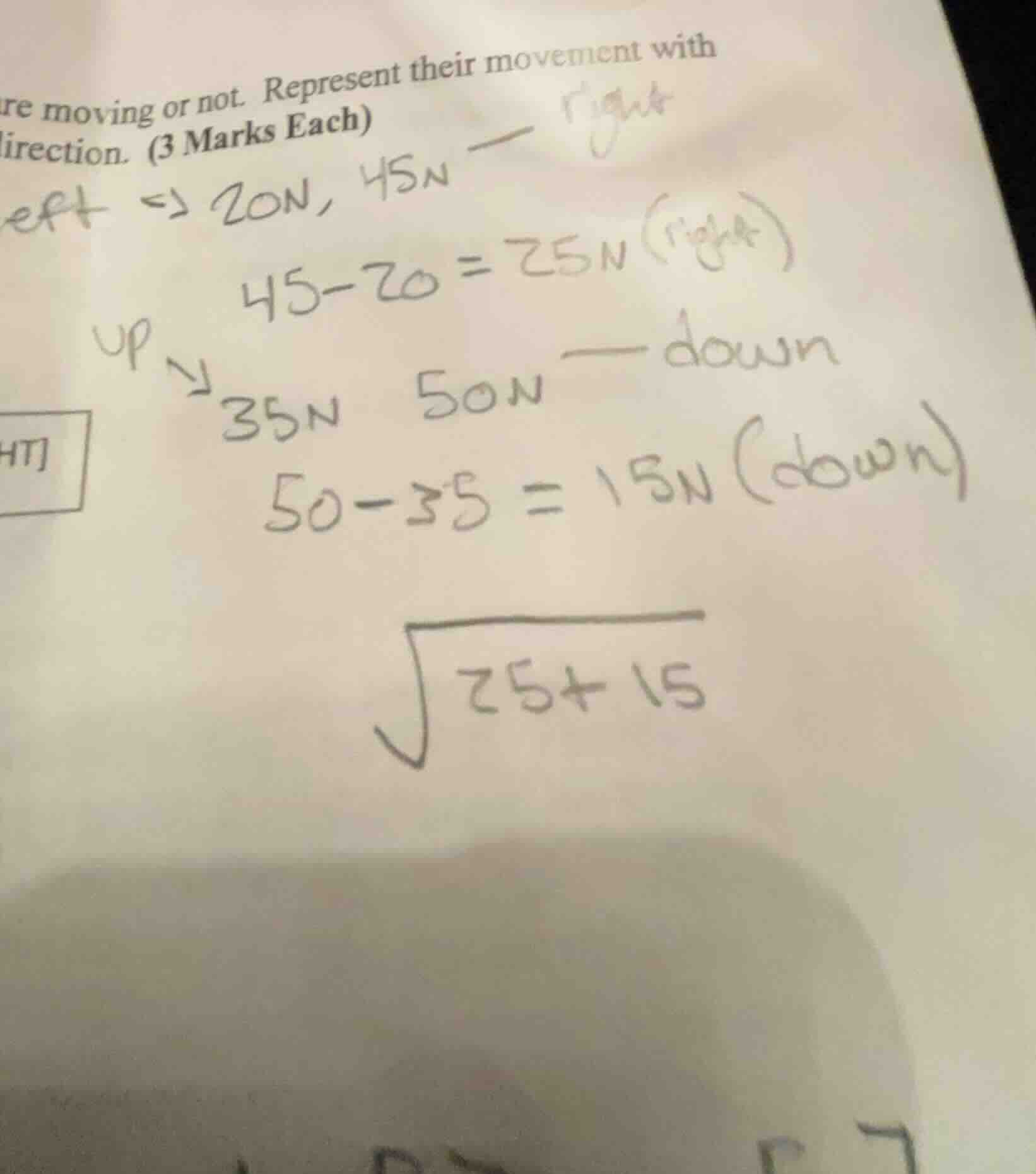
left 20n, 45n — right
45 - 20 = 25n (right)
up 35n 50n — down
50 - 35 = 15n (down)
\sqrt{25 + 15}
Step1: Correct the formula (Pythagorean theorem)
The resultant force of two perpendicular forces \( F_x \) (horizontal) and \( F_y \) (vertical) is given by \( F = \sqrt{F_x^2 + F_y^2} \), not \( \sqrt{F_x + F_y} \). Here, \( F_x = 25N \) (right) and \( F_y = 15N \) (down). So we should calculate \( \sqrt{25^2 + 15^2} \).
Step2: Calculate \( 25^2 \) and \( 15^2 \)
\( 25^2 = 625 \), \( 15^2 = 225 \)
Step3: Sum the squares
\( 625 + 225 = 850 \)
Step4: Take the square root
\( \sqrt{850} \approx 29.15N \) (the direction can be found using trigonometry, but for magnitude, we calculate this)

Snap & solve any problem in the app
Get step-by-step solutions on Sovi AI
Photo-based solutions with guided steps
Explore more problems and detailed explanations
The correct magnitude of the resultant force is approximately \( 29.15N \) (the initial formula in the image was incorrect; it should use the Pythagorean theorem with the squares of the forces, not the sum of the forces).