QUESTION IMAGE
Question
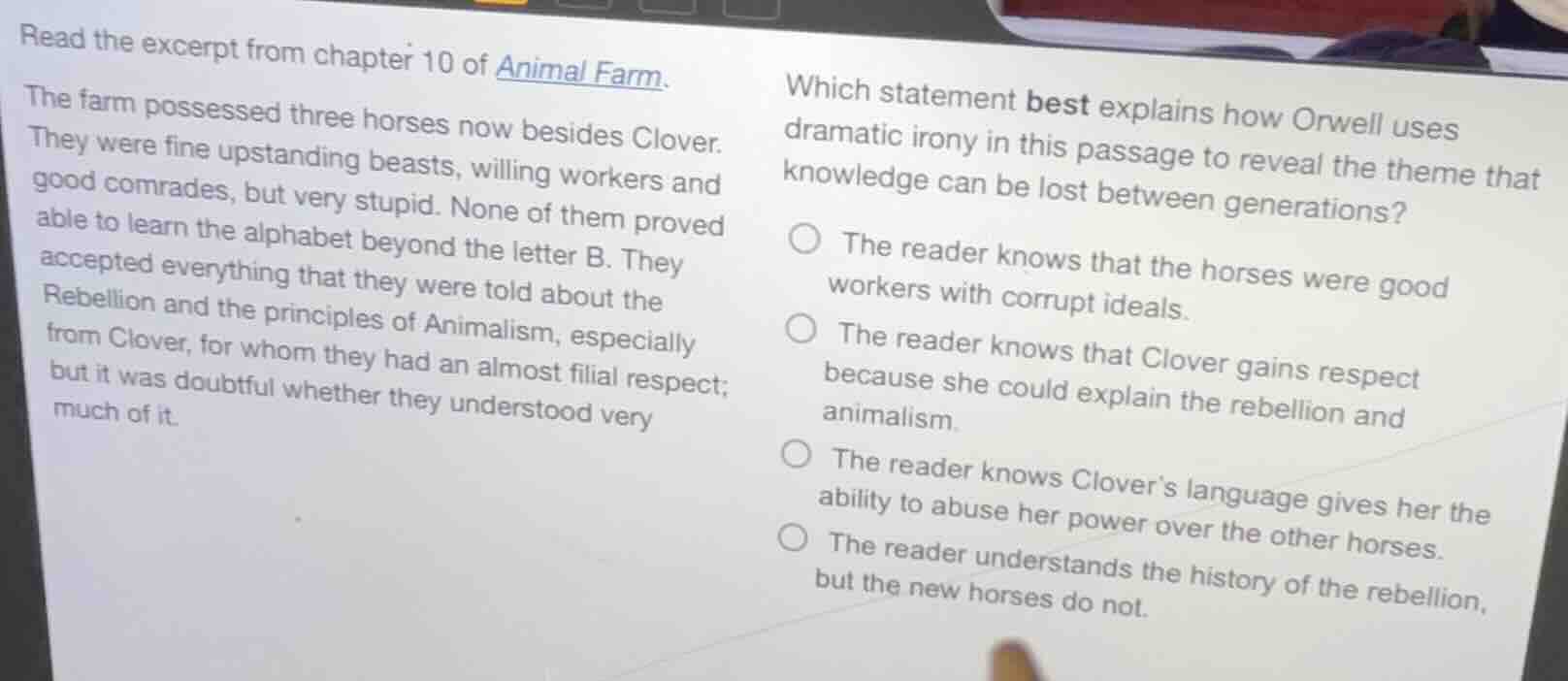
read the excerpt from chapter 10 of animal farm.
the farm possessed three horses now besides clover.
they were fine upstanding beasts, willing workers and
good comrades, but very stupid. none of them proved
able to learn the alphabet beyond the letter b. they
accepted everything that they were told about the
rebellion and the principles of animalism, especially
from clover, for whom they had an almost filial respect;
but it was doubtful whether they understood very
much of it.
which statement best explains how orwell uses
dramatic irony in this passage to reveal the theme that
knowledge can be lost between generations?
○ the reader knows that the horses were good
workers with corrupt ideals.
○ the reader knows that clover gains respect
because she could explain the rebellion and
animalism.
○ the reader knows clovers language gives her the
ability to abuse her power over the other horses.
○ the reader understands the history of the rebellion,
but the new horses do not.
Dramatic irony occurs when the reader knows more than the characters in the text. The theme of lost knowledge between generations is shown here because the reader is aware of the Rebellion and Animalism's history, but the new, uneducated horses only accept what they are told without understanding it, and cannot even learn the alphabet beyond B, meaning they lack the ability to grasp or preserve that knowledge. The other options do not connect to the theme of intergenerational lost knowledge via dramatic irony: the first misrepresents the horses' ideals as corrupt, the second focuses on Clover's respect not lost knowledge, and the third incorrectly claims Clover abuses power.

Snap & solve any problem in the app
Get step-by-step solutions on Sovi AI
Photo-based solutions with guided steps
Explore more problems and detailed explanations
The reader understands the history of the rebellion, but the new horses do not.