QUESTION IMAGE
Question
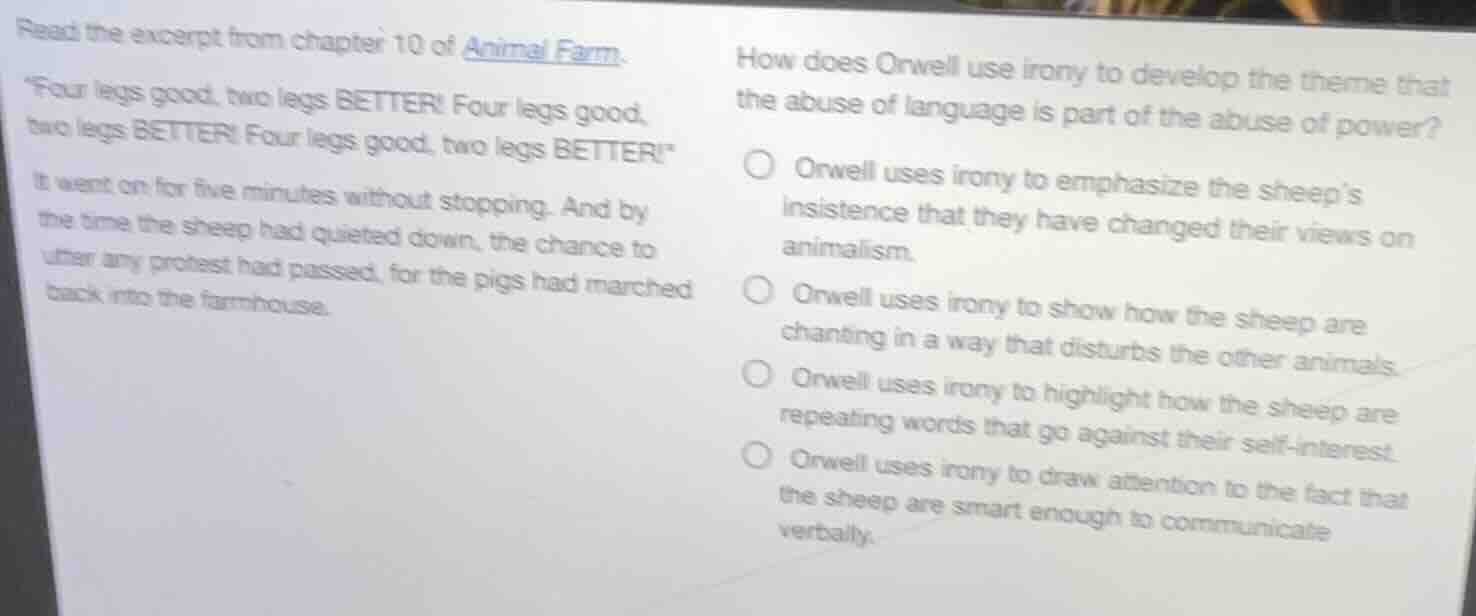
read the excerpt from chapter 10 of animal farm.
\four legs good, two legs better! four legs good,
two legs better! four legs good, two legs better!\
it went on for five minutes without stopping. and by
the time the sheep had quieted down, the chance to
utter any protest had passed, for the pigs had marched
back into the farmhouse.
how does orwell use irony to develop the theme that
the abuse of language is part of the abuse of power?
○ orwell uses irony to emphasize the sheeps
insistence that they have changed their views on
animalism.
○ orwell uses irony to show how the sheep are
chanting in a way that disturbs the other animals.
○ orwell uses irony to highlight how the sheep are
repeating words that go against their self-interest.
○ orwell uses irony to draw attention to the fact that
the sheep are smart enough to communicate
verbally.
The original core of Animalism was "Four legs good, two legs bad," which aligned with the sheep's self-interest (opposing human/pig tyranny). The ironic shift to "Four legs good, two legs BETTER!" has the sheep repeating a phrase that betrays their own interests, as it elevates the pigs (who now walk on two legs, adopting human-like oppressive power). This irony links the abuse of language (twisting the original slogan) to the abuse of power (the pigs seizing control). The other options are incorrect: the first misframes the irony's focus, the second ignores the power-language link, and the fourth is false to the sheep's portrayal.

Snap & solve any problem in the app
Get step-by-step solutions on Sovi AI
Photo-based solutions with guided steps
Explore more problems and detailed explanations
Orwell uses irony to highlight how the sheep are repeating words that go against their self-interest.