QUESTION IMAGE
Question
read the excerpt from chapter 10 of animal farm.
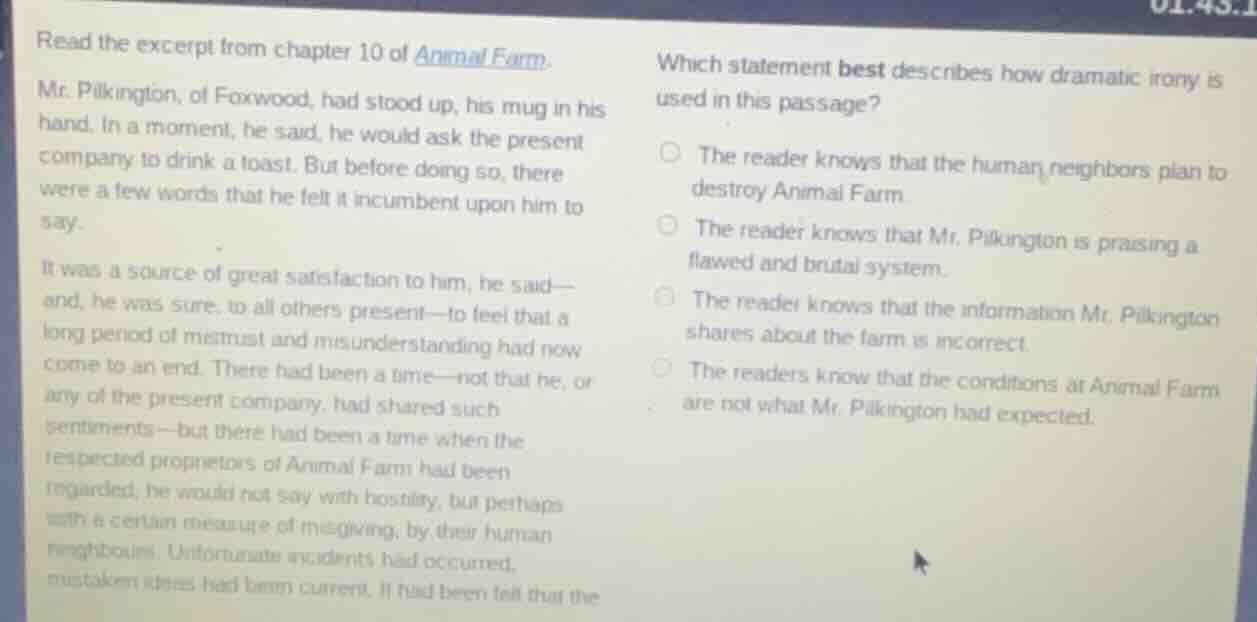
mr. pilkington, of foxwood, had stood up, his mug in his hand. in a moment, he said, he would ask the present company to drink a toast. but before doing so, there were a few words that he felt it incumbent upon him to say.
it was a source of great satisfaction to him, he said— and, he was sure, to all others present—to feel that a long period of mistrust and misunderstanding had now come to an end. there had been a time—not that he, or any of the present company, had shared such sentiments—but there had been a time when the respected proprietors of animal farm had been regarded, he would not say with hostility, but perhaps with a certain measure of misgiving, by their human neighbours. unfortunate accidents had occurred, mistaken ideas had been current. it had been felt that the
which statement best describes how dramatic irony is used in this passage?
○ the reader knows that the human neighbors plan to destroy animal farm.
○ the reader knows that mr. pilkington is praising a flawed and brutal system.
○ the reader knows that the information mr. pilkington shares about the farm is incorrect.
○ the readers know that the conditions at animal farm are not what mr. pilkington had expected.
Dramatic irony occurs when the reader knows key information that a character in the text does not. In Animal Farm, the reader is aware that the pigs have established a brutal, oppressive system on Animal Farm that mirrors the human tyranny they overthrew. Mr. Pilkington praises the farm's system as a model of efficiency, unaware (or willfully ignoring) its inherent cruelty and hypocrisy, which the reader recognizes. This matches the definition of dramatic irony here.

Snap & solve any problem in the app
Get step-by-step solutions on Sovi AI
Photo-based solutions with guided steps
Explore more problems and detailed explanations
B. The reader knows that Mr. Pilkington is praising a flawed and brutal system.