QUESTION IMAGE
Question
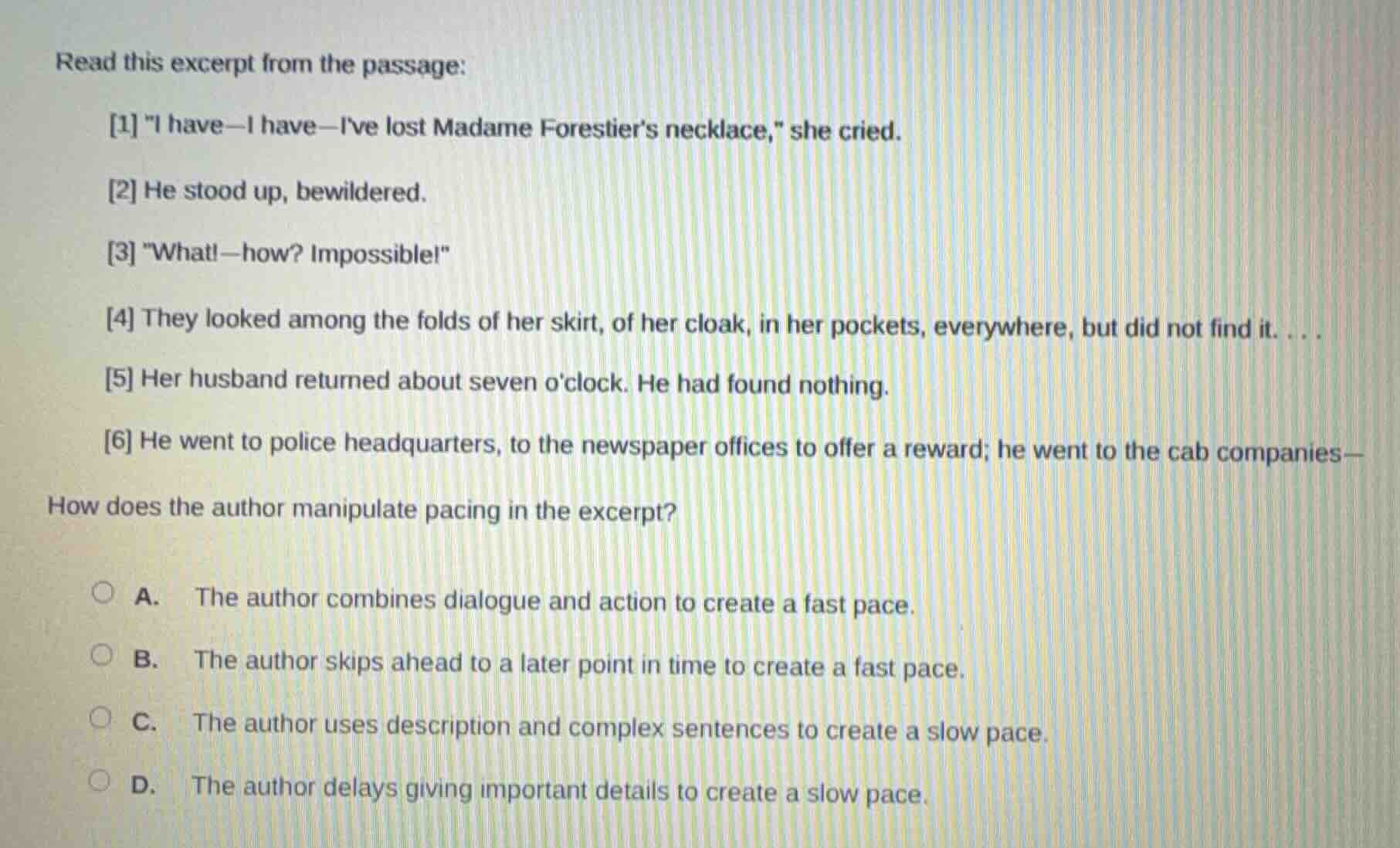
read this excerpt from the passage:
1 \i have—i have—ive lost madame forestiers necklace,\ she cried.
2 he stood up, bewildered.
3 \what!—how? impossible!\
4 they looked among the folds of her skirt, of her cloak, in her pockets, everywhere, but did not find it. . . .
5 her husband returned about seven oclock. he had found nothing.
6 he went to police headquarters, to the newspaper offices to offer a reward; he went to the cab companies—
how does the author manipulate pacing in the excerpt?
a. the author combines dialogue and action to create a fast pace.
b. the author skips ahead to a later point in time to create a fast pace.
c. the author uses description and complex sentences to create a slow pace.
d. the author delays giving important details to create a slow pace.
To determine how the author manipulates pacing, we analyze each option:
- Option A: The excerpt has dialogue (e.g., "I have—I have—I've lost...", "What!—how? Impossible!") and actions (e.g., "He stood up", "They looked...", "He went to..."). Combining dialogue and action moves the story quickly, creating a fast pace.
- Option B: The author does not skip ahead to a later time; the events follow a chronological order of the necklace being lost, searching, and the husband's actions.
- Option C: The sentences are relatively simple, and there's not extensive description to slow the pace. The actions and dialogue keep it moving.
- Option D: Important details (like the necklace being lost) are given early, and the subsequent actions/dialogue progress the story, not delay details to slow pace.

Snap & solve any problem in the app
Get step-by-step solutions on Sovi AI
Photo-based solutions with guided steps
Explore more problems and detailed explanations
A. The author combines dialogue and action to create a fast pace.