QUESTION IMAGE
Question
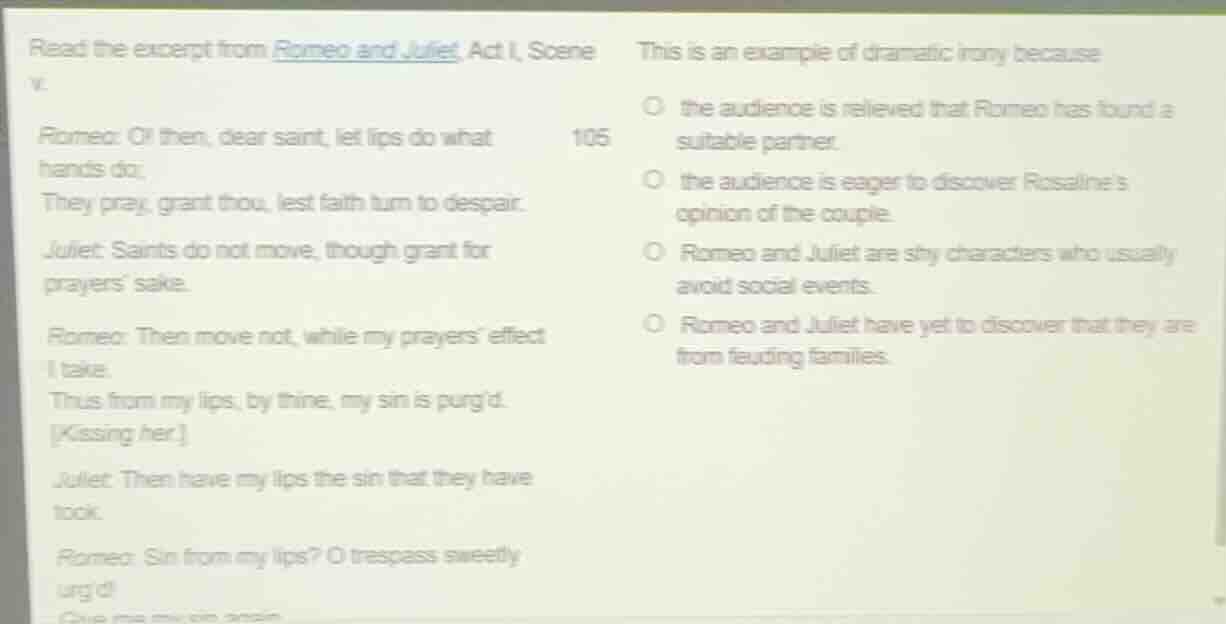
read the excerpt from romeo and juliet, act i, scene v.
romeo: o then, dear saint, let lips do what hands do;
they pray, grant thou, lest faith turn to despair.
juliet: saints do not move, though grant for prayers’ sake.
romeo: then move not, while my prayers’ effect i take.
thus from my lips; by thine, my sin is purg’d.
kissing her
juliet: then have my lips the sin that they have took.
romeo: sin from my lips? o trespass sweetly urg’d!
this is an example of dramatic irony because
○ the audience is relieved that romeo has found a suitable partner.
○ the audience is eager to discover rosaline’s opinion of the couple.
○ romeo and juliet are shy characters who usually avoid social events.
○ romeo and juliet have yet to discover that they are from feuding families.
Dramatic irony occurs when the audience knows information that characters do not. In this scene, the audience is aware that Romeo and Juliet belong to feuding families (Montagues and Capulets), but the characters themselves have not yet discovered this. The other options do not align with the definition of dramatic irony: the first option is about audience relief (not irony), the second about Rosaline's opinion (irrelevant to the irony here), and the third about their shyness (not related to irony).

Snap & solve any problem in the app
Get step-by-step solutions on Sovi AI
Photo-based solutions with guided steps
Explore more problems and detailed explanations
D. Romeo and Juliet have yet to discover that they are from feuding families.