QUESTION IMAGE
Question
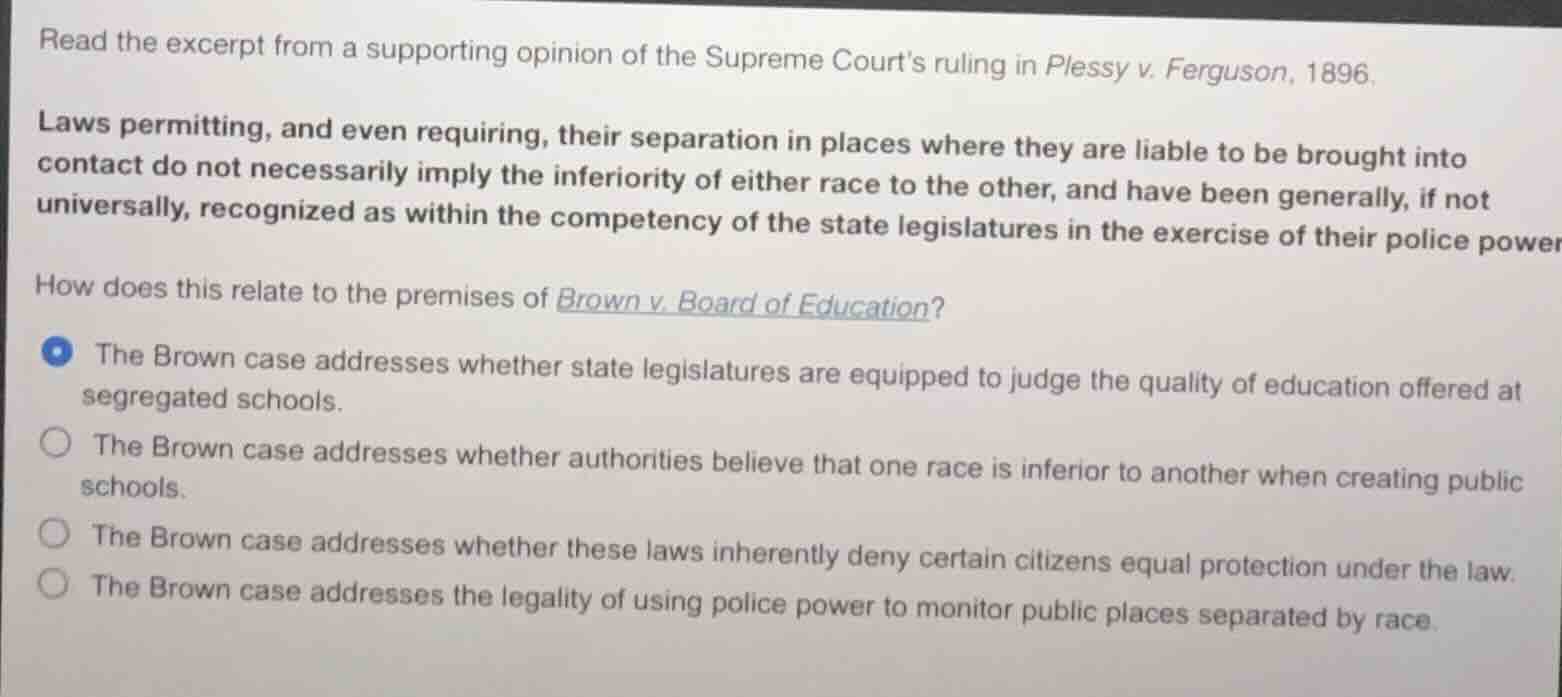
read the excerpt from a supporting opinion of the supreme courts ruling in plessy v. ferguson, 1896.
laws permitting, and even requiring, their separation in places where they are liable to be brought into contact do not necessarily imply the inferiority of either race to the other, and have been generally, if not universally, recognized as within the competency of the state legislatures in the exercise of their police power
how does this relate to the premises of brown v. board of education?
the brown case addresses whether state legislatures are equipped to judge the quality of education offered at segregated schools.
the brown case addresses whether authorities believe that one race is inferior to another when creating public schools.
the brown case addresses whether these laws inherently deny certain citizens equal protection under the law.
the brown case addresses the legality of using police power to monitor public places separated by race.
The Plessy v. Ferguson excerpt upholds state-mandated racial separation under the "separate but equal" doctrine, claiming it does not imply racial inferiority and falls under state police power. Brown v. Board of Education (1954) directly challenged this, arguing that racially segregated public schools inherently violated the 14th Amendment's Equal Protection Clause, as separate facilities could never be truly equal, thus denying equal legal protection to Black citizens. The correct option aligns with this core premise of Brown v. Board.

Snap & solve any problem in the app
Get step-by-step solutions on Sovi AI
Photo-based solutions with guided steps
Explore more problems and detailed explanations
The Brown case addresses whether these laws inherently deny certain citizens equal protection under the law.