QUESTION IMAGE
Question
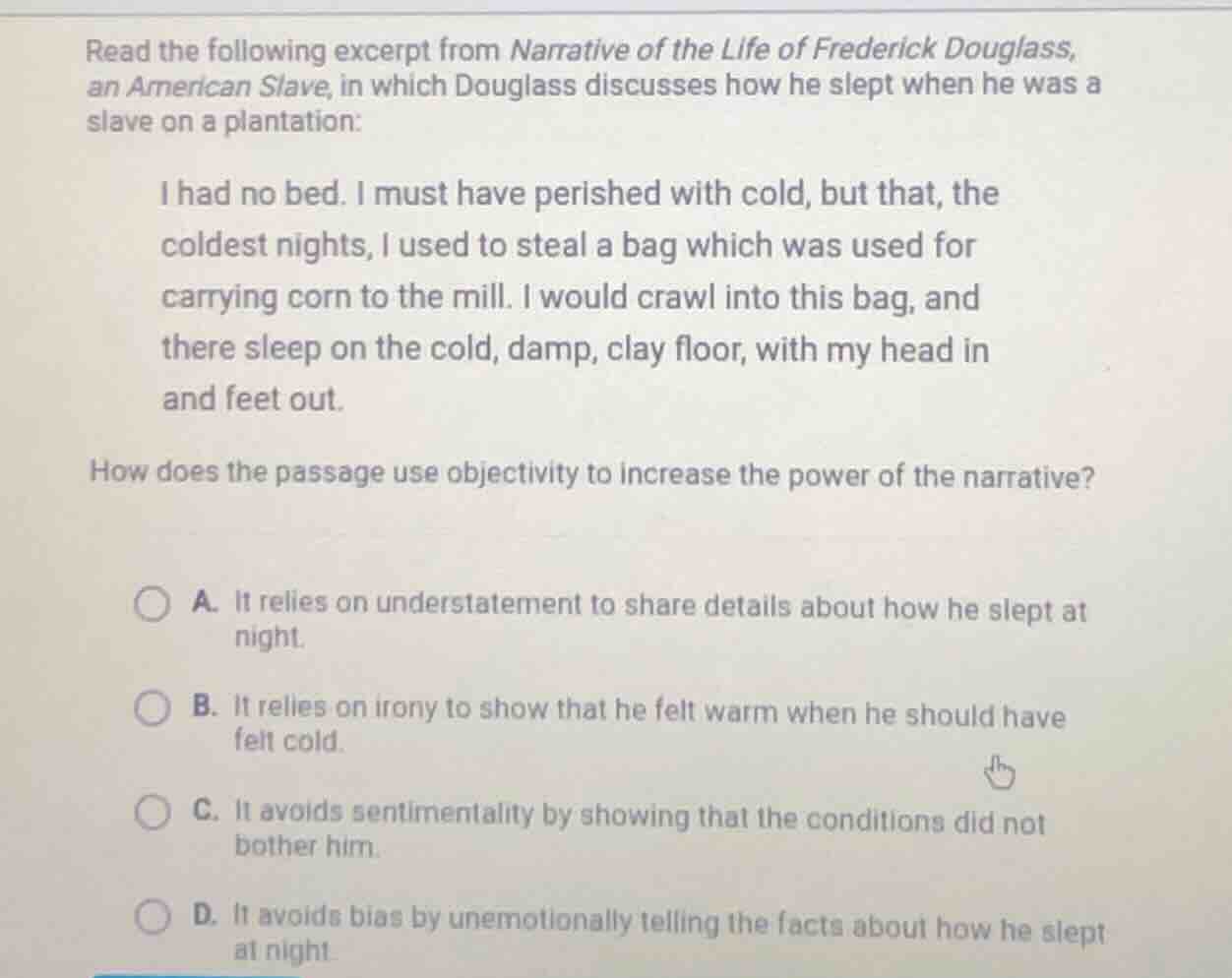
read the following excerpt from narrative of the life of frederick douglass, an american slave, in which douglass discusses how he slept when he was a slave on a plantation: i had no bed. i must have perished with cold, but that, the coldest nights, i used to steal a bag which was used for carrying corn to the mill. i would crawl into this bag, and there sleep on the cold, damp, clay floor, with my head in and feet out. how does the passage use objectivity to increase the power of the narrative? a. it relies on understatement to share details about how he slept at night. b. it relies on irony to show that he felt warm when he should have felt cold. c. it avoids sentimentality by showing that the conditions did not bother him. d. it avoids bias by unemotionally telling the facts about how he slept at night.
Objectivity in narrative means presenting facts without emotional bias or exaggeration. Douglass simply states the details of his sleeping arrangements (no bed, using a corn bag, sleeping on clay floor) without dramatic, emotional language.
- Option A: Understatement is downplaying, but the passage is just factual, not understating.
- Option B: There is no irony; he describes cold conditions directly.
- Option C: The passage does not say conditions did not bother him, just states what he did to survive.
- Option D: Correct, as he unemotionally shares the factual details of his sleeping situation, letting the harshness of the facts speak for themselves, which amplifies the narrative's power.

Snap & solve any problem in the app
Get step-by-step solutions on Sovi AI
Photo-based solutions with guided steps
Explore more problems and detailed explanations
D. It avoids bias by unemotionally telling the facts about how he slept at night.