QUESTION IMAGE
Question
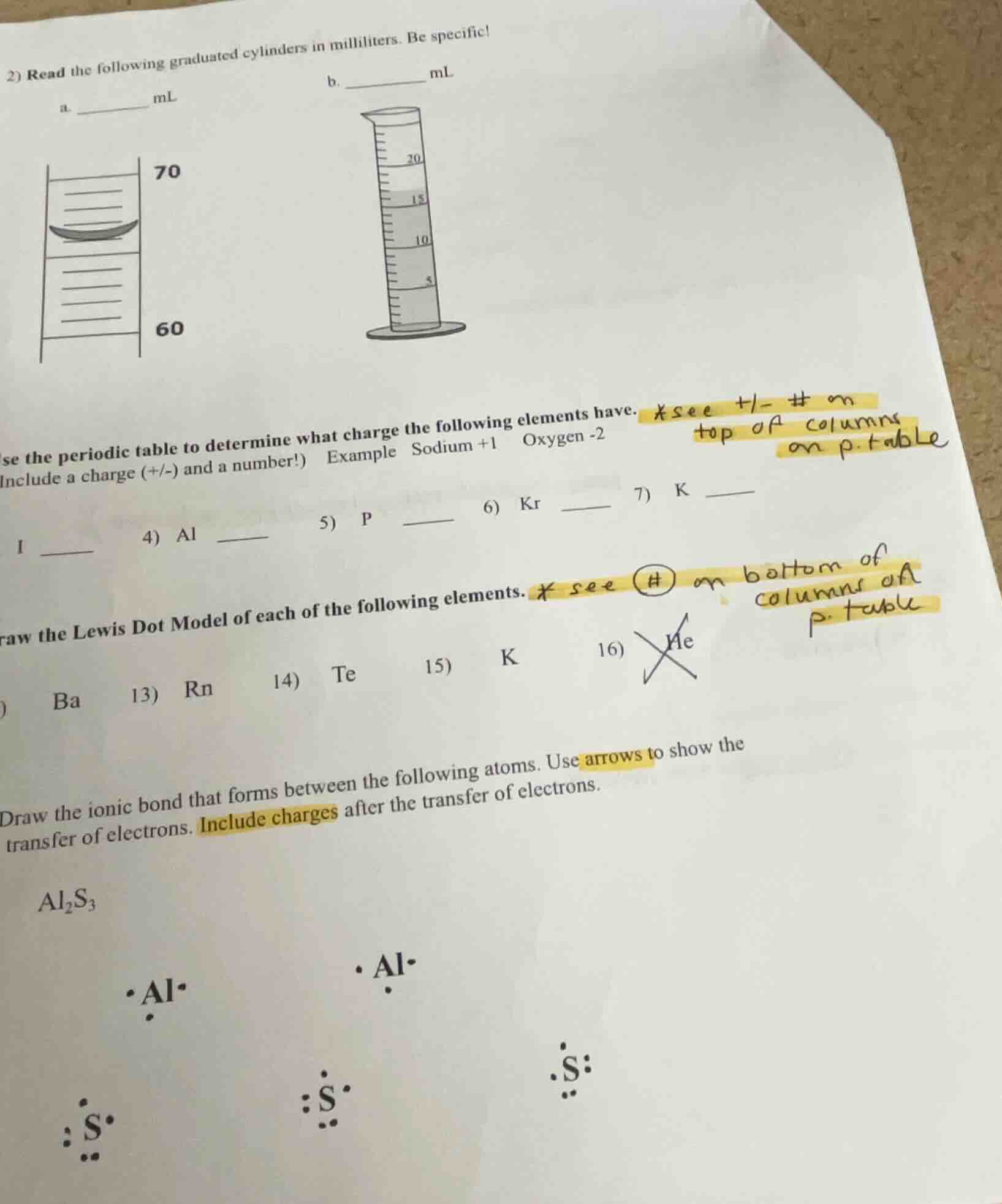
- read the following graduated cylinders in milliliters. be specific!
a. ______ ml
b. ______ ml
use the periodic table to determine what charge the following elements have. (include a charge (+/-) and a number!) example sodium +1 oxygen -2
______ i
- al ______
- p ______
- kr ______
- k ______
draw the lewis dot model of each of the following elements.
______ ba
- rn
- te
- k
- he (crossed out)
draw the ionic bond that forms between the following atoms. use arrows to show the transfer of electrons. include charges after the transfer of electrons.
$\ce{al_{2}s_{3}}$
Part 2: Reading Graduated Cylinders
a.
Step1: Identify the scale
The graduated cylinder has markings at 60 and 70 mL. The space between 60 and 70 is divided into 10 equal parts (since it’s a typical graduated cylinder), so each small division is \( \frac{70 - 60}{10} = 1 \) mL.
Step2: Read the meniscus
The bottom of the meniscus (the curved surface of the liquid) is at the 68 mL mark (counting 8 divisions above 60, as each division is 1 mL: \( 60 + 8 = 68 \)).
Step1: Identify the scale
The graduated cylinder has markings at 5, 10, 15, 20 mL. The space between 5 and 10, 10 and 15, 15 and 20 is divided into 5 equal parts, so each small division is \( \frac{10 - 5}{5} = 1 \) mL.
Step2: Read the meniscus
The bottom of the meniscus is at the 9 mL mark (4 divisions above 5, since each division is 1 mL: \( 5 + 4 = 9 \)).
Iodine is in Group 17 (halogens) of the periodic table. Elements in Group 17 typically gain 1 electron to achieve a stable octet, so their charge is \( -1 \).

Snap & solve any problem in the app
Get step-by-step solutions on Sovi AI
Photo-based solutions with guided steps
Explore more problems and detailed explanations
68