QUESTION IMAGE
Question
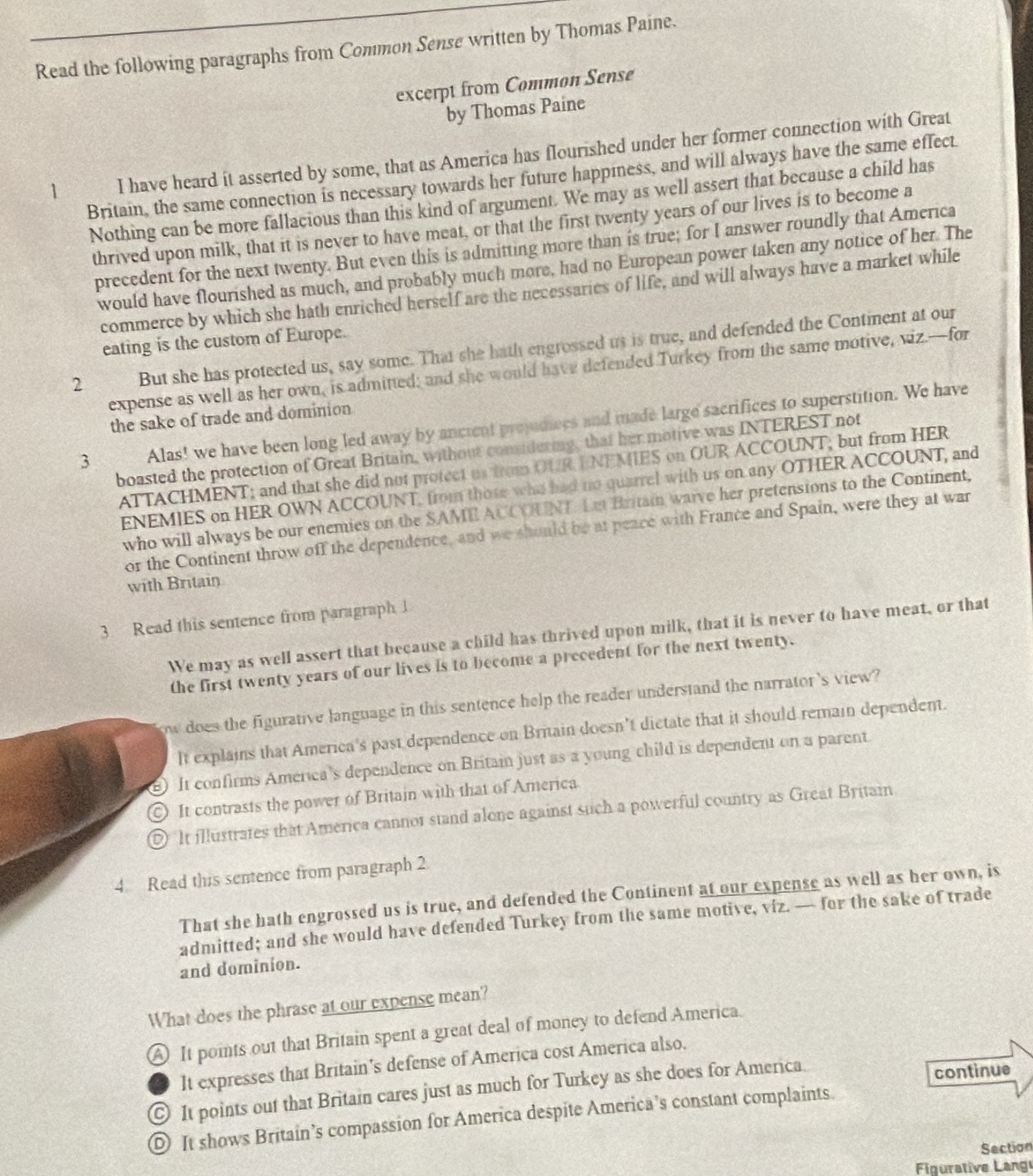
read the following paragraphs from common sense written by thomas paine.
excerpt from common sense
by thomas paine
1
i have heard it asserted by some, that as america has flourished under her former connection with great
britain, the same connection is necessary towards her future happiness, and will always have the same effect.
nothing can be more fallacious than this kind of argument. we may as well assert that because a child has
thrived upon milk, that it is never to have meat, or that the first twenty years of our lives is to become a
precedent for the next twenty. but even this is admitting more than is true; for i answer roundly that america
would have flourished as much, and probably much more, had no european power taken any notice of her. the
commerce by which she hath enriched herself are the necessaries of life, and will always have a market while
eating is the custom of europe.
2
but she has protected us, say some. that she hath engrossed us is true, and defended the continent at our
expense as well as her own, is admitted; and she would have defended turkey from the same motive, viz.—for
the sake of trade and dominion.
3
alas! we have been long led away by ancient prejudices and made large sacrifices to superstition. we have
bosted the protection of great britain, without considering that her motive was interest not
attachment; and that she did not protect us from our enemies on our account, but from her
enemies on her own account, from those who had no quarrel with us on any other account, and
who will always be our enemies on the same account. let britain wave her pretensions to the continent,
or the continent throw off the dependence, and we should be at peace with france and spain, were they at war
with britain
3 read this sentence from paragraph 1
we may as well assert that because a child has thrived upon milk, that it is never to have meat, or that
the first twenty years of our lives is to become a precedent for the next twenty.
how does the figurative language in this sentence help the reader understand the narrator’s view?
a it explains that america’s past dependence on britain doesn’t dictate that it should remain dependent.
b it confirms america’s dependence on britain just as a young child is dependent on a parent.
c it contrasts the power of britain with that of america.
d it illustrates that america cannot stand alone against such a powerful country as great britain
- read this sentence from paragraph 2
that she hath engrossed us is true, and defended the continent at our expense as well as her own, is
admitted; and she would have defended turkey from the same motive, viz. — for the sake of trade
and dominion.
what does the phrase at our expense mean?
a it points out that britain spent a great deal of money to defend america.
b it expresses that britain’s defense of america cost america also.
c it points out that britain cares just as much for turkey as she does for america.
d it shows britain’s compassion for america despite america’s constant complaints.
continue
section
figurative langu
Question 3
The figurative language (child - milk - meat analogy) is used to argue that just because America thrived under British connection (like a child thrived on milk), it doesn't mean it should remain dependent (like saying a child should never have meat). Option A matches this reasoning. Option B is wrong as the analogy is to show independence, not confirm dependence. Option C is wrong as it's not about power contrast. Option D is wrong as the passage argues America can stand alone.
The phrase "at our expense" means that Britain's defense of America also cost America (in resources, money, etc.). Option B says Britain's defense of America cost America also, which fits. Option A is wrong as it's not just about Britain's money. Option C is wrong as it's about cost, not care for Turkey. Option D is wrong as the passage shows Britain's motive is self - interest, not compassion.

Snap & solve any problem in the app
Get step-by-step solutions on Sovi AI
Photo-based solutions with guided steps
Explore more problems and detailed explanations
A. It explains that America’s past dependence on Britain doesn’t dictate that it should remain dependent.