QUESTION IMAGE
Question
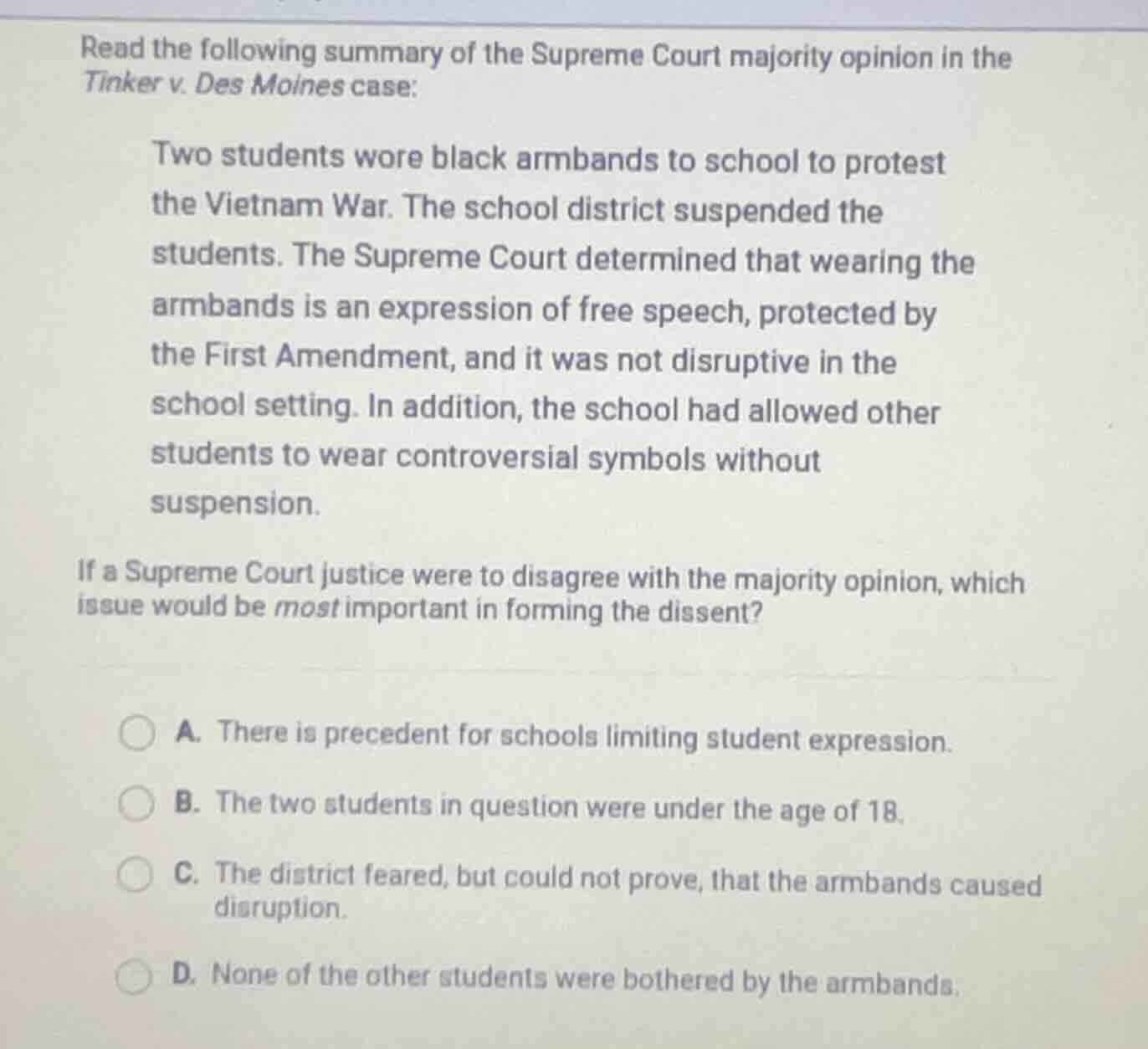
read the following summary of the supreme court majority opinion in the tinker v. des moines case: two students wore black armbands to school to protest the vietnam war. the school district suspended the students. the supreme court determined that wearing the armbands is an expression of free speech, protected by the first amendment, and it was not disruptive in the school setting. in addition, the school had allowed other students to wear controversial symbols without suspension. if a supreme court justice were to disagree with the majority opinion, which issue would be most important in forming the dissent? a. there is precedent for schools limiting student expression. b. the two students in question were under the age of 18. c. the district feared, but could not prove, that the armbands caused disruption. d. none of the other students were bothered by the armbands.
The majority opinion rested on two key points: the armbands were protected free speech, and they did not cause disruption. A dissenting justice would need to challenge these core claims. Option A provides a legal basis (precedent) for schools to limit student expression, directly countering the majority's finding that the speech was protected. Option B's age factor is not central to the First Amendment analysis here. Option C notes the district couldn't prove disruption, which aligns with the majority, not dissent. Option D supports the majority's finding of no disruption.

Snap & solve any problem in the app
Get step-by-step solutions on Sovi AI
Photo-based solutions with guided steps
Explore more problems and detailed explanations
A. There is precedent for schools limiting student expression.