QUESTION IMAGE
Question
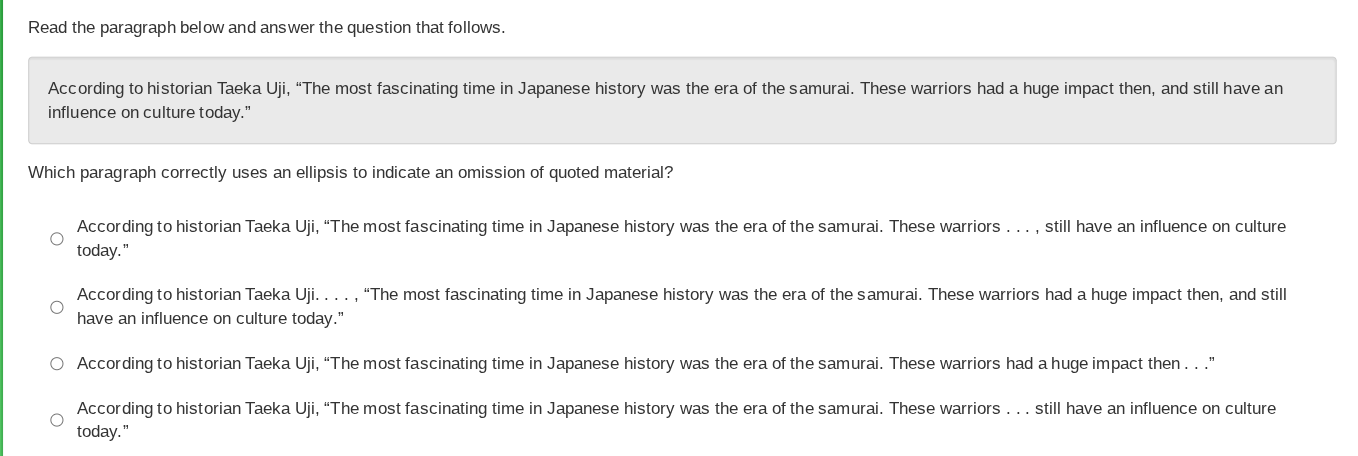
read the paragraph below and answer the question that follows.
according to historian taeka uji, \the most fascinating time in japanese history was the era of the samurai. these warriors had a huge impact then, and still have an influence on culture today.\
which paragraph correctly uses an ellipsis to indicate an omission of quoted material?
according to historian taeka uji, \the most fascinating time in japanese history was the era of the samurai. these warriors . . . , still have an influence on culture today.\
according to historian taeka uji. . . . , \the most fascinating time in japanese history was the era of the samurai. these warriors had a huge impact then, and still have an influence on culture today.\
according to historian taeka uji, \the most fascinating time in japanese history was the era of the samurai. these warriors had a huge impact then . . .\
according to historian taeka uji, \the most fascinating time in japanese history was the era of the samurai. these warriors . . . still have an influence on culture today.\
An ellipsis (...) correctly indicates omitted quoted material when it replaces words/phrases within a quoted sentence, with proper spacing around it and no extra punctuation that distorts the original meaning.
- The first option has an extra comma after the ellipsis, which is incorrect.
- The second option places the ellipsis outside the quote, incorrectly omitting part of the attribution instead of quoted content.
- The third option's ellipsis is at the end, but it truncates the quote without clearly omitting middle content as intended.
- The fourth option properly uses the ellipsis to omit the phrase "had a huge impact then," from the original quote, with correct spacing and no extra errors.

Snap & solve any problem in the app
Get step-by-step solutions on Sovi AI
Photo-based solutions with guided steps
Explore more problems and detailed explanations
According to historian Taeka Uji, "The most fascinating time in Japanese history was the era of the samurai. These warriors . . . still have an influence on culture today."