QUESTION IMAGE
Question
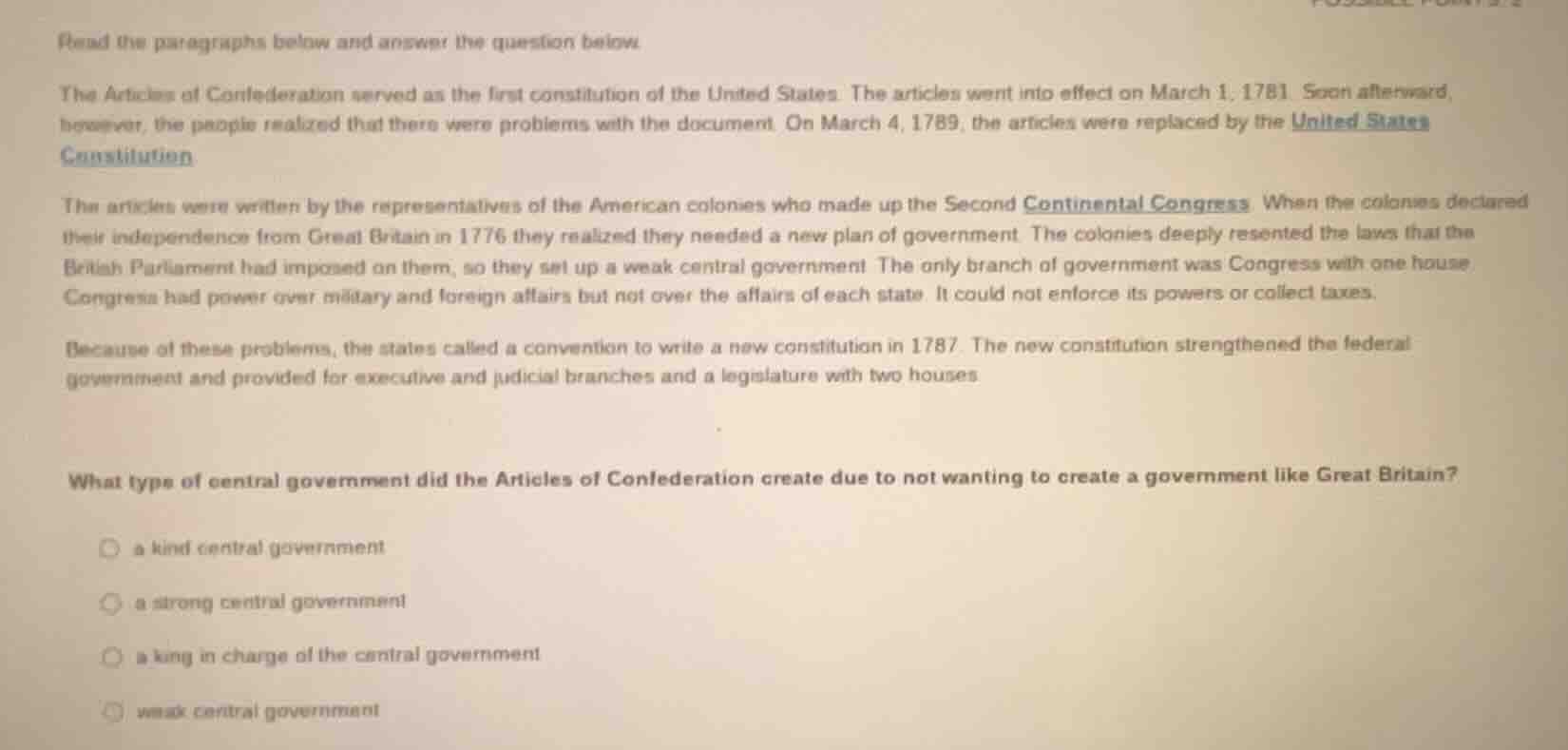
read the paragraphs below and answer the question below.
the articles of confederation served as the first constitution of the united states. the articles went into effect on march 1, 1781. soon afterward, however, the people realized that there were problems with the document. on march 4, 1789, the articles were replaced by the united states constitution.
the articles were written by the representatives of the american colonies who made up the second continental congress. when the colonies declared their independence from great britain in 1776, they realized they needed a new plan of government. the colonies deeply resented the laws that the british parliament had imposed on them, so they set up a weak central government. the only branch of government was congress with one house. congress had power over military and foreign affairs but not over the affairs of each state. it could not enforce its powers or collect taxes.
because of these problems, the states called a convention to write a new constitution in 1787. the new constitution strengthened the federal government and provided for executive and judicial branches and a legislature with two houses.
what type of central government did the articles of confederation create due to not wanting to create a government like great britain?
a kind central government
a strong central government
a king in charge of the central government
weak central government
From the passage, it says "the colonies deeply resented the laws that the British Parliament had imposed on them, so they set up a weak central government". Also, the other options don't match: "a kind central government" is not described, "a strong central government" is opposite (the new constitution strengthened it), and "a king in charge" is what they didn't want (like Britain). So the correct option is the one about weak central government.

Snap & solve any problem in the app
Get step-by-step solutions on Sovi AI
Photo-based solutions with guided steps
Explore more problems and detailed explanations
D. weak central government